Search This Blog

Monday, August 27, 2012

Urban Gadabout: Preview of a bountiful NYC fall gadding season

I'm taking the day off work to do the New York Transit Museum tour Squire Vickers, Subway Architect (Monday, October 15, 3-5pm), which features New York City Transit's chief architect, Judith Kunoff, who was gangbusters on NYTM's tour of the beautifully renovated landmark Avenue H and nearby stations on Brooklyn's Brighton Line.

by Ken

In case anyone was wondering, I've had an incredibly busy and rewarding summer gadding season, which for assorted reasons I haven't been moved to write about. Then, with fall schedules piling up, I had the clever idea of combining some highlights of the season with some look-ahead info. Only I'm still disinclined to write about it, and meanwhile the clock is ticking on more and more of the info, so I think we'd better just get on with it, starting with the New York Transit Museum, since the start of general registration is . . . yikes, tomorrow!


NEW YORK TRANSIT MUSEUM
Fall tours, September-December
Early registration for members in progress
General registration begins AUGUST 28


Already many of the most sought-after tours will be booked up from the members-only early-registration period, not to mention the tours (of the old City Hall subway station and the ghost site of the old underground trolley terminal at the Manhattan end of the Williamsburg Bridge) that are members-only -- by themselves excellent reasons to become a member, as I keep pointing out, though there are others, like free admission to the museum and major discounts on all the tours and at the museum shop.

Check out the Transit Museum calendar here. It includes not just the fall tours but the Transit Museum's fall educational programs, many of which are free!


MUNICIPAL ART SOCIETY
Fall tours, September-December
Registration in progress


I thought I would do some highlighting of the highlight-filled fall season, but there are so many highlights (I personally have registered for so many tours that I'd be embarrassed to tell you how many) that I would just encourage you to check out the listings for yourself (click on "Tours"). Remember that advance registration is now required for all tours; I think the online registration system is working out pretty well. Considering the quality of the tours, the asking price of $15 for members, $20 for nonmembers, is a pittance.


WaHi TOURS
Northern Manhattan: Washington Heights, Inwood, Marble Hill
by Northern Manhattan historian James Renner

Fall tours, September-October
No advance registration (pay at tour)

All tours are Sunday at 12 noon; $15 for adults, $10 for seniors and students; no reservations necessary. Since Jim's schedule isn't available online otherwise, I've posted the whole thing with his full descriptions here. In brief:

MARBLE HILL (the part of Manhattan that was joined to the Bronx when the Harlem River was rerouted)
DATE: September 2, 2012
MEET: 225th Street and Broadway in front of Chase Bank

TUBBY HOOK (Dyckman Street, Riverside Drive and Broadway)
DATE: September 9, 2012
MEET: Northwest corner of Dyckman Street and Broadway

FORT GEORGE (190th to 193rd Amsterdam and Audubon Avenues)
DATE: September 23, 2012
MEET: Northeast corner of 190th Street and Audubon Avenue

SHERMAN CREEK
DATE: September 30, 2012
MEET: Entrance of IRT #1 Dyckman Street Station

COLUMBIA UNIVERSITY MEDICAL CENTER (165th to 168th Broadway to Haven Avenue)
DATE: October 14, 2012
MEET: Southwest corner of 168th Street and Broadway

FORT WASHINGTON-HUDSON HEIGHTS
DATE: October 21, 2012
MEET: 181st Street and Fort Washington Avenue, northwest corner

WHAT'S OUT THERE WEEKEND NYC (WOTW, from The Cultural Landscape Foundation)
vs. OPEN HOUSE NEW YORK (OHNY)
Weekend of October 6-7

Registration for WOTW in progress, information for OHNY still to be published in the Sept. 26 issue of Time Out New York

WOTW has an absolutely sensational list of tours for this NYC version of its What's Out There Weekend, which I should have told you about sooner, because I'm told registration has been exceedingly brisk -- hardly surprising considering the range and degree of interest of the offerings, even apart from the price, which is $00. (Yes, that's zero.)
TCLF invites you to explore and discover the Big Apple during What’s Out There Weekend NYC, featuring a series of FREE expert guided tours highlighting the city’s remarkable landscape legacy. During the weekend, members of the public can visit more than two-dozen different sites around the city.
Check out the listings here, or just register here.

But wouldn't you know that WOTW NYC falls in the exact same weekend as one of the city's most cherished gadding institutions, the also-free Open House New York? OHNY will feature a much larger and even more diverse roster of events -- as soon as the listings become available. And you can be sure that as soon as they do, within seconds the dozen or two events that everyone wants to do will be booked up. Fortunately, the listings are likely to feature an assortment of events at least as interesting, or actually more interesting, that will appeal to gadders of quirkier tastes.

It's important, then, that as soon as you see an OHNY event listing that appeals to you, you pounce on it. Myself, I'm out of the running for 2012, having filled up my gadding card for that weekend with WOTW NYC events I couldn't resist (in all four outer boroughs, though not technically, since my Staten Island walk, around St. George, although originally announced as a WOTW event in conjunction with MAS, became a strictly MAS tour, whereupon I happily plunked down my $15).


JACK EICHENBAUM'S GEOGRAPHY OF NEW YORK CITY
For public tour info, or to sign up for Jack's e-mail list for announcements of scheduled events, go here

By now I've written so often about Jack that you can probably recite the litany on your own. As an "urban geographer," Jack is fascinated by how geographic factors (including topography, water and land access, transportation, and demography) shape the way cities -- or anyplace else -- develop, all illustrated before your very eyes. Nobody has done more to enable me to see neighborhoods and regions as living entities that develop for specific reasons, and I've hardly ever come away from a tour with Jack without some fundamental new understanding of the city -- not to mention all sorts of fascinating information about the area covered, including restaurant tips. It's a good bet that on any tour with Jack you're going to see places and things you won't see on any other tour.

Jack has four tours in the MAS fall season:

Renaissance in Newtown Creek (Saturday, September 29, 1-3pm)
Corona (Queens) Circuit (Monday, October 8, Columbus Day, 11am-1pm)
Public Housing’s Fertile Crescent (Thanksgiving Friday, November 23, 11am-1pm)
Keeping Off Midtown Streets (East Side): Grand Central Terminal to Bloomingdales [Jack also does a West Side version] (Saturday, December 29, 11am-1pm)

Undoubtedly he'll be scheduling other tours and perhaps other events, which is why it's so important to sign up for his mailing list, which anyone else would call a newsletter, except that Jack's contains real news. It is, for example, how I found out about the blockbuster of NYC's fall gadding season, a counterpart to his not-to-miss World of the #7 Train:
A DAY ON THE J
Sunday, October 21, 10am-5:30pm


This series of six walks and connecting rides is astride the colonial route between Brooklyn and Queens. We focus on what the J train has done to and for surrounding neighborhoods since it began service (in part) in1888. Walks take place in Highland Park, Richmond Hill, downtown Jamaica, Bushwick, South Williamsburg and the Lower East Side. Tour fee is $39 and you need to preregister by check to Jack Eichenbaum, 36-20 Bowne St. #6C, Flushing, NY 11354 (include name, phone and email address). The full day’s program, registration coupon and other info is available by email jaconet@aol.com The tour is limited to 25 people. Don’t get left out! Registration is proceeding briskly.

Jack hasn't done this tour in eight years, and it's going to sell out. The only question is when, and why anyone would take a chance of being shut out is beyond me. (I handed my registration to Jack personally at the first tour I did with him after the official announcement of the J train extravaganza.)

You can also find the public tour schedule by going to the home page of Jack's website, The Geography of New York City with Jack Eichenbaum.
#

Sunday, July 15, 2012

Urban Gadabout: On (and alongside) the waterfront

The Tribeca section of Hudson River Park: Hudson River Park -- which I just toured from the river as my City of Water Day trip -- is the subject of multiple walking tours by two of the Municipal Art Society's heavy hitters, Francis Morrone and Matt Postal.

by Ken

[Last night, writing about my City of Water Day river cruise along New York City's ever-developing Hudson River Park, I promised a rundown of some of the remaining summer tour activities focused on the New York-New Jersey waterfront. Here goes!]

Today I did the first tour in a series of walks the Municipal Art Society's Francis Morrone is devoting to "Walking the New Waterfront": "The New East River Waterfront." I didn't rush to mention it since I knew it was sold out. The MAS summer schedule includes the next two installments in Francis's waterfront series. (Some editorial help would have been in order to clarify that the August 18 walk is Part 2 of his waterfront series and Part 1 of a subseries devoted to Hudson River Park.) Francis mentioned today that there will be more installments in the next MAS schedule announcement, and also announced -- when he was pointing to Governors Island from a stop at the East River's Pier 11 that there will be a Governors Island tour in his waterfront series.

Francis, who has a book in the works on the subject, is fascinated by the revolution in landscape architecture on display in much of this new waterfront development, which he considers at the vanguard of such activity anywhere in the world.
Walking the New Waterfront: Hudson River Park, Part 1
Saturday, August 18, 2pm-4pm

The second in our series on the dramatically changing Manhattan waterfront with architectural historian Francis Morrone takes us to the West Side, where we will begin a series of walks up the Hudson shoreline as far as Riverside Park. The first of these walks begins in the northernmost reach of Battery Park City and moves north through the TriBeCa and Greenwich Village sections of Hudson River Park to at least Pier 45.

Walking the New Waterfront, Part 3: Brooklyn Bridge Park
Saturday, August 25, 2pm-4pm

Our third walk with architectural historian and author Francis Morrone exploring new waterfronts takes us to Brooklyn, where the ambitious Brooklyn Bridge Park is rapidly taking shape among the disused piers and other spaces between the Manhattan Bridge and Atlantic Avenue. Designed by the renowned firm of Michael Van Valkenburgh & Associates, this is the most talked-about recent urban landscape project in the country, after the High Line.

I should point out that this summer Francis has done the first parts of a pair of three-part series in Brooklyn:
* one devoted to Boerum Hill, which will continue with the bordering neighborhoods with which it's often linked, Cobble Hill and Carroll Gardens

* one devoted to Ditmas Park, one of three neighborhoods in "Victorian" Flatbush which contains a historic district -- still to come are walks in the others, Prospect Park South and Midwood


FRANCIS ALSO NOTED THAT MATT POSTAL
IS DOING HUDSON RIVER PARK AS WELL!


As I've pointed out a number of times, Francis can be very funny, and he usually doesn't telegraph his jokes. He also noted out that he and Matt did their first MAS tours in the very same week, and are the same age, so I guess it's a sort of MAS Hudson River Park throwdown. Matt has two Hudson River Park walks on the summer schedule:
Down by the River: Greenwich Village and Gansevoort
Saturday, July 21, 11am-1pm

Join Matt Postal, architectural historian and author, to visit the first section of Hudson River Park. Since they first debuted in 1999, the quiet blocks where Greenwich Village meets the Hudson River have attracted increasing attention. This walking tour examines how the decline of waterfront commerce in the 1960s set the stage for recent developments, viewing several early residential projects and conversions, such as the West Village houses and Westbeth, as well as a number of stylish new apartment buildings designed by Asymptote, Julian Schnabel, and FLAnk. We'll conclude in the Gansevoort Market Historic District, where the High Line starts and the future home of the Whitney Museum of American Art by Renzo Piano is now under construction.

Down by the River: West Chelsea and Hudson Yards
Sunday, August 12, 11am-1pm

This tour with Matt Postal, architectural historian and author, focuses on the once-gritty West 20s, where former freight facilities are being converted into luxury housing, public parkland, and commercial space. We'll discuss the present progress of the Hudson Yards Redevelopment Project, the next stage of the High Line, major historic structures in the West Chelsea Historic District, and visit Chelsea Cove, a particularly lovely section of Hudson River Park that includes gardens by Lyden B. Miller and a restored railroad float transfer bridge.

(I don't play favorites here. Yesterday I did Matt's "New to New York: Broadway's Cultural Corridor" tour, and today I did Francis's inaugural waterfront tour on the lower East River, and I'm registered for both of Francis's and both of Matt's upcoming waterfront tours.)


MAS'S JOE SVEHLAK IS ON THE WATERFRONT
THIS SUMMER TOO -- AND IN CYPRESS HILLS


Joe has a long history with Coney Island, and this summer once again is doing a walk there.
Saturday, August 11, 10:30am-12:30pm
Coney Island: What's Next?

Join preservationist and lifelong Brooklyn resident Joe Svehlak for a summer favorite as we explore America's first great seaside resort. We'll look for remnants of Coney Island's "honky-tonk" past, when as many as a million people would visit "Sodom by the Sea" on a hot summer day. Have a Nathan's Famous, view the popular ballpark, the new amusements, the historic rides, and enjoy the boardwalk as we discuss the struggle to designate landmarks and the future of the fabled resort. Wear your bathing suit if you want to go for a swim with Joe after the tour!

Actually the tour of Joe's I'm really looking forward to is the next in his series of neighborhood walks, pushing farther along the Terminal Moraine that separates Brooklyn and Queens from Bushwick (which unfortunately I wasn't able to do; I sure hope he does it again!) to Ridgewood and now to Cypress Hills (see below), and also Sunset Park (where he grew up, and also very much part of the Terminal Moraine story, since it sits atop and along the shoreward side of the all-Brooklyn section of the ridge) and Boerum Hill.

Joe has been doing a bang-up job of showing us -- not just telling but showing -- how each area came to be settled, and by whom, and how those original settlers either stayed on or (so often) moved on, and who replaced them and why, and accordingly how the neighborhoods have evolved.
Brooklyn Down East: Cypress Hills/Highland Park
Sunday, August 19, 10:30am-12:30pm

Join preservationist and lifelong Brooklyn resident, Joe Svehlak, in this area east of Bushwick on the Queens border known as the Eastern District home to some lovely and varied architecture. Fine civic buildings, grand mansions, interesting row houses, and even a church by Richard Upjohn are to be found here. The varied hilly topography due to the terminal moraine from the Ice Age, makes for a fascinating walk up and down the streets. At the beginning of the tour we will make a short visit to the Evergreens Cemetery, one of the city's first garden cemeteries (1849), whose park-like setting is the final resting places of some of Bushwick's finest citizens.


AND DON'T FORGET WORKING HARBOR'S
TOURS, NOW ON LAND AS WELL AS SEA


Of course there are now kajillions of cruises on the harbor these days -- morning cruises, afternoon cruises, evening cruises; dinner cruises, cheese-tasting cruises, hideous-entertainment cruises; etc. etc. etc. But most of them tend to focus on the narrowish band of water that can be comfortably covered in an hour or two from the lower Hudson to the lower East River, naturally including the Statue of Liberty. Now, however, there are all sorts of other harbor tours, and I've just begun to discover them myself.

I should probably have called more attention to this year's schedule of those wonderful "Hidden Harbor" tours the Working Harbor Committee does aboard the yacht Zephyr in conjunction with New York Water Taxi (Circle Line Downtown), and have neglected them only because I did all three last year. However, it's still possible to do all three. They're all two hours, and scheduled for Tuesday evenings, departing from Pier 16 at South Street Seaport, with sailings scheduled for 6:15pm in July and August, 5:30pm in September. Each tour normally features a harbor veteran as running commentator plus a guest speaker with a particular interest in the particular subject.
* Newark Bay, the one I really got worked up over last year ("Newark Bay or bust! (Is there anyone else whose pulse is sent racing by the prospect?)"), which has three more outings -- on July 24, Tuesday, August 21, and September 18

* North River (i.e., the Hudson River, the river that came from the north), on August 7

* Brooklyn (a view from the river of Brooklyn's western shore from the Queens border at Newtown Creek on the north all the way down to the Sunset Park waterfront), on September 4

Working Harbor also schedules all manner of other special waterfront events -- for example, a three-hour "intensive" tour of Newtown Creek with Newtown Creek Association historian Mitch Waxman ("Walking Dutch Kills with Mitch Waxman, 'Your Guide to a Tour of Decay'") on Sunday, July 22, 11am-2pm (which I can't do, because that's the day I'll be heading to the Thomas Edison National Historical Park on a New York Transit Museum tour). Definitely keep an eye on the WHC website and blog, and get yourself on their e-mail list.

I did, however, tell you about Working Harbor's new-this-year walking tours, both of which still have upcoming dates:
* Lower Manhattan, led by Captain Maggie Flanagan, on Saturdays, July 21 and August 11, 1pm-3pm, ending up at the South Street Seaport Museum

* Staten Island (from the St. George Ferry Terminal to Sailors' Snug Harbor, spotlighting the Kill van Kull separating Staten Island from Bayonne, New Jersey), led by none other than Mitch Waxman, on Saturdays, July 28 and October 13, 11am-1pm, ending up at one of my favorite places, the Noble Maritime Collection in Snug Harbor
#

Saturday, July 14, 2012

Urban Gadabout: Out on the water on City of Water Day

"Come see the sights," said he.
"New York in lights," said he.
Said I, "It might be amusing."
Next thing I knew we were cruising
on the SS Bernard Cohn.

Chilly and shivery,
out on the river, we
found us a corner to chat in,
as we were circling Manhattan,
on the SS Bernard Cohn. . . .

Barbara Harris, plus Barbara Monte, William Reilly, and Gerald M. Teijelo, vocals; Theodore Saidenberg, musical dir. From RCA's 1965 Original Broadway Cast Recording of Alan J. Lerner and Burton Lane's On a Clear Day You Can See Forever

by Ken

Okay, it wasn't the SS Bernard Cohn, and the city wasn't in lights this afternoon, and we weren't circling Manhattan, but still . . . . (It was kind of overcast, if that counts. That made it maybe a little less hot than it might otherwise have been, but not exactly "chilly and shivery.")

Today was New York's annual City of Water Day, presented by the Metropolitan Waterfront Alliance, a celebration all over the area of the city's roughly zillion miles of waterfront. (Oh, I could look up the number, but would that improve any of our lives?)
City of Water Day is the Metropolitan Waterfront Alliance’s way to bring together everything about the water that is exciting and fun, from port commerce to environmental education to active recreation. The event is a celebration of the potential of the waterfront.

MWA works to transform the New York and New Jersey Harbor and Waterways to make them cleaner and more accessible, a vibrant place to play, learn and work with great parks, great jobs and great transportation for all.

Through our work, the New York and New Jersey harbor and waterways will be alive with commerce and recreation; where sailboats, kayaks and pleasure craft share the waterways with commuter ferries, barges and container ships; where beautiful, cared-for parks are connected by affordable waterborne transit; where there are dozens of exciting waterfront destinations that reflect the vitality and diversity of the great metropolis that surrounds it; a waterfront that is no longer walled off by highways and rails, or by private luxury residences; a waterfront that is a shared precious resource and is accessible to all. MWA is a leadership organization that will make this vision real for our region.

Over 650 organizations that make up the Metropolitan Waterfront Alliance can participate and play a major role in putting on City of Water Day.

When the schedule of events was finally announced, for most people it represented an embarrassment of riches. It was a little dicier for me, since by then I had registered for Matt Postal's Municipal Art Society walking tour "New to New York: Broadway's Cultural Corridor" at 11am, so I needed an event that I could get to in time from the Upper West Side starting somewhere between 1:15 and 1:30. To my relief and delight, I actually found one: the second sailing of the day of a river-eye tour of Hudson River Park, the still-developing park that consists of the immediate shoreline plus an ever-growing number of repurposed or rebuilt Hudson River piers over the five-mile span from Tribeca up to about 59th Street. (North of 59th Street Riverside Park begins its river journey.) The tour was narrated by Nicolette Witcher, vice president for environment and education at the Hudson River Park Trust, which oversees the development and maintenance of the park.

The lovely celebration of City of Water Day provides a striking reminder of the growing role our waterfront has come to play in the lives of more and more New Yorkers. Of course, once upon a time it played an essential, if barely visible, role in the lives not just of New Yorkers but of much the country, when it was one of our leading industrial plants, and city dwellers. While it's still very much a working waterfront, it's nowhere near the not-fit-for-human-habitation miasma it once was.

This week's Time Out New York has a useful little roundup of upcoming waterfront-themed tours on MAS's summer schedule, and if I could find an online link on the magazine's next-to-useless website, I would offer it. In any case, tomorrow I'm going to do a roundup of my own, including a number of other offerings in addition to MAS's.
#

Friday, July 13, 2012

No News From Mali Is Good News These Days-- Letter From Mopti

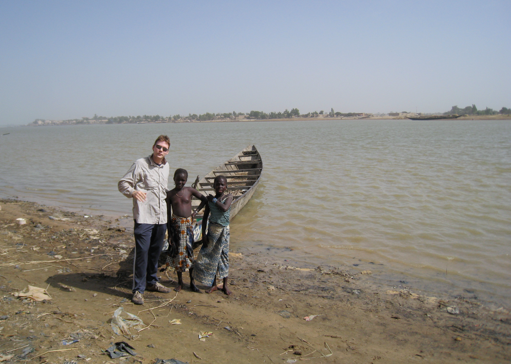
Roland finally found a couple of Bozo ladies to pose for a photo

The thing I liked most about visiting Mopti, Mali's second largest city, wasn't actually in Mopti but nearby. Mopti is a stereotypical seedy African river port. Just outside of it-- as though in another world entirely-- are Bozo fishing encampments which couldn't have possibly been any more primitive a thousand years ago. We rented a boat and went up river 'til we came to an island with some thatch-roofed huts, a Bozo village. Roland and I walked around for an hour, taking photos, poking around. No one paid us any attention whatsoever. Nothing-- neither positive nor negative... nothing.

In town we stayed at the most beautiful hotel in Mali, French architect Amédé Mulin's boutique establishment La Maison Rouge. I've been wondering how the small hotels have been faring now that the country is engulfed in civil war. I know they're all shut down and destroyed in Timbuktu, who has been taken over by slavers and religious fanatics but things in Mopti are just bad, instead of horrendous. The hotel is closed but the most recent letter I got from Amédé is mildly optimistic. He's been in France but he was just back to Mopti for a visit. I'll share a few paragraphs:
I have found that the hotel was generally OK, though degraded by lack of maintenance of the building and the first rains. 6 employees were still in office. The cook resigned during my absence, the mason and his maneuver worked in general maintenance during the month of April and ceased operation in May and June Power cuts, although nearly constant, have not damaged the stock of freezers. The plant has recently commissioned two new groups, the power cuts have almost ceased. Banks are always closed and government in part.

The team is demoralized by the closure of the hotel, the gloom in the city, lack of opportunities and stagnation of the political and security situation in Mali, a certain feeling of abandonment. Some began to develop other activities, such as the cook who has returned from Burkina Faso, or the wizard ruler who would also resign.

We met a few days ago to review the call for support. Staff hoped to reopen the hotel, after listing the charges of the hotel operation estimated at over € 1,500, given the lack of cash and revenue prospects, given the attendance of other catastrophic hotels remained open to Mopti and Sévaré, we agreed that it was reasonable to remain temporarily closed.

The staff, however, has pledged to work towards a quick reopening if special request rental, important booking or processing in offices or rented house in a project... [I]t is unlikely that we have reservation requests. The hotel will remain closed unless major reservations. We hope the situation will evolve positively, particularly in terms of security, so that projects and humanitarian actors can work in good conditions and create economic activity.

It is always possible that the board of the UN Security eventually bow to the many requests for a military intervention that would transform de facto humanitarian hub in Mopti, recreating a certain dynamism to the hotel sector, waiting for the Mali again become a tourist destination.

I don't imagine tourists-- at least not American ones-- will be returning to Mopti (or anywhere in Mali) any time soon. There were very few Americans when Roland and I were there a couple years ago but between the kidnappings and violence and the destruction of everything of historical value (other than in Dogan country down south), the country is being completely avoided by international tourists. There was a decent analysis of the situation at AllAfrica.com this week. It looks like the split between the Tuaregs and the al Qaeda faction has widened... into chasm. I always find it bizarre that no one ever brings up that the Tuaregs capture people and enslave them. I guess that's considered to barbaric to even mention.
'Islamist rebels' have been blamed for a campaign of plunder in Timbuktu this week, but who exactly are they and what do they want?

As momentum builds outside Mali to launch some kind of military intervention into rebel-held territory, the conflict in northern Mali has grown increasingly complex in recent weeks. Even as reports of rampaging Islamists in Timbuktu proliferate our news bulletins, however, the complexity of the conflict has been steadily ignored.

It has been several months since rebel groups wrested control of Northern Mali from government forces. One group, a Tuareg tribal militia known as MLNA, was armed by former Libyan leader Muammar Gaddafi and fought for him during in the Libyan war last year. When Gaddafi fell, the MLNA raised guns for their old cause-- a state of their own. They are ethnic nationalists, embittered against colonialism. And as the MNLA gathered their forces, they formed an alliance with other militias in Northern Mali, all of them rebels with separate causes-- but, crucially, a common enemy.

One of these groups, Ansar Eddine (Arabic for helpers of the faith), has been described by commentators as the Taliban of the Sahel. This is the group currently in control of the town of Timbuktu, a city that once was the hub of cultural and intellectual pursuits in Africa.

The MNLA captured Timbuktu without a fight after the Malian army abandoned the city. A day later, however, Ansar Eddine drove out the MNLA, and has held the city ever since. Andrew Lebovich, a Washington DC-based researcher on the Sahel, says that although Ansar Eddine was formed late last year, its leader, Iyad Ag Ghali, has long been a power broker in northern Mali. Analysts say Ag Ghali's importance as a leader lies more in his kinship and tribal roles in northern Mali than in his new-found role as the leader of a so-called Islamist faction. Ag Gali has repeatedly fallen out with the MNLA, who accuse him of humiliating them.

The MNLA, then, was drawn into conflict with Ag Ghali. Crucially, though - and unlike the MNLA - Ansar Eddine's Islamist credentials have increasingly been linked to the Al-Qaeda branch in west Africa (AQIM)."Reports indicate that Ag Ghali has grown more religious in recent years, but initially Ansar Eddine appeared no different to the MNLA," Lebovich tells Daily Maverick.

Other analysts say Ag Ghali has emerged as a committed Salafist in recent years, and declared his intention to put all Mali under Sharia law-- angering the MNLA, who disagree with his interpretation of what the identity of the new Malian state should be. Negotiations between the two factions have been futile. What is becoming clear is that Ansar Eddine does have stronger links with Al-Qaeda in the Islamic Maghreb than previously suspected. "There is a general belief that much of the support lent to Ansar Eddine came from AQIM," Lebovich says, noting that this includes weapons, money and ideological support. There is, however, very little credible information on the exact nature of the influence of AQIM on Ansar Eddine.

Ag Ghali's embrace of the Salafi brand of Islam is significant to understanding Ansar Eddine's rampage on the heritage of Timbuktu in the last week. Salafists believe that any innovation from the original version of Islam, as practised in the Arabian Peninsula in the time of Mohammad, is akin to polytheism-- blasphemy. Now that Ansar Eddine has firm control over Timbuktu, they've started to purge the city of its religious relics and destroy historic cultural sites deemed blasphemous.

Great mosques and mausoleums to local saints-- of unique architectural design-- were erected in the 15th and 16th century, and the city is home to a long tradition of a local Sufism, which is an Islamic mystic tradition.

It's little wonder, then, that this campaign has been compared to the Taliban's 2001 destruction of the Buddhas of Bamiyan.

As international condemnation of the destruction of United Nations world heritage sites in Timbuktu grows, so, too, do the calls for international intervention in northern Mali. Lebovich, however, is sceptical of the prospects of international intervention taking place, let alone succeeding. "Everyone knows that international intervention will be very difficult. This is one of the harshest climates in the world, infrastructure is poor, international interventional may not be favourably received in Mali and then it's not clear what these groups actually want," he explains.

Attempts by regional body ECOWAS to negotiate with rebels in northern Mali have yielded nothing so far. As one negotiator put it, "We're in talks at the moment, but obviously they're not going well because we want different things." Rebels with separate causes defeated a common enemy, but now it remains to be seen which cause will trump the other.

The rebel insurgency in northern Mali began as yet another expedition in the life and times of the Tuareg people to win sympathy from the world.

But while the MNLA will win some sympathy for being victims of Ansar Eddine, in the end, the prospect of broad international support for a Tuareg state is now in tatters, much like Timbuktu.

The two factions are now fighting for real and the al Qaeda Islamists have driven the Tuaregs out of Gao, the other big prize after Timbuktu. The third "city," Kidal, is also under their sway. The Tuaregs are out in the cold.

Tuesday, July 10, 2012

Urban Gadabout: Two more evening walks in Western Queens; a great ballpark and some lousy ice cream; and a date for "A Day on the J"

Maybe there's a ballpark somewhere that can compare with Richmond County Bank Ballpark, home of the Staten Island Yankees (of the Penn-New York League), with its vista of Lower New York Harbor, but I haven't seen it. In the distance over the right-center-field fence is the Jersey City skyline.

by Ken

There's a whole lot of gadding about to get caught up on, especially coming off a five-event weekend, spread over two days with a combined temperature upwards of 200 degrees. (Of course it felt like 300.) But because we have breaking news, I'm going to reserve comment on the three Municipal Art Society tours, all in Brooklyn (separate walks in the really unrelated neighborhoods of Bedford and Stuyvesant led by Suzanne Spellen and Morgan Munsey, and Francis Morrone's saunter through Ditmas Park, one of Flatbush's three neighborhoods with a landmarked historic districts), not to mention the transit logistics that got me to all five (on time!), and limit myself to observations from each day's purely recreational final destination.

(1) A BALLPARK IN AN AMAZING SETTING
(2) ICE CREAM THAT DIDN'T MAKE ME SMILE


(1) Based on my first-ever Staten Island Yankees (of the "Short-Season A" Penn-New York League) home game Saturday night (against the Williamsport Woodcutters), I can report that I've never encountered either a more atmospheric walk to a ballpark than the short jaunt along Staten Island's north shore from the Staten Island Ferry Terminal to Richmond County Bank Ballpark at St. George, or a more atmospheric place to watch a ball game. My gosh, you're trying to concentrate on the game, with the up-close feeling you only get in minor-league parks, and there, beyond the fence in right-center field, amid all the other bustle out on Lower New York Harbor, is a giant container ship majestically making its way from Kill Van Kull (and the container ports in Newark Bay) toward the Verrazzano Narrows leading into the Upper Harbor and on to the open Atlantic Ocean.

(2) Wouldn't you think that an Ice Cream Takedown featuring samples of 30 flavors of ice cream would be as close as Life As We Know offers us to a slam-dunk guarantee of psychic and gustatory yumminess? At the event on Sunday at Brooklyn's Bell House, I decided that, while $18.88 was an outlandish price to pay for 30 teaspoons of crap, it wasn't an unreasonable price for the startling lesson that ice cream, even mediocre ice cream, may be the only substance on earth that guarantees a smile. I know I wouldn't have believed it if I hadn't experienced it myself. (In fairness, it wouldn't have been such a gustatory horror show if a reasonable number of the contenders -- oh yes, there was both fan and "expert" judging! -- had risen to the level of "mediocre.")

BREAKING NEWS NO. 1: JACK EICHENBAUM HAS ADDED
A WEDNESDAY EVENING WALK IN WESTERN QUEENS


The news comes via an e-mail that Sunday Classics' esteemed "urban geographer" Jack Eichenbaum (who's also the Queens borough historian) just sent out to his e-mail list. The new information doesn't appear yet on the "Public Tour Schedule" page of Jack's website, but that's the place to sign up for the e-mail list.

Coming up tomorrow, as previously announced is the last of the three originally announced Wednesday-evening walks in Western Queens. (Jack notes: "Meeting points are 10-20 minutes from midtown Manhattan and all tours end in food-rich neighborhoods with suggestions for inexpensive dinners.") Tomorrow:'s walk is Long Island City to Old Astoria. In addition, Jack has been encouraged enough by the response to the first two walks in the series that he has scheduled a fourth for Wednesday, July 25: #7 Sunnyside to Jackson Heights (Ethnic Route).
Long Island City to Old Astoria (THIS WEEK!)
Wednesday, July 11, 6-8pm

Walk the East River shore between the Queensboro and RFK (Triboro) Bridges. Begin at Queensbridge Houses and head for the remnants of Old Astoria. The sights include increasing oblique views of Manhattan’s Upper East Side from three parks, a (former) piano factory, a huge power plant, a “big box” store, the Socrates Sculpture Park, the Isamu Noguchi Museum and ante-bellum mansions. Ends in Astoria at the Bohemian Hall Beer Garden (Czech food) with Greek and other cuisine nearby.

This tour is self-sponsored. Fee $15. Meets at the NW corner of 21 St and 41 Ave. (F Queensbridge). No reservations necessary.

#7 Sunnyside to Jackson Heights (Ethnic Route)
Wednesday, July 25, 6-8pm

The core of the ethnic diversity under the “The International Express” has visible commercial concentrations of Irish, Mexican, South American, South Asian, Filipino, and Thai cultures. Some domestic gentrification has occurred at both termini. The train and the constantly evolving eats are always in focus.

This tour is self-sponsored. Fee $15. Meets under the Sunnyside arch, south side of the elevated 46 St/Bliss station (local #7). No reservations necessary.

JACK'S 2012 WESTERN QUEENS SUMMER
SERIES HAS BEEN GOING GREAT GUNS


We started with Astoria -- or more specifically, as Jack explained, "new" Astoria, not to be confused with the older part, which we'll be visiting tomorrow evening. And then, on a punishingly hot July evening, came one of the really great walking tours I've ever done, one that targeted three neighborhoods -- Sunnyside, Woodside, and Jackson Heights -- that are adjacent but developed in almost entirely different ways for reasons that start with basic geography, Sunnyside being almost entirely lowland, meaning originally marshland unsuitable for real-estate development; Woodside being a mix of some higher ground and lowland, and Jackson Heights being mostly the high ground coveted by developers to house the rich. Once sewers were installed even the lowlands became developable (though a hefty chunk of Sunnyside had already been given over for a prime lowland use: railroads, specifically the yards and western end of the Long Island Rail Road).

There has been fascinating, historically important, innovative residential development in all three neighborhoods, and Jack showed us and explained lots of that. But more important, with his choice of sites and the sort of "back-door" route he charted, he "gave" us three wildly different contiguous neighborhoods, not only enabling us to get a feeling for the basic character of each but allowing us to actually experience the basic rise in elevation as we advanced toward Jackson Heights. This is Jack at his best, which is seriously special.

BREAKING NEWS NO. 2: MARK YOUR CALENDAR
FOR JACK'S ALL-DAY "DAY ON THE J" -- OCT. 21


I've made a big deal here of Jack's day-long World of the #7 Train tour, which I did in spring 2011 and was powerfully tempted to do again in the spring 2012 edition. I can't find a link, but I could swear I'd already mentioned that Jack was talking about scheduling another subway-line tour he has done in the past, along the J train, which follows "the colonial route beteween Brooklyn and Queens." In any case, Jack has now made it official: A Day on the J, which he reports he hasn't done in eight years, is scheduled for October 21! Jack will e-mail you a great information sheet on request; it includes a registration coupon, but you can register without it by mailing him the information specified in the description below -- along with your check, of course

Like The World of the #7 Train, A Day on the J is organized in the form of six walks in dramatically different areas, reflecting widly different geography and development histories, spanning the three boroughs through whichf the J runs: Highland Park, Richmond Hill, and downtown Jamaica in Queens; Bushwick and South Williamsburg in Brooklyn; and the Lower East Side in Manhattan. The walks are linked, of course, by rides on the J train itself (unlimited-ride Metrocard highly recommended). As with the #7 tour, A Day on the J has a lunch break built in, in this case in Jamaica.

I think it's safe to say that, except to people who live or work along the J route, this train is a lot less familiar to most New Yorkers (and visitors) than the #7 train cutting through Queens to Flushing.
A Day on the J
Sunday, October 21, 10am-5:30pm

This series of six walks and connecting rides is astride the colonial route between Brooklyn and Queens. We focus on what the J train has done to and for surrounding neighborhoods since it began service (in part) in 1888. Walks take place in Highland Park, Richmond Hill, downtown Jamaica, Bushwick, South Williamsburg, and the Lower East Side. Tour fee is $39 and you need to preregister by check to Jack Eichenbaum, 36-20 Bowne St. #6C, Flushing, NY 11354 (include name, phone and email address) The full day’s program, registration coupon and other info is available by email: jaconet@aol.com. The tour is limited to 25 people. Don’t get left out!

Take the J Train: Jack Eichenbaum's Oct. 21 Day on the J will feature walks in Queens (Highland Park, Richmond Hill, and downtown Jamaica), Brooklyn (Bushwick and South Williamsburg), and Manhattan (Lower East Side), plus lunch in Jamaica and of course lots of trips on the J.
#

Saturday, June 30, 2012

The 3 Scariest Things I Ever Did On My Travels


For those who think hopping on a plane for a trip to London or Paris or Mexico City is adventurous and dangerous, this post may be hard to relate to. I started hitchhiking across America when I was 13. I hitched from Brooklyn to L.A. when I was 15 and stowed away on ship so I could make a new, simpler life for myself on Tonga. I celebrated my 21st birthday in my home-- a thatch-roofed bungalow steps from the Arabian Sea in Goa. But this morning, after reading about the latest deprecation in war-torn Mali, I tried to recall what the most dangerous stunts I had pulled on my travels.

Because I was swimming when I was thinking about it-- and because I get really scared of crocodiles and alligators-- one that popped into my mind was a trip to Esteros del Iberá a swampy section of northern Argentina where Argentina, Brazil and Paraguay all come together. They call it the Serengeti of Latin America because of the abundance of wildlife and, as I noted at the time, "the most important thing was to get the idea of "swamp" out of my head. This was easy because the place is not only gorgeous, it is fresh and even cooler than everyplace around it. The water is so beautiful that if it weren't for the alligators, pirhanas, capybaras and anacondas, you'd want to jump right in-- as many of the folks who live around there do anyway (and have the missing fingers and toes to prove it)."

Alligators-- they call them Yacare Caiman in the neighborhood, like the fella in the picture-- are something I usually go out of my way to avoid. So, for me, the scariest moment came when I agreed to go with a local in a dugout canoe for an afternoon of caiman, capybara (word's biggest rodent) and anaconda watching. And for hours that's all I saw... not anacondas, just a billion alligators and giant prehistoric rats.

Years earlier I had a run-in with an even scarier creature. I was bumming around Afghanistan in 1969 and found myself captured by a militia up in the mountains. I didn't understand a word of Pashtun at the time-- I learned a few months later when I got snowed in and stranded in a tiny Pashtun village for the winter-- but I sure understood the universal motions and grunts for "put your hands over your head or I'll unload this Kalashnikov into it." So I did. Maybe they wanted to go for a Ripley's Believe It Or Not Record, but they just had us keep our hands over our heads for hours. Eventually some Australian hippie who was with me-- and peaking on acid-- just started laughing and lowered his hands. At first the Afs all started screaming menacingly and made like they were about to shoot us. Then I started laughing and lowered my hands too. And then everyone else did-- and soon we were sitting around the campfire drinking tea with the militia all laughing away and smoking opiated hash like we were all best friends.

Most recently though, Roland and I went to Mali and wound up in Timbuktu on the outskirts of the Sahara Desert. It's not really the outskirts anymore; the desert is encroaching rapidly and the streets get covered in sand all the time. One night we decided to go with Mohammed, our Tuareg guide, into the Sahara itself. It's trackless; there's nothing but sand dunes and the light is the moon and stars and our flashlights. Our destination: a Tuareg encampment a few miles away where some nomads had come down from the desert to trade. We were leaving for America in a few days and there was plenty of stuff to trade-- from my high-end REI walking sticks to cans of sardines Roland had brought... and toilet paper, airline shaving kits, bits and pieces of clothes... all kinds of stuff we didn't want to schlepp back to L.A. It went pretty well. It might not have. As I've been writing in the last few months, a Tuareg rebellion was brewing and it's boiled over... big time. They've seized two-thirds of the country. And these are bad guys; they believe slavery is condoned by their religion, for example. And in the name of their primitive and ignorant concept of Islam, they are destroying Timbuktu, ironically a centuries-old center of Islamic learning.
Armed fighters of Mali's al-Qaida-linked Ansar Dine Islamist group on Saturday destroyed mausoleums in the ancient trading city of Timbuktu, classified as a UNESCO World Heritage site, witnesses said. 

The attack came just four days after UNESCO agreed to a request by the West African state to place Timbuktu on its list of heritage sites in danger following the seizure of its northern two-thirds in April by separatist and Islamist rebels. 

"They have already completely destroyed the mausoleum of Sidi Mahmoud (Ben Amar) and two others. They said they would continue all day and destroy all 16," local Malian journalist Yeya Tandina said by telephone of the 16 most prized resting grounds of local saints in the town. 

"They are armed and have surrounded the sites with pick-up trucks. The population is just looking on helplessly," he said, adding that the Islamists were currently taking pick-axes to the mausoleum of Sidi El Mokhtar, another cherished local saint.

Roland is protesting because I didn't include the time I was stranded on a coral reef in Sri Lanka and the time we almost drove over a cliff in the High Atlas Mountains of Morocco south of Marrakech.

Saturday, June 16, 2012

Urban Gadabout: Walking Dutch Kills with Mitch Waxman, "Your Guide to a Tour of Decay" (NYT)

Mitch Waxman: "This would be a great place
to base yourself if you were a supervillain"


"You don't get to have Manhattan without having a Newtown Creek," Mitch says at 2:33 of this NYT video. "It's funny because the comic-book guy in me wants to find a villain. You know, I want to find a Lex Luthor. He's out here somewhere, I could tell ya. But the thing is that there is no villian here. The villain is us. We use too much and waste too much, and this is just a theme that you have to come back to continually -- that there's a price of those skyscrapers and that fabulous modern city, in this place."

by Ken

Mitch made this same point today at the end of the three-hour walk around Dutch Kills, the Queens-sided tributary of Newtown Creek which I mentioned earlier this week. The tour ended at the lovely Newtown Creek Nature Walk adjoining the Newtown Creek Wastewater Treatment Plant on the Brooklyn side of Newtown Creek (opposite the mouth of Dutch Kills), the once-crucial industrial highway flowing into the East River which still provides the western part of the border between Queens to the north and Brooklyn to the south. Throughout the walk Mitch had emphasized the role the area around Newtown Creek played, not just locally but nationally, as a receiving ground for materials shipped in by water for the manufacture or processing of substances crucial to the country's supply of energy, food, and building materials, among many others.

Of course not a lot of attention was paid to the environmental impact of the way the Newtown Creek area was industrialized, leaving behind a waterway of EPA Superfund-level toxicity. And today, let me tell you, the creepy shade of green of the water of Dutch Kills looked as scary as chemical analysis tells us it is. Newtown Creek itself, however, looked surprisingly and quite deceivingly okay. And it's not just the water's toxic. Vast quantities of oil from the numerous storage tanks still highly present on the creek pollute the water table -- not just in Brooklyn's northernmost neighborhood, Greenpoint, as is well known, but through much of the Brooklyn side of the creek and (not at all well-known) the Queens side as well.

As it happens, as Newtown Creek Allliance Executive Director Kate Zidar happily informed us when we met her at one of the street bridges over Dutch Kills, Mitch is about to become a citywide celebrity, with the publication of a really good piece about him by Steven Stern which will appear in the Metro section of tomorrow's NYT (and of course is already posted online).

Mitch stressed that the NCA, which he serves as historian (Kate Zidar told Steven Stern, "Mitch got that title by proving it, over and over"), isn't trying to convert the area around the creek into an upscale theme-park-type environment (my words, not his). The city needs its increasingly lost industrial base. But industry can be brought back and new industry created in an environmentally sustainable way, and that's the kind of development strategy that NCA likes to champion.

CRUISING NEWTOWN CREEK WITH MITCH: JULY 22

Even in its present state of pollution, Mitch insists, the area around Newtown Creek isn't "dead." Give nature even a small opening, he said, and it will come back. We saw bird life in the mouth of Dutch Kills (there are nests all over the area, he said), and as I mentioned the other day NCA has a birding tour scheduled for June 24. It's free, but you have to RSVP (to rsvp@newtowncreekalliance.org).

The next big event is a Newtown Creek cruise with Mitch, in association with Working Harbor Tours.

On July 22nd, Mitch shares his unique point of view and deep understanding of the past, present and future conditions of the Newtown Creek as the narrator and expedition leader for this years Hidden Harbor Tours: Newtown Creek exploration.

Our NY Water Taxi leaves from South Street Seaport at 11 a.m. sharp on a three-hour tour of the Newtown Creek. From the East River we’ll move into the Newtown Creek where we’ll explore explore vast amounts of maritime infrastructure, see many movable bridges and discover the very heart of the Hidden Harbor.

Limited seating available, get your tickets today.

AND SPEAKING OF WORKING HARBOR TOURS . . .

Don't forget the new walking tour of the northern shore of Staten Island which Mitch is doing, from the Ferry Terminal along Kill Van Kull to Snug Harbor, offered on three Saturdays -- June 30, July 28, and October 13, from 11am to 1pm.

NOW HERE'S THE NYT PIECE
Your Guide to a Tour of Decay


By STEVEN STERN
New York Times, Metro section, June 17, 2012

Stand on the pedestrian walkway of the Greenpoint Avenue Bridge, and you might notice a vaguely ominous red brick tower on the Queens side of the Newtown Creek, looming over the railroad tracks and asphalt plants.

If Mitch Waxman is your guide, he will identify it as the derelict smokestack of Peter Van Iderstine's fat-rendering business, which first set up shop in 1855. But he won't stop there.

He will expound on the archaic waste-disposal operations that once flourished on the creek, conjuring scenes of putrescent horse carcasses floating in on barges from Manhattan and docks piled with manure three stories high. The narrative will extend to Cord Meyer's bone blackers and Conrad Wissel's night soil wharf -- the gothic names of these forgotten businesses rattled off in a distinct Brooklyn accent.

At some point, he will start in on the horrors of the M. Kalbfleisch Chemical Works, eventually making his way to the sins of Standard Oil.

If the city's dead industries leave ghosts behind, Mr. Waxman is an adept medium.

The Newtown Creek watershed, his field of expertise, is a place where such specters are all too real. In the murky depths of the 3.8-mile estuary, the past haunts the present. Since the creek was designated a Superfund site in 2010, contractors from the Environmental Protection Agency have been dredging and testing in search of that past. The sludge acid that the Kalbfleisch factory sluiced into the water back in the 1830s is of more than academic concern.

Not that Mr. Waxman is any sort of an academic. While the Newtown Creek Alliance, an environmental advocacy group, lists him as its resident historian, his credentials were earned on the street and the Internet, through countless solitary walks and countless nights poring over obscure archives. ("Mitch got that title by proving it, over and over," said Kate Zidar, executive director of the organization.)

Formerly a comic-book artist and writer, Mr. Waxman earns his living doing photo retouching out of his apartment in Astoria, Queens. Since 2009, he has documented his passion for the creek -- in oddly beautiful photography and beautifully odd prose -- on his blog, The Newtown Pentacle.

Lately, he has been leading public walking tours of the waterfront for the alliance and other groups, as well as personally guiding anyone else who comes calling. He has lectured to local politicians and environmentalists, shepherded documentary filmmakers around Calvary Cemetery and taught German industrial ecology students a thing or two about sewage. Somehow, almost everyone interested in the polluted waterway seems to find his or her way to Mr. Waxman. He's become a docent of decay, the cicerone of Newtown Creek.

Mr. Waxman begins his tours with a well-rehearsed opening line: "This is not the world you know."

For most visitors, that's probably true. The Newtown Creek area was once one of the nation's great manufacturing centers, the waterway carrying more freight than the Mississippi River. Walking around the massive factory buildings of the Degnon Terminal in Long Island City, Queens, now mostly repurposed as warehouses, you catch a glimpse of a lost working-class city only blocks from the gleaming condominiums now rising by the East River.

After World War II, that industrial greatness faded, just as its environmental cost started to become apparent. A 1950 sewer explosion in Greenpoint, Brooklyn, was the first indication of the huge quantities of petroleum poisoning the water and leaching into the soil. But the full extent of the damage wasn't discovered until the late 1970s: At least 17 million gallons of oil spilled over the previous century (more than the Exxon Valdez), much of which, after years of legal wrangling and recovery efforts, is still there.

Mr. Waxman calls the area a "municipal sacrifice zone" -- the urban equivalent of the bomb test sites of Nevada. And his tours are meant in part to expose the unsavory infrastructure that has been shunted there. He can name the 19 waste-transfer stations lining the creek and point out each of the 23 combined sewer outflows that disgorge their contents into the water. The lurking danger of the creek's emanations is a constant undercurrent. He will intone: "The very air you're breathing is a poisonous fume!"

But despite the toxic atmosphere, Mr. Waxman is clearly in love with the place. Based on the enthusiastic groups that show up for each tour, that perverse attraction is shared by others.

The journalist Andrew Blackwell, who traveled to some of the world's most polluted places for his recent book, Visit Sunny Chernobyl, seemed unsurprised that such a blighted area would hold an aesthetic appeal. Ravaged industrial sites, he suggested, might actually fulfill a longing for nature.

"Part of what people are looking for in a wilderness experience," Mr. Blackwell said, "is the sense that it's not a mediated thing, that it's not made for them. A place like Newtown Creek isn't a product. It's supposedly a place that no one wants to go. That almost makes it more wild, makes people feel like they're discovering something about the world."

Mr. Waxman's own discoveries began, strangely enough, as an effort to improve his health.

Until 2006, his life was sedentary and circumscribed, revolving around wife, dog and (primarily) computer. "My friends called me ‘veal,' " he said, "because I never left the little white room."

That led to a heart attack at 39, a weeklong hospital stay and a command to exercise. So he began walking. Headphones blasting Black Sabbath, camera at his side, he circled out from Astoria, exploring colonial graveyards, abandoned factories and, eventually, the Newtown Creek waterfront.

"I started to see all these things I couldn't explain," he said. So began the cycle of wandering and research that continues to this day. "The more time you give it, the more stuff you find, and the more questions get asked," he said.

These questions brought him in contact with a circle of like-minded seekers: amateur urbanists and self-taught historians, railroad enthusiasts and infrastructure aficionados. In their company, Mr. Waxman distinguished himself as someone equally comfortable on the street and in the archive. "Mitch is the type that will go up to a stranger and ask things," said Kevin Walsh, creator of the popular urban history blog Forgotten New York. Mr. Waxman's social ease, combined with a willingness to share the knowledge he was acquiring, helped him "make allies among the people who work along the creek," Mr. Walsh said.

One day, Mr. Waxman signed up for a boat tour narrated by Bernard Ente, a maritime devotee from Maspeth. They hit it off, and Mr. Ente, a founding member of the Newtown Creek Alliance, became a sort of mentor. When he died, in April last year, Mr. Waxman essentially stepped into his shoes.

The distinctively apocalyptic spin he brings to his newfound role, however, is his alone. That "sense of looming menace" comes to full flower on his blog. An oddball mix of history, reportage and genre pastiche, it is written in a self-consciously florid prose modeled on H. P. Lovecraft, the cultish writer of pulp horror fiction. Slipping in and out of the voice of a demented antiquarian, the daily posts portray the creek as home to unspeakable, possibly supernatural, terrors.

"You have these buried secrets," he said, explaining the thinking behind the occult conceit. He's spotted early-19th-century terra-cotta pipes protruding from bulkheads, antique masonry sewers connected to who knows what. He added: "There really is no telling what's in the ground there."

The more Mr. Waxman discovers about the creek's hidden past, the more he has become an advocate for its survival. Last summer, while out on the water surveying bulkheads with the crusading conservation group Riverkeeper, he discovered and documented a previously unreported oil spill on the Queens side.

His fascination with the darker aspects of the landscape has made him a fitting counterpart to the environmentalists working toward its future. As E.P.A. scientists begin the long process of rehabilitating the waters, Mr. Waxman is engaged in a parallel effort. His work is a kind of historical remediation, reclaiming the waterway's forgotten role in the life of the city.

"It's an odd thing," he said. "The creek has been waiting for me all this time. And I've been waiting for it."
#

Tuesday, June 12, 2012

Urban Gadabout: Jack Eichenbaum in the Bronx and Queens; scenic Dutch Kills; Hidden Harbor on land as well as sea

The scenic Dutch Kills tributary of Superfund site Newtown Creek

by Ken

There's a lot of news to cover, but some of the events I promised to tell you about as a continuation of Sunday's Urban Gadabout post, "Jamaica Bay, here I come!," in which I reported on the upcoming Jamaica Bay Ecology Cruise setting sail from Brooklyn's Sheepshead Bay at 3pm on Sunday, June 24 (information here; buy tickets online here), are coming up right soon.

As I mentioned, I'll be making my way to Sheepshead Bay from the last of Jack Eichenbaum's Municipal Art Society series of three walks in the part of the Bronx crudely known as the South Bronx. Following March's walk through Mott Haven and last week's walk through Melrose (perhaps best known as Fort Apache country -- though almost unrecognizably changed since then), next up is Morrisania.
Morrisania: From Suburbia to the Grand Concourse (Part 3 of "Back to the Bronx": The Three M's)
Sunday, June 24, 10am-12n

Let Jack Eichenbaum, Urban Geographer, show you the Bronx in a new way. Dealing with similar challenges of urban disinvestment and blight, the neighborhoods of Mott Haven, Melrose, and Morrisania were often referred to dismissively as simply "the South Bronx." In recent decades, planning and new buildings have begun to restore their livability. This walking tours stresses renewal in response to basic urban geography. Please be prepared to walk two miles and at a brisk pace. Cost: $20 / $15 Members.
Notes:
Please purchase tickets online or call (212) 935-2075, Monday-Friday, 9am-5pm.
Meeting locations are provided after tickets are purchased.

WEDNESDAY EVENINGS IN QUEENS

Meanwhile, tomorrow evening Jack is launching another summer series of Wednesday-evening walking tours in his native Queens (of which, you'll recall, he is the official borough historian).
Astoria
Wednesday, June 13, 6pm-8pm

This demographically changing neighborhood is opposite Manhattan‘s Upper East Side. Italians and Greeks are being replaced by Arabs, Bosnians, Brazilians, Mexicans, and yuppies. We’ll explore Astoria from its important transportation arteries: Steinway St (a former trolley route), 31 St (under the elevated train), the Grand Central Parkway which bisected the neighborhood 70 years ago, and 30th Avenue, its café-lined promenade.

Fee $15. Meets at the SW corner of Steinway St. and Broadway (M, R Steinway St.) No reservations necessary. Ends near many good restaurants.

More Space and New Arrangements in Western Queens: Sunnyside to Jackson Heights
Wednesday, June 20, 6pm-8pm

During the first third of the 20th century, Western Queens nurtured developments where traditional open space/building area relationships were altered to create new urban architecture. The Sunnyside Gardens and the Jackson Heights Historic Districts anchor the route which also includes Phipps Gardens, Matthews Flats, Metropolitan Life apartments, and early truck-oriented industrial buildings.

Fee $15. Meets under the Sunnyside arch, south side of the elevated 46 St/Bliss station (local #7) No reservations necessary. Ends near many good restaurants.

Long Island City to Old Astoria
Wednesday, July 11, 6pm-8pm

Walk the East River shore between the Queensboro and RFK (Triboro) Bridges. Begin at Queensbridge House and head for the remnants of Old Astoria. The sights include increasing oblique views of Manhattan’s Upper East Side from three parks, a (former) piano factory, a huge power plant, a “big box” store, the Socrates Sculpture Park, the Isamu Noguchi Museum and ante-bellum mansions. Ends in Astoria at the Bohemian Hall Beer Garden (Czech food) with Greek and other cuisine nearby.

Fee $15. Meets at the NW corner of 21 St and 41 Ave. (F Queensbridge) No reservations necessary.

AN "INTENSE EXPLORATION" OF DUTCH KILLS

Some readers may recall that it was with Jack that I finally got the first exposure I craved to Newtown Creek, the waterway-turned-Superfund site that forms the East River end of the border between Brooklyn and Queens, actually walking across the Pulaski Bridge. Since then I've cruised the scenic creek, thanks to the invaluable Newtown Creek Alliance, which has a walking tour coming up this weekend for which I dropped everything else: "an intense exploration of Newtown Creek’s Dutch Kills tributary — found less than one mile from the East River," with NCA historian Mitch Waxman.
Newtown Creek Walking Tour
Saturday, June 16, 11am-2pm
"Drizzle or Shine" (in case of total downpour we will reschedule)
$10 ticket required


Join Newtown Creek Alliance Historian Mitch Waxman for an intense exploration of Newtown Creek’s Dutch Kills tributary -- found less than one mile from the East River. Dutch Kills is home to four movable (and one fixed span) bridges, including one of only two retractile bridges remaining in New York City. Dutch Kills is considered to be the central artery of industrial Long Island City and is ringed with enormous factory buildings, titan rail yards — it’s where the industrial revolution actually happened. Bring your camera, as the tour will be revealing an incredible landscape along this section of the troubled Newtown Creek Watershed.

Full info here.

Also coming up from NCA is a free (though reservations are required) "Newtown Creek Birdwatching Excursion" the morning of Sunday, June 24, when I will, alas, be occupied with my Bronx-to-Sheepshead Bay-to-Jamaica Bay loop.

HIDDEN HARBOR TOURS: NOW ON LAND AS WELL AS SEA

I wrote last summer about the fascinating Hidden Harbor tours jointly promoted by the Working Harbor Committee and Circle Line Downtown. (Information about this summer's schedule of the three tours -- to Newark Bay; along the Brooklyn shore; and along the Hudson shores of Manhattan and New Jersey -- is here.)

This year there are Hidden Harbor walking tours as well, beginning this Saturday with the first of three dates for a tour of Lower Manhattan, led by Working Harbor Committee member Captain Margaret (Maggie) Flanagan.
New Hidden Harbor Walking Tours!

Now you can explore the working waterfront by land on our NEW Hidden Harbor Walking Tours.

Tour hidden or overlooked places and experience the working harbor’s rich history and its fascinating role today. The walking tours are 2-hours long and like our boat tours, are narrated by maritime experts, historians, and other titans of the working waterfront.

Hidden Harbor Walking Tour of Lower Manhattan

Join us on the walk around the tip of Manhattan from the mouth of the Hudson River to the South Street Seaport Museum on the East River, where New York’s port began and maritime piers in action today.

The tour starts with sweeping views out over the harbor from the public roof deck at Robert Wagner, Jr. Park and includes historic Pier A and Battery Park to the US Custom House, Broad Street (the Gentleman’s Canal in Dutch times) and the historic shoreline along Pearl Street.

Landmarks along the way include Fraunces Tavern, handsome India House, and along the East River, the newly opened waterfront esplanade.

We then continue north to the historic ships and structures of the South Street Seaport District. The tour ends at the South Street Seaport Museum where your Hidden Harbor ticket includes admission to its recently inaugurated galleries celebrating the interweaving of the city and the sea.

MEET UP: Meet at the brick archway/entrance to Robert Wagner, Jr. Park at 20 Battery Place across from the Ritz Carlton Hotel at 1pm. Ends at the South Street Seaport Museum at 3pm.

Saturdays, June 16, July 21, and August 11, 1pm–3pm
Lower Manhattan tour is limited to 20 people per tour, so book your tickets now! $20
Click for Tickets

The other Hidden Harbor walking tour being offered is of the northern coast of Staten Island from the ferry terminal to Snug Harbor, led by none other than Mitch Waxman!
Hidden Harbor Walking Tour of Staten Island

Join WHC’s Mitch Waxman for an intense exploration of the Staten Island coastline of the Kill Van Kull, the busy waterway connecting Port Elizabeth-Newark with the lower harbor. Expect tugboats, special guests and a few surprises as we walk the two miles from the Staten Island Ferry terminal at St. George to Sailors Snug Harbor, home of the Noble Maritime Collection, featuring works of maritime artist John A. Noble.

MEET UP: Meet at the St. George Ferry Terminal in Staten Island, walk to the outside plaza at the north end exit (toward the baseball stadium, plaza above/over the cab stand), at 11am. Ends at Snug Harbor Cultural Center & Botanical Garden, Nobel Maritime collection at 1pm.

Saturdays, June 30, July 28, and October 13, 11am–1pm
Staten Island tour is limited to 30 people each tour, so book your tickets now! $20
Click for Tickets
#

Sunday, June 10, 2012

Urban Gadabout: Jamaica Bay, here I come!

See below for information about the Jamaica Bay Ecology Cruise leaving from Sheepshead Bay, Brooklyn, on June 24.

by Ken

Some years back I had the pleasure of providing overnight accommodations to a friend who had a layover in New York on his journey from the Midwest abroad, and because he'd never been in the city, I went to the airport to meet him and drag him all the way back to my place in Washington Heights -- not quite as long a distance as you could have within the five boroughs of NYC, but a long distance anyways.

The Air Train was up and running by then, providing -- for the first time! -- easy access from JFK to the Howard Beach station of the A train for the long trip back to my place, but I still feel kind of bad about what I did. Instead of doing the logical thing and planting us on the Manhattan-bound platform, I dragged my poor friend to the opposite platform, from which the A train begins what I consider an amazing trip across Jamaica Bay to the Rockaway peninsula.


I think of this as one of the amazing rail journeys a person can make for the price of a subway fare. I do it at least a couple of times a year, even if I have no desire actually to be in the Rockaways. I realized, though, that my friend had no interest in this little ocean voyage by rail, or in my labored efforts to explain the geography of our journey. I suppose it was understandable that his mind was more wrapped up in the long and laborious trip still ahead of him, and the several months he would be spending in his remote destination.

I thought about that day when I took my most recent trip across Jamaica Bay, but for the first time not all the way across the bay. At the Broad Channel station, the next stop after Howard Beach, I was getting off to meet a tour group led by the incomparable Justin Ferate, which would begin with a walk through the community of Howard Beach -- an extremely right-wing neighborhood with a heavy concentration of police and firefighters -- as the start of a mile-and-a-half walk to the visitor center of the Jamaica Bay Wildlife Refuge. As many times as I've made the train crossing of Jamaica Bay, I never had any idea there even was such a destination.

I was caught short again when some of my fellow tour-group members not only had never done the Jamaica Bay train ride but really didn't even know where they were. They had followed Justin's instructions (in some cases never having set foot on an A train before) and arrived at the designated subway station and found the designated meeting place, but the rest was a mystery to them.

Jamaica Bay has always been a mystery to me, but not that kind of mystery. I've always been a compulsive map-reader, and when my family moved to New York when I was 12, and I began to become obsessed with the map of NYC, my eyes were riveted by that enormous expanse of bay bounded by the coasts of Brooklyn, "mainland" Queens, and the Rockaways. So when I saw that Justin was doing a walking tour of the Wildlife Refuge, I got my check in the mail immediately. And it was a terrific afternoon tramping around the most accessible portions of the refuge guided by Don Riepe, director of the Northeast Chapter of the American Littoral Society, and the enormously capable and charming Elizabeth, who works with Don.

It was a wonderful but exhausting afternoon, and I'm going to share something with "Urban Gadabout" readers which I somehow managed not to mention to readers of my DownWithTyranny "Sunday Classics" posts. (I'm figuring there isn't much overlap between the readerships, even making the large and presumptuous assumption that either has any readership.)

I've written several posts now based on the New York Concert Artists series of "Evenings of Piano Concerti," including today's, and while it's true that most of what interested me had already happened in the first three concerts, I never got around to mentioning that I blew off the fourth and final one, because that Saturday I would have had to go straight from the Jamaica Bay outing to Good Shepherd-Faith Presbyterian Church on Manhattan's West Side, with possibly time to stop at a conveniently located branch of my gym to shower. And the next day I had walking tours scheduled first in the Bronx (the second walk in Jack Eichenbaum's terrific Municipal Art Society series of South Bronx walks, which began in March with Mott Haven and concludes June 24 with Morrisania) and then in Brooklyn (the New York Transit Museum tour of several historic subway stations, which I wrote about recently).

There's more to that story, including tales of a number of other upcoming events around the city, but I'm going to leave that for sometime soon, maybe even tomorrow, in order to pass on news that Don and Elizabeth shared with us before we left the Wildlife Refuge.
June 24 - Jamaica Bay Sunset Cruises (3pm-6pm)

Leave from Sheepshead Bay, Brooklyn aboard the "Golden Sunshine" for a narrated tour of Jamaica Bay. Learn about the history, ecology, wildlife and management of the refuge and see egrets, herons, osprey, peregrine falcon, terns, shorebirds and waterfowl. Cost: $45 includes tour, wine & cheese, fruit, drink, snacks. Call (718) 318-9344; e-mail: donriepe@gmail.com. You can also make payment here. (With Gateway NRA and NYC Audubon.)

You may have noticed that the date is the same as Jack Eichenbaum's walk through Morrisania in the Bronx. Yes, once again, as with both previous installments in Jack's Bronx series, I'm headed straight from there to Brooklyn!

More about upcoming walking tours of Jack's, and some other tantalizing events, in the next installment.
#

Saturday, June 09, 2012

Closed To Tourists... Tibet And Timbuktu

Ever see the uncropped version of this famous picture of Tiananmen Square? (click on it to enlarge)

Roland and I were just rejoicing that we had a chance to visit Timbuktu and northern Mali before the whole area-- as much as two-thirds of the country-- was captured by savage Tuareg slavers and closed up tight. Supposedly the alliance between the militant Islamists and the slavers has been cancelled but, on the other hand, flotsam and jetsam, fanatics and jihadists from all over the Muslim world are flocking to northern Mali. There's not much there. I mean, beautiful, varied Afghanistan it will never be. And now the residents-- or what's left of them-- are fighting back against the conquerors, at least in Timbuktu.

Timbuktu was incubating a proper little tourist industry when we were there a couple years ago-- I mean beyond just for tourists who were backpacking and roughing it. That's totally over now. Everyone who invested in boutique infrastructure must be bankrupt. And the Islamists are systematically destroying whatever it was-- apart from the allure of the name itself-- that has drawn people to Timbuktu for hundreds of years.
Since seizing the city in March, Ansar Dine has targeted Timbuktu's precious Muslim heritage.

The shrine of a 15th Century sufi saint Sidi Mahmoud Ben Amar has been attacked, according to Lazare Eloundou Assomo of Unesco.

"The entrance gate of the mausoleum was completely destroyed and burnt," Mr Assomo told the BBC World Service. "The curtain that protected the shrine was destroyed."

Timbuktu is known as the city of the 333 saints, says Alida Jay Boye, author of Hidden Treasures of Timbuktu.

The fundamentalist Salafi branch of Islam objects to the veneration of saints' tombs, maintaining that it amounts to saint worship.

"Salafis do not want there to be any intermediary between the believer and God. It looks like Ansar Dine is going after shrines just like other groups have done in Egypt, Morocco and Tunisia," she says.

Neil Whitehead, a former hotelier in Timbuktu, has fled to Morocco because of the recent unrest.

He says that conditions are deteriorating in the city.

"The Salafis are turning on the locals, raiding their homes and taking anything of value, together with any food. All shops are shut and, in the words of our friends, 'everything is broken'," he said.

"They have introduced a form of Sharia and the locals feel like prisoners in their houses."

His account is confirmed by Mari Touri, a Timbuktu resident.

"There is no food in the shops, no stocks of supplies, because everything in Timbuktu comes from Bamako in the south and it cannot get through at the moment."

Another resident, Youba Ag Moha, said that the situation in the city was "calm" but that government offices were closed and there was a problem with the electricity supply.

There are also concerns for the city's wealth of manuscripts.

Exactly a year ago, Roland and I were getting ready to visit Tibet. Unfortunately, just as we were getting ready to leave, our visas were pulled and the borders were shut. We wound up staying far longer than anyone should have to in Katmandu, the overly polluted capital of Nepal. It was for one of the periodic crackdowns-- they normally last a few weeks-- that the Chinese occupiers impose on the country for a brutal crackdown they don't want to be embarrassed by in the West. But this week ABC News is reporting, ominously, that China has shut down tourism to Tibet indefinitely.
In a matter of days, the number of expected foreign visitors to Tibet has gone from millions to zero.

Chinese authorities alerted foreign travel agencies Tuesday that they would no longer be issuing entry permits to Tibet, the latest in a series of regulations being put on travelers to Tibet. The announcement follows the self-immolation of two Tibetans last week.

Tibet is no stranger to Chinese interference in its tourism industry. Tibet’s failed rebellion in March 1959 and the event’s annual memorial on National Uprising Day has chronically put the region at odds with the People’s Republic of China. In 2008, protests after National Uprising Day turned into riots that were met with violence by PRC forces. The Chinese government temporarily closed Tibet to foreign visitors. That is a now-annual practice in March, and during other national events significant to the Chinese government.

Now, many are saying that the latest in a string of Tibetan self-immolations led to the country’s shutdown to outsiders. According to Free Tibet, a campaign promoting Tibetan independence from China, there have been more than 30 self-immolations since March 2011. Most recently, on May 27, 2012 two Tibetans were the first to set themselves on fire in Lhasa, Tibet’s tightly-controlled administrative capital. The shutdown also coincides with the Saga Dawa festival, which celebrates the Buddha’s birth and draws many Buddhists to Tibet. This year, the festival began on June 4, which is also the anniversary of the Chinese government crackdown on the Tiananmen Square protests.

While many tourism agencies have learned to adapt and predict the trends on tourism bans, this closure comes as something of a shock. According to Nellie Connelly, marketing director of WildChina, a prominent travel company that regularly coordinates trips to Tibet, Chinese authorities informed the company in mid-May that travelers would only be allowed to visit Tibet in groups of five people of the same nationality. Last week, the government stopped issuing entry permits to Tibet altogether.  Connelly is in the process of rerouting customers whose Tibetan vacations are affected by the new ban. Only those Chinese nationals are allowed to enter the region.

“Tibet is a bucket-list destination for many people,” she says.

Last year, WildChina sent approximately 100 travelers to Tibet. This week, the company had to turn down approximately 10 inquiries about travel to Tibet. Four other WildChina trips are being re-routed, and five more are on indefinite hold.

The loss of income for Tibetan communities is significant. Tibet received 21.25 million domestic and foreign tourists in between 2006 and 2010, generating $3.58 billion in income for the country. Tourism is a staple of the region’s economy. Tibet set a goal to increase tourism revenue between 2011 and 2015 to more than 20 percent of its gross domestic product.

The Chinese government’s recent actions will make reaching 2012 targets difficult.

We never made it to Damascus either.