Search This Blog

Saturday, September 10, 2011

Urban Gadabout reminder for NYers: James Renner's series of Northern Manhattan walks starts tomorrow (Sept. 11)

Morris-Jumel Mansion, on Jumel Terrace in Washington Heights

by Ken

For six Sundays at noon, starting tomorrow and running through October 16, the official historian of Manhattan Community District 12 is offering walking tours of selected locations in "WAHI," the Northern Manhattan neighborhoods of Washington Heights and Inwood, plus little Marble Hill, which on maps looks like it should be part of the Bronx but is actually part of Manhattan. (I listed the subjects of the individual tours in my last post on the subject.)
Sunday, September 11, 2011, 12:00 noon
JUMEL TERRACE HISTORIC DISTRICT & SUGAR HILL


JUMEL TERRACE HISTORIC DISTRICT & SUGAR HILL are noted for the Morris-Jumel Mansion, Sylvan Terrace and the moes of famous African American entertainers Paul Robeson, Count Basie and Duke Ellington at 555 Edgecombe Avenue. The area is home to a local bookstore and the Washington Heights branch of the New York Public Library. Nearby Coogan's Bluff is where baseball fans watched the New York Giants play at the Polo Grounds at 155th Street.

There is an admission fee to the Morris-Jumel Mansion; $5 for adults, $4 for seniors and students.

DATE: Sunday, September 11, 2011
TIME: 12:00 noon
MEET: 160th Street and St. Nicholas Avenue in front of the Library

I've been grappling with scheduling conflicts for a number of the six WAHI tours (which are $15, $10 for seniors and students) but have managed to keep tomorrow clear for this one, which syncs wondefully with the free "Highbridge Park Hike" -- essentially along the upper edge of Coogan's Bluff -- I did in July with expert urban geologist Sidney Horenstein. We started that walk at the lower edge of the park (and the bluff), on 155th Street opposite the northern edge of the famous northern Harlem enclave of Sugar Hill.
#

Tuesday, September 06, 2011

Maybe You'd Better Move That Trip To Bangkok Up A Little Sooner


Anyone who's been following this blog has probably noticed that I'm a big fan of Thailand. I gave up counting how many times I've been there after a dozen. Whenever we go to Asia, we always try to spend some time in Bangkok on the way there or on the way back, like we just did on our trip to Nepal a couple months ago. The people, the food, the varied cultural offerings make Thailand one of the world's-- if not the world's-- best tourist destinations. So I'm sure I wasn't the only person alarmed at the headline in today's Guardian proclaiming the risk of Bangkok sinking into the sea. No doubt Pat Robertson or Michele Bachmann will soon by croaking that it's God's punishment for a pervasive climate of tolerance there-- though no one seems to be addressing God's decision to burn down Texas, despite big-tent prayer events led by the state shaman, Rick Perry. But no matter the craziness of American right-wing politics, the gloomiest assessments are that parts of Bangkok will be underwater by 2030.

Driving into town from the new airport, I'm always struck by the number of new highrises that are always going up in Bangkok-- all those huge cranes... more than I've ever seen in an American city. It's almost like China! But then there are parts of Thornburi on the other side of the river, way up beyond where the tourist hotels are, where life is entirely on the water. We love spending days in longtail boats cruising the canals and getting into the slow pace of life in these parts of the city-- even though it feels like you're in the countryside. Regardless of delusional Republican Party ideology and their bizarre self-destructive dogma, Thai's know why their capital city is sinking.
Several factors – climate change, rising sea level, coastal erosion, shifting clay soil-- are threatening the great city on the Chao Phraya delta, founded in April 1782 by the first monarch belonging to the Chakri dynasty, still ruling today.

The population has greatly increased, with about 10 million people now living in the city and its suburbs. Even the weight of the skyscrapers, constantly on the rise in a conurbation in the throes of perpetual change, is contributing to Bangkok's gradual immersion. Much of the metropolis is now below sea level and the ground is subsiding by 1.5 to 5cm a year.

In the medium to long term more than 1m buildings, 90% of which are residential, are under threat from the rising sea level. In due course the ground floors of buildings could be awash with 10cm of water for part of the year, according to the Asian Institute of Technology.

In the port of Samunt Prakan, about 15 km downstream from the capital, the residents of detached houses along the river already spend several months a year up to their ankles in water.

A joint report published in December by the World Bank, the Asian Development Bank and Japan's International Co-operation Agency highlighted the threat from climate change to three Asian mega-cities: Bangkok, Ho Chi Minh City, and Manila.

Illegal tapping of groundwater is one of the causes of the capital's misfortunes, according to Jan Bojo, a World Bank expert based there. Not all the specialists endorse this view, but they do agree the situation is bound to deteriorate over the next few years. Smith Dharmasaroja, the head of the National Disaster Warning Centre, is predicting that by 2100 Bangkok will have become a new Atlantis. However gloomy this may seem, Dharmasaroja's forecasts are taken seriously. In the 1990s he predicted the fearful tsunami which devastated countries round the Indian Ocean in 2004.

Dharmasaroja maintains that "no decision has been taken" at government level "to stop the problem." And, he adds, if nothing is done Bangkok could be underwater by 2030.

One of the solutions he has suggested is to build a series of dykes along the coast of the Gulf of Thailand, a scheme which would cost well over $2bn. He says work should start immediately, otherwise it will be too late to halt the chain of events leading to disaster.

Anond Snidvongs, an oceanographer and specialist on climate-change impacts in southeast Asia, takes a more cautious line. "No one can predict how long it will take for Bangkok to be flooded and how this process will unfold," he says. He sees no point in building huge dykes. "The rise in sea level is not that great and climate change only plays a fairly small part-- about one-fifth-- in the current scenario," he adds.

"It's pointless," he stresses, "to try to protect the coastline which is being eroded by three to four centimetres a year. But there are plenty of other ways of combating flooding, such as better management of building land in the city."

Friday, September 02, 2011

Urban Gadabout: NY Transit Museum tours announced plus those "WAHI" Upper Manhattan tours

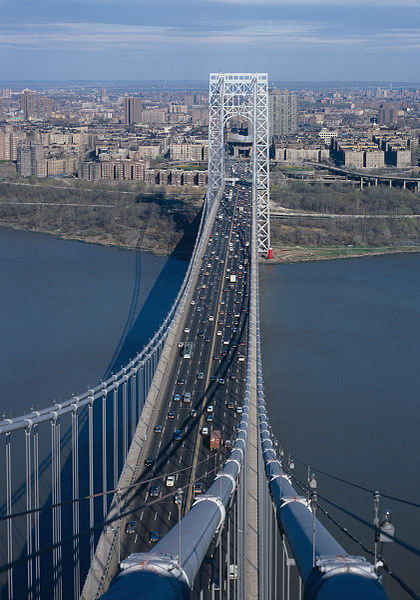
Wikipedia offers this view of Washington Heights beyond the George Washington Bridge, from the west. For a listing of historian James Renner's upcoming tours of the Northern Manhattan neighborhoods of Washington Heights, Inwood, and Marble Hill, see below.

by Ken

Since I last wrote, the New York Transit Museum tour schedule has been announced (you can find it on the Calendar of Events page of the website, and the early registration period for members is in full swing. As I mentioned, all the regular tours on the fall schedule are offered at least twice, and some of the especially popular ones, which in the past were generally already offered more than once, are offered even more often.

The four I pounced on start with two led by peerless "urban geographer" Jack Eichenbaum. With Jack you not only begin to understand why neighborhoods and regions have developed the way they have, but you see things you just wouldn't see with less tuned-in tour leaders.

PENN STATION "ECOLOGY"
Saturday, September 17, 10am-12n, and Sunday, October 9, 1-3pm
Constructed in a once squalid are known as the "Tenderloin," Penn Station united rails from Long Island, New Jersey and points south that previously terminated on the other side of the Hudson. Urban geographer Jack Eichenbaum will lead this walking tour through the remnants of the neighborhood's past and look at its proposed future, including the Farley Post Office building, the historic Hotel Pennsylvania, Herald Square, and "Koreatown."

LIFE ALONG THE L TRAIN
Saturday, October 15, 10am-1pm, and Saturday, November 19, 10am-1pm
Since its expansion to 8th Avenue in Manhattan in the 1930s, the L line has stimulated gentrification along its route. We will explore the West Village and Meatpacking District -- including a portion of the new Highline Park -- and on to Bushwick and Williamsburg, noting the continuous transformation of each of these neighborhoods.

By the way, Jack has announced some additional fall tours of his own, including an on-the-ground survey of the area he's currently watching with perhaps the greatest fascination, What's New in Long Island City? (Saturday, October 22, 11am-1pm) and one in his home area, which has already undergone an unrecognizable transformation, Religion on the Land: Polytheologic Flushing (Saturday, November 12, 12n-2:30pm). I've already done a fair amount of wandering in both Long Island City and Flushing with Jack, and I can assure you it's a special experience. (I would definitely do LIC with him again if I weren't already registered for the Municipal Art Society tour of the Chinatown-Little Italy Historic District at the same time.)

Jack also invites us to "hold the dates" for a pair of cold-weather tours ("both partially indoors"), with details to be announced: Keeping Off the Streets of Midtown Manhattan (East Side) (Saturday, December 3) and Flushing's Chinatown (Sunday, December 18).

The other two tours I couldn't resist are:

POWER UP! A SUBSTATION INSIDER
Saturday, November 5, 10am-12n, and Saturday, December 3, 10am-12n
As part of subway construction in 1904, the 59th Street Powerhouse was built to supply the massive amounts of power required to move trains and light tunnels in the new subway. Robert W. Lobenstein, former General Superintendent of New York City Transit, will take us inside magical Substation No. 13 and lead a sidewalk tour of the 59th Street Powerhouse.

MOVIN' ON UP: 75 YEARS OF SUBWAYS UNDER QUEENS BOULEVARD
Sunday, November 13, 11am-2pm, and Saturday, December 10, 11am-2pm
Seventy-five years ago the Independent Subway System was extended from Jackson Heights to Jamaica under Queens Boulevard, now a shopping mecca. Ridership at Forest Hills station now ranks 40th out of the system's 468 stations. Ride sections of this line and walk its surrounding neighborhoods with subway historian and retired LIRR manager Andrew Sparberg.

These are all $30 for NYTM members, $45 for nonmembers.

Two perennial favorites are offered four times each but are so popular that they're likely still to be tough to book.

At some point I will definitely do the CONEY ISLAND YARD tour again, and prepare for it better by schooling myself on the various kinds of subway cars that are serviced in this giant maintenance facility, and how exactly they work, to better appreciate this unparalleled close-up view of how that maintenance done. But the pièce de résistance is the visit to the tower where New York Transit personnel oversee the extraordinary coming together at Coney Island of four separate subway lines.

This is a must. It's being offered Tuesday evenings, 6-8:30pm, on September 13, October 11, November 8, and December 13 ($30 for members, $50 for nonmembers), and you're going to need photo ID -- they take security very seriously at the Coney Island Yard. (Anyone who didn't understand how essential the subways are to the life of the city got a demonstration when they were shutdown in anticipation of Hurricane Irene.)

The visit to THE JEWEL IN THE CROWN: OLD CITY HALL STATION is also enormously popular. When the old City Hall station was built, it was the anchor of the original subway line, and the station was built on a decorative scale that was never repeated. You're really traveling back in time here, and the station may be less "wow"-inspiring than you expected. (For one thing, it's not that large. The trains of the time were only five cars, cars that were much shorter than later ones.) But more than anything, you're seeing history here. The station was abandoned both because of lack of use and because the extreme track curve on which it sits could never have been adapted to handle the much larger, multiple-trains that became standard on the NYC subways.

You can glance at the station by staying on a no. 6 train after its last southbound stop at Brooklyn Bridge, when it makes the loop that turns brings it onto the northbound local track of the station -- and you are allowed to stay on the train, we were told, unless Transit personnel tell you the train is going out of service -- but you won't see much. The tour is the only way to get out onto the station platform and actually see what there is to see. This is the one NYTM tour that's members only, and may be itself be reason enough to join, though there seem to me plenty of other reasons, not least all those other tours. (Note that in addition to using my early-registration privilege, I paid $120 for my four tours, which for nonmembers would be $180.)

And oh yes, as I mentioned last time, there's one more of the museum's famous day-long NOSTALGIA RIDES, once again riding the old IRT lo-V cars up the Lexington Avenue line to Woodlawn Cemetery in the Bronx (Sunday, October 23, 10am-3pm; $35 for members, $50 for nonmembers). This time it's offered as a package deal with a box lunch and a tour of this final resting place of some of New York's Fanciest citizens (with cemetery architecture by some of New York's fanciest architects).

And I haven't even mentioned the museum itself, in downtown Brooklyn, which is terrific, both for its permanent exhibitions and the special ones offered for limited periods. (I was grateful at the two cracks that the summer Nostalgia Rides that departed from the museum gave me at the incredible exhibition on the Triborough Bridge, an amazingly thorough documentation with photos, archival documents, models, plans, etc. of how the concept for this complex of structures took shape and how it was executed, including what it displaced.)

Nor have I mentioned the numerous other special events, including all sorts for kids (many of whom are incredibly knowledgeable about the subways; at the Coney Island Yard, the youngsters on the tour knew everything about those trains!). Or the Museum Annex at Grand Central Station, which has free admission and is currently hosting an exhibition called "The Once and Future Penn Station." If you're visiting the city, you should definitely try to get to one if not both locations, and if you live here and haven't been yet, you really should go. For basic information, the Transit Museum website is a great starting place.


"WAHI" TOURS

Well, I've gotten my copy of James Renner's Washington Heights, Inwood, and Marble Hill, and it's a terrific book. But it didn't register for me before that it's part of the valuable Images of America series, which means it's basically a book of photos. There are lots of fine historical photos, informatively captioned, but alas no, it's no substitute -- as I was hoping -- for the tours I'll have to miss, owing to schedule conflicts, in this six-Sunday September-October series offered by the official historian of Manhattan Community District 12.

By way of overall introduction, James writes:
Washington Heights and Inwood (WAHI) are communities that have, over the years, gained recognition in massive demographic changes. People from other parts of the city are visiting and moving here because of its affordable housing and beautiful parks. These tours will demonstrate to the resident and visitor alike how upper Manhattan has changed and adapted to suit the needs of its new inhabitants and tourists.

You can find the full schedule with tour descriptions here. There are parts of the city it's easy to find covered by multiple walking tours; these aren't among them. The tours on the schedule ($15, $10 for students and seniors) are:

JUMEL TERRACE HISTORIC DISTRICT & SUGAR HILL (Washington Heights)
Sunday, September 11, 12n (additional fee for Morris Jumel Mansion admission)

COLUMBIA UNIVERSITY MEDICAL CENTER (Washington Heights; 165th to 168th, Broadway to Haven Avenue)
Sunday, September 18, 12n

FORT GEORGE (Washington Heights; 190th to 193rd, Amsterdam and Audubon Avenues)
Sunday, September 25, 12n

SHERMAN CREEK (Inwood)
Sunday, October 2, 12n

TUBBY HOOK (Inwood; Dyckman Street, Riverside Drive and Broadway)
Sunday, October 9, 12n

MARBLE HILL
Sunday, October 16, 12n
#

Thursday, September 01, 2011

Mérida And The Yucatán Peninsula Seem Safe Enough


We love Mexico. I started going when I was a teenager and I've always found the country awesome and inspiring and beautiful. I love the food and the folks have been kind. Mexico City is a terrific, cosmopolitan megapolis, as is Guadalajara and villages I've been to like San Miguel de Allende have been stupendous. Right now Roland, Helen, Michael and I are trying to decide between Mérida on the Yucatán Peninsula or Oaxaca on the other side of the country for a winter getaway. (And, to make it a little more complicated, Roland threw in the picturesque old colonial city of Cuernevaca in the country's heartland.)

We found a beautiful house to rent in Mérida and I'm really leaning that way right now. All the tour books give the place a big thumbs up. It's filled with gardens and plazas that give it a relaxed, tropical atmosphere and it boasts the oldest cathedral on the continent, built between 1561 and 1598, with stone walls from the ruined buildings of Tihó, the former Mayan city. In fact Mérida is right in the middle of the old Mayan Empire and there are ruins to visit all around, including some really close ones like Dzibilchaltún, founded in 500 BC, just 9 miles away. It covers around 6 square miles and since being rediscovered in 1941 something like 8,000 buildings have been mapped. Still close enough for a day trip are the even more outstanding Mayan ruins at Uxmal, Tulum and Chichén Itzá.

Lately there have been safety concerns in Mexico. But not really in the Yucatán. Last month Mexican Tourism Secretary Gloria Guevara was in the U.S. trying to reassure American tourists-- and U.S. visitors make up 60% of Mexico's tourism visitors-- that, despite warnings from the State Department, most of the country is safe.
[W]e acknowledge there are some issues in some pockets, in some specific locations. To give you an example, Mexico has 2,500 counties. Eighty of those have issues. So does that mean that the entire country has issues? Of course not. Eighty of 2,500 is less than 5 percent. Ninety percent of Americans go to six destinations. The tourist destinations are very far from where we have these issues.

...For us in Mexico, when we talk about the U.S., we don’t say the U.S., we say Orlando, L.A., Washington. If something happened last week, if there was a shooting in East L.A., does that mean you can’t go to Washington? Of course not.

Friday, August 26, 2011

There's More To The Galápagos Than Iguanas, Nazca Boobies And Albatrosses


My friend Kelly works for a cruise ship line that travels all over the world, including to a place I've always wanted to go but still haven't reached yet-- the Galápagos. I asked him to give us a taste of what it's like and thought we'd wind up hearing a lot about strange animals and birds. Instead, he wrote about an important and wonderful component for any traveller: indigenous music.

Rock the Islands: The Growing Rock Music Scene in Galápagos and Ecuador

-by Kelly Darmer

Over the course of the last 20 years, as it has become increasingly simple to exchange ideas, opinions, and content across cultural and physical boundaries, music has served as a vital conduit for communication. A truly universal language, music is enjoyed the world over, and there is seemingly little rhyme or reason for why a style becomes popular with a particular group. The music that emerges from a particular region or population is often heavily influenced by the indigenous musical roots of that region or population. Over the course of the last twenty years, however, music from different cultures has spread, collided, and mixed to form some very interesting contemporary sounds. Tune into any online radio station and it is as if you have found yourself aboard one of many musical world cruises. This mixing of sounds has become most noticeable in the world of rock. Rock bands crop up in surprising places, and the rock sounds emanating from Ecuador and the Galápagos Islands have a distinct vibe all their own.

The Galápagos Islands and Ecuador are most commonly known for three types of music, Andean folklore, pasillo, and cumbia. Andean folklore is characterized by the use of a bamboo panpipe called a rondador. Go just about anywhere in the world, and at some point in a street market you will probably encounter two or three men with speakers and CDs, playing a rondador arrangement of a Celine Dion hit. The sound of the pipes has become synonymous with the region and their haunting quality has proved popular worldwide. Pasillo is the oldest music of the region and is a close cousin of the waltz. It has fallen out of favor since the late 70s, but has still managed to influence contemporary artists all over Latin America. Cumbia, which was developed in Colombia, is a relatively new form of music in Ecuador and the Islands, and the Ecuadorian population has altered it a bit, creating a rawer, funkier sound that is played everywhere from backyard barbecues to high-end clubs. All three of these musical traditions have had an impact on the sounds of the rock bands of Ecuador and the Galápagos Islands. However, what makes these groups so interesting, are the elements of punk, ska, reggae, rap, hip hop, and jazz that have been liberally combined to create some fascinating sounds.

Every country needs some head thrashing rock, and a heavy metal group named Viuda Negra fills that bill. Formed by two friends in the late 90s, the group is known for their heavy music and socially conscious lyrics. They released their first album in 2003 and continue to perform together to crowds as large as 10,000 in Latin America.

The group that has managed to have the most crossover success is Esto Es Eso. With their funky, accessible mix of reggae, rock, hip hop, pop, pasillo, and folklore, Esto Es Eso has toured Europe and the US, and was formed by an Ecuadorian musician and a former Californian. Their sound has been described as “Ecuafornian”, and there is no denying that it rocks. Check out the video below.

Afrik’ns Homosapiens created their own form of rock music under the direction of famed folkloric artist Guillermo Avoyi, also known as Papa Roncon. Combining sounds particular to coastal regions of Ecuador and the Galápagos Islands, including Bunde, Arrullo, Chigualo, Alabao, with ska, reggae, calypso, and other musics of the Caribbean, Afrik’ns Homosapiens developed what is now called Bao. Their slowed down groove is characterized by the use of hand drums, marimba, and other traditional instruments alongside electric guitars and bass. (One of their videos is up top.)

Since 1996, one band has dominated the ska and punk scene in Ecuador and the Galápagos Islands. El Retorno de Exxon Valdes was formed in 1996 and fifteen years later, they are still going strong. In the tried and true fashion of all ska/punk groups, their early albums focused on issues of identity and feelings of disassociation. Their lyrics have matured along with the members of the band, and their popularity continues to grow.

If you are headed to the Galápagos Islands, make sure to take a trip to some of the local music venues. There is a long tradition of excellent music making in the region and the energy surrounding the live music sceneis infectious. You never know, you just might stumble upon the next.

Urban Gadabout: NYC tour updates -- breaking news!

The Bowery in 1896 -- it sure doesn't look like this now, and the long-ago disappearance of the el is almost the least of the changes. The third in Francis Morrone's MAS tours focusing on the East Village (October 9) targets the Bowery.

by Ken

As I wrote Sunday, given how perilously close we're getting to September, the new tour schedules of the Municipal Art Society had to be released momentarily, and now they have been, more or less. I've done some difficult triage and filled in a lot of my fall calendar.

NEW YORK TRANSIT MUSEUM

Again as I wrote Sunday:
In the case of the Transit Museum, the smartest thing you can do for now is to become a member. While it's technically true that very few of its tour offerings require you to be a museum member, in fact members take such advantage not just of the lower members' price but of the early registration period that it's awfully hard to squeeze onto most of the tour lists if you aren't a member.

Members have now received the full fall tour schedule, and the members-only early registration period is set for August 31-September 8, and this time it's going to be doable online as well as by phone. (I've got my sights set on four tours.)

I assume there will be a general announcement of the tour list shortly. I don't feel at liberty to pass on what we've been told, except to note that the cutthroat competition for tour slots should be eased with all of the fall regular tours offered at least in duplicate, and some of the likely most popular ones being offered even more frequently. There is, by the way, another one of the Transit Museum's famous Nostalgia Tours, scheduled for late October.

My advice still is to join immediately, and ask to have the tour list sent to you if it's still not posted.

MUNICIPAL ART SOCIETY

The September and October listings are now up on the "Tours" page of the MAS website, and there's lots of exciting stuff. I'm conflicted out of a couple I would have loved to do: The Architecture of Literacy: University Heights, the Bronx (Saturday, September 17, 11am, with Jean Arrington), Arts for Transit: Brighton Line (Sunday, October 2, 11am, with Amy Hausmann, registration required -- when I moved to NYC at age 12, the Brighton line from Brooklyn was my lifeline to "the City," as I learned to refer to Manhattan), and Crown Heights North (Sunday, October 16, 11am, with Suzanne Spellen and Morgan Munsey, with whom I did an MAS tour of sections of Bedford-Stuyvesant a month or two ago -- unfortunately that's the day of my Working Harbor Committe Circumnavigation of Staten Island, also mentioned in my Sunday post).

However, in a frenzy of excitement I've already registered for seven tours. Except as noted, the tours are all still $10 for members, $15 for nonmembers.

Dawn Powell and the Greenwich Village of Her Time. Sunday, September 4, 2pm, with Francis Morrone
The World Trade Center: 10 Years Later. On the eve of the anniversary, Saturday, September 10, 6pm, with Francis Morrone, $20
The Architecture of the Garment District. Tuesday, September 20, 5:30pm, with Andrew Dolkart
Starchitecture NYC, 2011, "a concentrated three-hour tour via small motor coach and on foot of some of the city's most talked-about buildings, structures, and spaces," Saturday, September 24, 10am, with Matt Postal (also offered Saturday, October 15 -- I think! the schedule says "Sunday, October 15), $49 for members, $55 for nonmembers
East Village III: The Bowery, the third in a series of East Village tours Francis Morrone is leading. Sunday, October 9, 2pm
Chinatown-Little Italy Historic District. Saturday, October 22, 11am, with Kerri Mulhane

Then there are a bunch of tours offered on a walk-up basis (as I've mentioned, tours director Tamara Coombs likes offering the tours in both formats, to accommodate the widest range of potential tour-walkers) which I've inscribed on my calendar:

Sixth Avenue and the 1961 Code Revisited, the first of two walks looking at the wave of high-rise construction that was build in accordance with the major changes in the code implemented in 1961 (Sunday, September 18, 11am, with Matt Postal)
Battery Park City Evolving, "love it or hate it," focusing on the northern section. Sunday, September 25, 4pm, with Francis Morrone
Catalysts for Change: East Midtown and the 1961 Code, the East Side continuation of Matt Postal's Sixth Avenue walk above (September 18). Saturday, October 1, 11am
Forest Hills: Garden City in the City. Sunday, October 23, 2pm, with Francis Morrone
Downtown's Forgotten Neighborhood, the immigrant-rich "Lower West Side" that remained a multicultural hotbed until it was largely displaced by the World Trade Center. Saturday, October 29, 11am, with Joe Svehlak ("whose family settled here in the early 1900s")

There are also a pair of "Beyond Sight" tours specifically conceived for people with visual impairments (though open to others), stressing "visual description and multi-sensory exploration," led by art historian Sylvia Laudien-Meo (reservations required for both): Grand Central Terminal, September 3, 11am, and The September 11 & Irish Hunger Memorials, October 20, 12n.

And a tour of a project that was never built --

I'm also delighted to see that Matt Postal is once again doing what was my first MAS tour (only last fall!), one I talk about all the time: LOMEX Remembered (Thursday, September 15, 5:30pm) -- a tour of a project that was never built (!), Robert Moses's planned Lower Manhattan Expressway, when a local community threatened with destruction discovered that it could too fight City Hall, in a long series of battles (Moses didn't give up easily; every time the opponents thought they had thwarted the project, he came back with a revised plan and they had to start all over) in which Jane Jacobs's name was heard for the first time.

I STILL HAVE TO WRITE ABOUT THOSE "WAHI" TOURS

Sherman Creek seen from the northern edge of Inwood, Manhattan -- target of James Renner's October 2 WAHI tour.

It's a series of six, covering areas of Washington Heights, Inwood, and Marble Hill, being offered Sundays at noon from September 11 to October 16 by Northern Manhattan historian James Renner, author -- by strange coincidence -- of the book Washington Heights, Inwood, and Marble Hill (Arcadia Publishing; I've ordered my copy!) and the official historian of Community District 12 Manhattan. Again, you'll find the schedule here, and the tours are $15, $10 for students and seniors.

I'm sorry to say that after the triage with the NYTM and MAS schedules, plus other tour plans (like, again the Staten Island circumnavigation, which I have no intention of missing!), I'm probably only going to be able to make two of the six, but they're two I'm especially eager for: Jumel Terrace Historic District & Sugar Hill (Washington Heights and Harlem, the first of the series, September 11) and Sherman Creek (Inwood, October 2). I'm hoping that the book will help me plug some of those gaps. And of course I assume James will be offering more tours in the future.
#

Tuesday, August 23, 2011

Urban Gadabout: How I spent the earthquake, plus gadding to the North River, SI's Freshkills Park, and Constitution Island (opposite West Point)

"It's not nice to fool Mother Nature."

So I guess it was a little before 2 this afternoon. Hey, if I'd known it was going to be history, I'd have checked the time -- I just thought it was, well, I didn't know what the heck it was, but I considered and dismissed "earthquake" as a possibility. We don't normally have earthquakes on the 14th floor of my building in the Financial District (Lower Manhattan) of New York.

So like I said, it must have been a little before 2, and I was at my desk in my cubicle on the 14th floor of a pretty sturdily built building (at least in the 2½ years my company has been here, the building has never moved that I'm aware of), and for a while the floor and everything kind of trembled, and after awhile people sort of looked at one or another, and somebody mentioned that there had been a 5.8 earthquake in Washington. Only I didn't make out exactly what that person said; I reconstructed it later after I found out that there had been a 5.8 earthquake centered in northern Virginia, which was also reported as 5.9 or even 6.0 Online somebody joked that S&P had upgraded the earthquake from 5.8 to 6.0.

Then we were hustled into the conference room to hear our HR director, who happened to be in California (as it happens, our office manager was also out of the office -- coincidence?), via conference call tell us to do whatever we felt necessary for our safety. She also warned us about taking precautions before getting on a subway, but somebody else reported that New York Transit was reporting no service delays. (And New York Transit wouldn't kid us now, would it?)

Me, I figured if an earthquake is coming to get me, I really wouldn't know where to go to escape its clutches. I figure you're just as likely to walk into it as to escape it. When I went back to working on the InDesign file I had been working on, the computer claimed that the file was damaged. I rebooted and tried reloading it, and while the program still voiced suspicion about the file being damaged, it then accepted and saved some small changes, and the asterisk went away. So far the file seems to be OK.

And that's how I spent the earthquake. We're not used to this sort of stuff here, but believe me, I take it seriously. It's not nice to fool Mother Nature.


STILL, I HOPE MOTHER NATURE ISN'T PLANNING MORE OF
THIS SEISMIC STUFF JUST NOW, WITH URBAN GADDING AHEAD


Constitution Island, viewed from the West Point side

As I write, I'm getting read to leave the office for this evening's Hidden Harbor Tour of the "North" (i.e., Hudson) River waterfront, and then tomorrow I'm actually taking off work for my first look, courtesy of a tour offered jointly by SI 350 (a volunteer group promoting celebration of Staten Island's 350th birthday -- apparently someone thinks Staten Island is 350 years old; I wonder how Mother Nature feels about that) and the NYC Parks Dept., at the work-in-progress Freshkill Parks, built with huge infusions of technology, cash, and manpower on top of the old trash megadump.

The Parks Dept. has been offering tours, but I could never figure out from the website where I would have to get to, or therefore whether I could get there via public transit. This tour, however, is leaving from in front of the library in St. George, the part of Staten Island where the ferry lands -- and that I know how to find.

Then Saturday I'm actually venturing outside the five boroughs of NYC, well up the Hudson River to venture onto Constitution Island, which is opposite West Point on the west bank of the river, and is only open three weekends a summer. I'm expecting to meet up with a Shorewalkers group at the Metro North train station in Cold Spring, on the east side of the river from the island.
#

Sunday, August 21, 2011

While we wait for tour announcements from MAS and the NY Transit Museum, here are some upcoming NY area tours for your schedule

I was really looking forward to this morning's MAS walking tour of Manhattan's Lower East Side, but no, I was still struggling with my Sunday Classics post on Andrea Chénier. Oh well.

by Ken

I've recovered my wits a bit since the post I wrote yesterday upon return from the New York Transit Museum's subway-and-bus Nostalgia Tour to the Rockaways, and I want to add some information.

First, while I focused on NYTM and Municipal Art Society (MAS) tours, anyone who clicked through to the respective websites would have found the tour cupboards pretty bare. (Well, MAS had an awfully interesting-looking walking tour of Manhattan's Lower East Side scheduled for this morning, but I had to blow that off because I was doing battle with Andrea Chénier.) I should have mentioned that both NYTM and MAS are presumably days if not hours away from announcing schedules that cover September and beyond.

I've been checking the MAS website daily. Oh, even the tours that require preregistration won't sell out that quickly, but I'm kind of out of my mind with excitement to see what MAS's Tamara Coombs has cooked up for us. And for your planning purposes, it's wise to assume that the tours that do require preregistration will sell out well before the tour date. The prices are ridiculous for tours of this quality -- as of the summer offerings, still $10 for members and $15 for nonmembers for most tours. (Longer tours or more elaborate tours are priced higher.)

In the case of the Transit Museum, the smartest thing you can do for now is to become a member. While it's technically true that very few of its tour offerings require you to be a museum member, in fact members take such advantage not just of the lower members' price but of the early registration period that it's awfully hard to squeeze onto most of the tour lists if you aren't a member. I can't wait to see what Luz has cooked up for us, and assuming I have the information in time, I plan to do what I did this summer: call in with my request list as early as possible the morning of the start of the registration period!


WORKING HARBOR TOURS

In July I wrote with great excitement about the first of three Hidden Harbors Tours I was doing, arranged jointly by the Working Harbor Committee (WHC) and Circle Line Downtown this one through the Kill Van Kull, which separates the west of Staten Island from New Jersey, to exotic Newark Bay. The trip was fantastic! Since then I've also done "The Brooklyn Tour," which took us up the East River to the junction of Newtown Creek, then close along the Brooklyn waterfront until we swung across New York Harbor past Staten Island to the opening of the Kill Van Kull and the New Jersey shore, then past the Statue of Liberty and back to the Fulton Street pier. We did much of the trip with lightning flashing, and then a wild thunderstorm broke out just as we passed the Battery for the short trip back to the pier -- it's a shame they can't plan on including this effect all the time!

I mention them now because both "The Newark Bay Tour" (September 13) and "The Brooklyn Tour" (September 27) have one more incarnation coming up for the current season, while the final offering of the "North River Tour" (i.e., the Hudson River, formerly known as the North River) which I haven't done yet, is this Tuesday, August 23. I bought all my tickets online; there's a discount for WHC members.

CIRCUMNAVIGATION OF STATEN ISLAND

For all the tours, the WHC's Captain John provide running commentary along with a guest for the particular tour. One event he has talked about on both the tours I've taken is a circumnavigation of Staten Island, for which the date has finally been announced -- Sunday, October 16 -- and ticket sales begun. A planned WHC Lighthouse Tour sold out before I had a chance to book it, so I wouldn't wait on this one. (As a matter of fact, I didn't!)

FIVE WALKING TOURS OF NORTHERN MANHATTAN

I also wanted to report on an exciting series of tours "WAHI Tours" of Northern Manhattan being offered Sundays from September 11 through October 16 at noon by James Renner, author of Washington Heights, Inwood, and Marble Hill (Arcadia Publishing; I haven't had a chance to get my copy yet!), and the official Community District 12 Manhattan historian -- priced at $15 for adults, $10 for seniors and students. I'll write more about them soon.
#

Saturday, August 20, 2011

Urban Gadabout: A year later, I finally made it to the Rockaways Nostalgia Tour

1) Great Kills, 2) Miller Field, 3) Fort Wadsworth, 4) Canarsie Pier, 5) Jamaica Bay Wildlife Refuge, 6) Floyd Bennett Field, 7) Jacob Riis Park, 8) Fort Tilden, 9) Breezy Point 10) Sandy Hook, 11) Fort Hancock

by Ken

It was full circle for me today, participating in the New York Transit Museum's final Nostalgia Tour of the summer, to the Rockaways -- not so much because I participated in all three of the summer's Nostalgia Tours (the previous ones were to Woodlawn Cemetery in the Bronx and Coney Island in Brooklyn), not to mention a slew of other NYTM tours over the last year, bt because it has been a year. It was last summer around this time that I took advantage of a half-price offer for NYTM membership just in time, I thought, to go on its first-ever combined subway-and-bus Nostalgia Tour -- taking a train of vintage cars as far as the subway will take you on the Rockaway peninsula, to Rockaway Park, and then piling onto vintage buses for the additional journey farther west, beyond the residentially settled area of Rockaway to Jacob Riis Park, yet another Robert Moses creation of the '30s.

The problem was last year that I hadn't booked ahead, but knew that there was space on a walk-up basis, but didn't know that they weren't taking credit cards. I had meant to stop at an ATM en route to the Transit Museum that morning, but I was worried that I was running behind time-wise. As it turned out, I arrived in plenty of time, and waited in a long line, only to find out that no, they were taking cash only. Somebody said something about a bank nearby, but I couldn't rally myself.

An inauspicious beginning, but when the next batch of tours was announced, I took advantage of the week's advance reservation period for members, and began a year of discovery, fascination, and wonder in, literally, all five boroughs of New York City. It's a city I've lived in since I was 12 (no, I'm not going to tell you how many years ago that was, but it's a lot, though still on this side of

Via Transit Museum tours I've seen things I literally couldn't have seen any other way: the Coney Island subway repair center and signal tower; behind-the-scenes Penn Station including its ultra-secure command station; the inside of the awaiting-development Farley Post Office. Some of these are things we probably still should talk about. And there were a host of others, thanks to Luz, the indefatigable director of NYTM's tours.

Perhaps the most profound impact was from the tour that introduced me to "urban geographer" Jack Eichenbaum (the Queens borough historian), who took us to and through three subway "nodes," places where two or more separate subway lines intersect -- the ultimate node, Times Square in Manhattan, plus Queens Plaza and Jackson Heights in Queens -- and showed us how the intersection of those subway lines shaped the subsequent development of the areas. It set me on a whole other way of thinking about, well, places. After all, every place where there's human habitation exists where it does for a set of specific reasons.

That has changed my life, and since then I've seized a bunch of opportunities to take tours with Jack which aren't like anybody else's, always showing us places that hardly any other tour leader would think to show people. (I would have to single out the all-day tour of the No. 7 line to Flushing, Queens.) But my life was also changed by a tip Jack gave us: about the Municipal Art Society. I'm embarrassed to say that all these decades it was just a name to me, and I assumed it had nothing to do with me, since I am not what you would call an "art person." But MAS's concern is the municipal art, the art of making a more livable city, and as I've written here, MAS tours have become inextricably with my week-to-week life -- there have been a bunch of weeks when I've done MAS tours back-to-back on Saturday and Sunday.

I would be tempted by pretty much any tour announced to be led by my MAS standbys: Jack Eichenbaum, of course, and the more architecturally oriented Matt Postal and Francis Morrone, and the boundless-spirited and inexhaustibly knowledgeable Justin Ferate. I've been to bunches of places on Staten Island with Justin and Francis (and the MAS's equally indefatigable tour director, Tamara Coombs, who's a Staten Islander herself), where I'd previously hardly ventured beyond the St. George ferry terminal; and lots of places in Brooklyn with Francis and Matt, and learned to look at Manhattan skyscrapers a whole other way with Matt, and . . . well, I could go on and on, but I won't. ditto with all the other tours I've found my way to. It's been quite a year! (Oh yes, when I got a renewal notice from the Transit Museum, I sent my check in that very day.)

I'll just say that Rockaway was a blast today, and it was especially interesting wading in the surf -- real surf, since this is open ocean, in contrast with the beach at Coney Island, which as Joe Svehlak had just pointed out to us in an MAS tour of Coney Island, has the protection of being inside the Lower Bay of New York Harbor. You see how these things all fit together? One of the things I've written about here most often is my fascination with New York as a coastal city, a major harbor.

I know I'm babbling, and have left out all sorts of points I planned to make. But it's been a long day!
#

Sunday, August 14, 2011

Starting The Ball Rolling Towards A Trip To Ethiopia

Three ladies from the Mursi tribe

I started my adventure traveling before I understood anything about sex. In fact, the first time I ever even had sex was when an older woman-- she was 17 I think, or almost 17-- seduced me in the back of a Greyhound station in Jacksonville, Florida. I had virtually no idea what was going on and mostly all I remember were the big black rubber tires we were surrounded by. I was on my way to visit my grandparents for Pessach in Miami Beach. Later being physically attracted to a people helped determine where I wanted to visit; I've had wide tastes and see beauty in almost every kind of people. But that was a long time ago and these days I'm much more likely to pick a destination because I like the cuisine. Really.

Roland, who is really eager to go to Ethiopia (not to mention Eritrea and Somalia; he's insane)-- and knows my proclivities-- has been trying to talk me into liking Ethiopian food for just around a decade now! He keeps claiming it's "one of the great cuisines of the world." L.A. has a Little Ethiopia about half and hour from my house. There are over a dozen well-regarded Ethiopian restaurants within 2 blocks of each other. The basic building block of the cuisine is injera, a kind of sour bread that he just loves and I never really took to-- until this year. The meal consists of the injera and some wats or stews. Just when I was starting to get used to the taste of the injera I found out it's made of fermented teff, which is totally in synch with my health regime. Teff is a kind of grass, but not wheat-- which I avoid-- and it's not gluten. It's more like quinoa or millet and it's a good source of fiber, protein, iron and calcium-- very healthy.

Anyway, Roland's in Maine for a few weeks and yesterday I went to Little Ethiopia for lunch. My favorite restaurant there-- by far-- is Rahel, which is the only pure vegan place. The others-- Messob, Rosalind's, Nyala, Merkato, etc all serve vegetarian dishes, which are common in Ethiopia, but Rahel makes an art of it. On Saturday's lunch is an all-you-can-eat buffet for something like $12. There are a dozen dishes, all delicious and healthful. So Ethiopia passes the food test and we're in the early stages of planning a trip there. One of my neighbors has an orphanage in Lalibela.

In his enthusiasm, Roland has been feeding me this line about how it doesn't only have "one of the world's great cuisines" but that it's also the "land of eternal spring." I decided to double check, knowing how completely unreliable he is when he's made up his mind. He's been pushing for next June.
When to go to Ethiopia?

The main rainy season is June to end of September. Don't go then unless it is the ONLY period you can take a holiday. it rains pretty well every day-- some is drizzle but much is heavy tropical rain. Things get very muddy. IF you can only go in this period of the Big Rains try to spend some time in lower altitude areas like the Rift Valley Lakes zone, where it will be warmer and a bit less wet...

Best time to visit is mid October to mid March-- the dry season.

Since this coming December we're set on the Yucatan, it'll have to be the following Christmas. Long way... But here's a video I found with an overview of the capital, Addis Ababa, a city with 4 million people that everyone tells me to have a quick look around and then out into the country.