Search This Blog

Showing posts with label Bali. Show all posts

Monday, January 09, 2012

Dengue Fever-- Something You Don't Want To Bring Back From A Vacation


I didn't buy any souvenirs on my recent trip to the Yucatán. Mostly what they sell visitors to Mérida are hammocks and Guayabera shirts. I took something else home instead-- Dengue fever, an infectious tropical disease transmitted by mosquitoes. It's different from the deadly dengue hemorrhagic fever, which I don't have. The one I have takes a week or two and you're better... or so my doctor says.

I'd like to say I got it traipsing around the jungle investigating the connections between Mormon polygamists and the worship of the Mayan and Aztec feathered serpent deity Quetzalcoatl. The Mormons, who were led to Mexico as a way of preserving their polygamist lifestyle 125 years ago by Mitt Romney's great grandfather, notorious polygamist Miles Park Romney, believe that Jesus Christ came to America after he was resurrected and was remembered by the Mexican Indians as Quetzalcoatl. The second president of the Mormon church, John Taylor, who sent the Romney family down to Mexico wrote, "The story of the life of the Mexican divinity Quetzalcoatl closely resembles that of the Savior; so closely, indeed, that we can come to no other conclusion than that Quetzalcoatl and Christ are the same being." But that isn't how I contracted Dengue fever.

I met plenty of Mormons and plenty of Mayan Indians who the Mormons are trying to convert-- there's a Mormon temple next to all the big intercity bus terminals so that missionaries can prey on the illiterate peasants arriving in the cities for the first time. But the mosquito that got me came from a broken fountain in the beautiful house we rented in downtown Mérida.
When Romney’s father was five years old, the Mexican Revolution broke out and his parents moved back to the United States to avoid the violence. Mitt Romney was eventually born in Michigan. But the other branch of the family-- leading down to Romney's cousins Leighton, Mike and Meredith-- stayed behind in Mexico, their numbers growing. The Romneys chose to remain in Mexico because they established good lives for themselves and their families there.  Most of them are now dual-citizens. 

“We certainly have a love for both countries,” adds Leighton. “I can sing both national anthems and tear up at both of them.  I think that having two countries that you love and two countries that you can serve or be a beneficiary of their service is a great thing.”

The Romneys living in Mexico are well aware of their wealthy and famous relative’s popularity in the Republican primary race. They support their cousin's candidacy and they hope that Mitt will be more open about the issue of his religion and Mexican heritage during the campaign.  It’s a family history they’re proud of, despite the fact that Mitt Romney has never come to visit.

Dengue fever is becoming quite the problem for tourists in tropical countries lately. Popular tourist destinations like Cambodia, Polynesia, Bali and India have had problems recently.
The mosquito menace which has even led to a few deaths has spread its net of fear amongst the monks and tourist visiting Bodhgaya, the important Buddhist pilgrim destination in the state of Bihar.

Bodhgaya is famous for the Mahabodhi Temple and the Bodhi tree in its courtyard under which Lord Buddha attained enlightenment. The Mahabodhi Temple is a World Heritage Site and attracts a large number of Buddhist pilgrims from all over the world.

However the past three months has seen the mosquito menace increase from bad to worse and has resulted in the spread of encephalitis, dengue fever and malaria, which has resulted in quite a number of deaths that have occurred over this period.

As such most devotees, monks and even tourist who come to visit Bodhgaya are virtually caged inside portable mosquito nets even during the day, even blocking their free movement. This has caused a real panic among the visitors who are in constant fear of being bitten by mosquitoes.

"Mosquitoes killed even Alexander the Great, and hence we too are quite frightened," said Madelina Illibery, a tourist from Italy. "I was told encephalitis and malaria together [caused by mosquito bites have claimed many lives in the Gaya district alone in the past few weeks…and hence I too have brought a foldable mosquito net for I can't afford to get exposed to those deadly mosquitoes," she added.

Many of the foreign countries have advised on the need of a mosquito net in their travel advisories. This is so because of the current tourist season which attracts a lot of visitors and also to enjoy a hassle free journey in good health.

My case seems pretty mind... at least so far. Not so for this Australian tourist, Trevor Proudlove, who picked it up in Bali.
He said he knew something was wrong when, after returning home from a 10-day holiday in October, he broke out in a bad rash and was so unwell he was unable to drive.

But Mr Proudlove said it was not until he developed pain in his joints and muscles about a month later that he was diagnosed with the disease, which doctors told him he was genetically susceptible to.

He said he would not travel to Bali again because of the distress it had caused him and his family, despite their efforts to stay safe.

"I couldn't even lift my arm to comb my hair and trying to get on and off chairs caused excruciating pain," he said. "It was like somebody was tearing my muscles out of my legs every time I would get up.

"My feet swelled up to twice the size they normally are, my hands swelled up, too. I couldn't bend my wrists because my joints were so sore. It was horrific."

It's far worse than dealing with proselytizing Mormons. And, yes, you can get it here in the U.S. as well, especially in Florida and Texas.
"We know now that Key West is a high-risk area for dengue and we could have ongoing dengue outbreaks again," said the report's lead author, Carina Blackmore, from the Florida Department of Health. However, if people use air conditioners and screens and stay inside during hot, muggy days there is little chance dengue will become endemic, she said.

Dengue remains a leading cause of illness and death in tropical areas but was largely thought to be absent from the United States since the 1950s.

However, in 2009, 27 people living in Key West came down with illness via locally acquired infections, and then 66 more residents contracted the illness in 2010, the researchers report. The outbreak seems to have eased since then, with no cases reported in 2011.

...Because Key West has a large population of the type of mosquitoes that transmit dengue, called the "house mosquito," Blackmore's team decided to investigate the size of the outbreak there. They identified a number of cases and found that people who got dengue were less likely to use air conditioning, and they often had birdbaths or other types of containers where the mosquitoes could breed.

Blackmore noted that dengue is not transmitted person to person, but from humans to mosquitoes and then back to humans again. However, trying to eradicate house mosquitoes has never been successful, she said, because of where they tend to propagate. "House mosquitoes are lazy mosquitoes-- they breed in [even] very small containers," she said.


UPDATE: How Old Is That Mosquito?

Interesting story on Dengue Fever mosquito research on NPR.
There's a nasty disease called dengue that is just beginning to show up in the United States. It's caused by a virus, and it's transmitted from person to person by a mosquito. A mild case of dengue is no worse than flu. A serious case can mean death.

Michael Riehle at the University of Arizona is trying to solve a curious puzzle about dengue: why there have been dozens of cases in nearby Texas and none, or virtually none, in Arizona. Riehle thinks the answer has to do with Arizona's geography.

"It's right on the edge of the range where these dengue mosquitoes are found," he says. "It's a fairly harsh environment, and we think that they might not be surviving long enough to efficiently transfer the disease to other people."

Wednesday, July 22, 2009

Healthy Eating In Bangkok and Bali

I was happily surprised to find so much health food consciousness in Bali. Wherever you looked, at least in Ubud, restaurants had signs that said "No MSG" and "organic food." Ubud has several that serve raw vegan food and there really was a lot of options for people concerned with good nutrition. Putu and Made, our cooks happily made delicious, healthful meals everyday combining organic Balinese vegetables with raw food preparation techniques and, homemade food is always better than restaurant food. Still Bali Buddah and Kafe always had good, healthful food including raw dishes.

I was even more surprised when I got to Bangkok. I have to admit I had some anxiety knowing my favorite Thai restaurant had closed this year. I'd been eating at Bussaracum for decades. Last year I even wrote a post, Lunch In The Same Bangkok Restaurant Everyday For A Month-- Bussaracum, The Best Restaurant In Thailand. Where would I eat? The food in Bangkok isn't always so wonderful and a number of my favorite restaurants have closed down or moved away to locations miles away.

Looking back over my own 2006 Bangkok restaurant guide, I was reminded that someone had told me about a raw food restaurant called the Rasayana Retreat. I ate there today. HEAVEN!

Clean, beautiful, wonderful vibes and the food... unbeatable. The food was very seriously raw and health oriented and SO DELICIOUS! I had lasagna and key lime pie and I can't wait to go back tomorrow to try some more. Here's their raison d'etre:

From the moment that a fruit or vegetable is harvested it undergoes change in it’s chemical and nutritive make up. The fresher a fruit or vegetable is, the higher it’s nutritive content. When you cook food a huge percentage of available nutrient is destroyed, and its chemical make-up is altered, in essence stripping the food of the very nutrients that your body is requesting when it signals hunger to your mind and stomach. Nutrient stripped food does not satisfy the body’s hunger, leading to overeating and dissatisfaction with food for many people. But there are also much greater consequences.

In order for the eliminative systems and organs of the body to function optimally a person must eat at least an 80% alkaline diet. The majority of alkaline foods are fruits and vegetables. The majority of acid foods are animal products, such as meat and dairy, or processed foods that have been heated (as in cooked), ground and separated, and/or have added sugar, salt, preservatives, stabilizers, colorings and many other additives as well. If acidic foods are the greater part of the diet, elimination from the bowels, lymph, kidneys, respiration and skin becomes sluggish, allowing a build up of toxins to collect in the organs and tissues of the body. This ultimately leads to unpleasant symptoms and chronic disease.

Eating raw food is like giving yourself high-octane fuel so that your body can be energized, run efficiently, cleanse efficiently, think clearly and work out toxins so that health and beauty can be a reality instead of a distant goal. On a cleansing program a 100% alkaline diet is a necessity if one wishes to get maximum results from the cleanse. A cleansing diet treats food like medicine, using food to assist the body in healing and rejuvenation. A wonderful aspect of this is that Living Food also tastes good.

It's open everyday. It's real close to the skytrain that runs down Sukhumvit. And it is very inexpensive.

Thursday, July 16, 2009

Being Fair To The Other Bali


Maybe I haven't been fair to the southern part of Bali-- Kuta, Seminyak, Legian, Jimbaran Bay, Sanur, the sprawling tourist ghetto surrounding the airport, where upwards of 90% of the tourists who come to Bali stay. And I mean stay.

To me Bali is everything but this consciously created tourist ghetto. I go for places that don't have fast food restaurants, don't have economies based solely on tourism and don't have hordes of pastey tourists looking for they know not what. I've always preferred quiet places or places where peoples' interactions with me aren't necessarily based on the previous interactions they've had with thousands of others "just like me."

I've never eaten in a Wendy's or a Kentucky Fried Chicken or a McDonald's or any of those poisonous industrialized food substitute feeding places and I tend to find little in common with people who do. The tourist ghettos have them woven into their existence, the other 90% of Bali doesn't. I write about the other 90%. But is that fair?

I met a young German the other day who's been living in Bali for the last few years. He's staying on the outskirts of Ubud helping a friend refurbish a house. But he lives in Seminyak. "Ubud," he told me, "is the most boring place in Bali. Everything is closing when I'm getting ready to go out and party." He loves Seminyak, a real party town. You can drink and find plenty of cheap sex there. The Australian partiers are exact duplicates of the American spring break crowd that makes places like Cancun and Cabo so absolutely avoidable. Avoidable to me. There's no doubt that far more people like those places than the quiet kinds of places I prefer.

So let this serve as a warning; most people prefer a very different Bali-- and a very different Mexico-- to the one I prefer. I once went to Athens with a friend and every morning when I'd being going out to see the Acropolis and the sights that drew me to Greece, he'd be dragging his ass home from a night of cruising the sights that drew him to Greece. Who am I to say my way is superior or more worthwhile? He had a great time. Personally I'd rather spend a day on the slopes of Mount Agung or white water rafting on the Ayung than spend a night of club hopping in Kuta. And I basically eat a variation of vegan Nasi Campur or gado gado everyday. I'm sure it's not right for everybody. And I'm sure Disney World and the Atlantis Paradise Island are a million times more popular as travel destinations than the kinds of places this blog covers.

When we got to the Amankila the other day, the security guards searched underneath our car with a huge mirror, the way it's done in much of the third world. We didn't think it looked very effective. I wonder if someone did the same at the Ritz-Carlton and Marriott in Jakarta today, each of which was bombed. Noisiest thing around ole Ubud is the roosters crowing away day and night... and the mosquitos buzzing.

Saturday, July 11, 2009

Anyone Ever Offer You A Cup Of Mongoose Crap Coffee?


I never drank a coffee in my life and I resisted the temptation to try yesterday when Roland, Helen and Michael sampled some coffee made from mongoose crap. Sound enticing? We spent the day traipsing around northern and eastern Bali seeing sites from the Batur volcano and Bali's mother temple on the slopes of Mt Agung to an aboriginal village, Tenganan, known for intricate books painted on palm leaves, and the ancient kingdoms' hall of justice at Klungkung with wonderful paintings of punishments all over the ceiling. Roland especially liked the one depicting demons sawing into someone's head who had been disrespectful towards his parents. But the highlight of the day was probably the trip to a coffee and spice plantation where one is able to sample some Kopi Luwak.

As a preface just like me say that I'm a huge fan of argan oil from the Essaouria region of Morocco. The oil is pressed from the undigested pits of a fruit that grows on the argan trees which are eaten by tree climbing goats and then pooped out. (See the photo at the link above.) So it isn't poop-processed food per se that turns me off. And the mongoose poop coffee doesn't really even come from a mongoose. The creature is a civet cat. Here's how Wikipedia describes the concoction we're talking about: "Kopi Luwak, also known as caphe cut chon (fox-dung coffee) in Vietnam and kape alamid in the Philippines, is coffee that is prepared using coffee cherries that have been eaten and partially digested by the Asian Palm Civet, then harvested from its feces."
Sound unappetizing? Roland, who used to work at Starbucks and is a coffee addict said it's strong but "bueno."

If you want to add a bit of a fear factor moment to your coffee morning with your friends, ask them to drink some civet droppings with you. It will be quite a test of courage for some of them. Really though, there is nothing to be alarmed at. You are actually serving them coffee, but it is coffee that went through a more exotic process than your regular cup of Joe goes through.

It is called civet coffee. What makes this coffee most unusual is that it literally is the dropping of the palm civet. These furry little creatures love coffee cherries, particularly the reddest ones. They do have excellent taste, don’t they? They swallow them whole. While in their stomach, the cherries are processed by the civet’s stomach acids and ezymes. After a while the beans exit the civet body. The fruit has been removed but the beans are whole.

The resulting bean is has an aroma and flavor distinctly its own. The beans are cleaned and dried before roasting, if that’s on your mind. When roasted it results in oilier beans. The oilier the better is what the experts say. The result is coffee that tastes rather like dark chocolate with a hint of hazelnut.

Civet coffee has more than one source. The best known is Indonesia where it is called Kope Luwak. This exotic coffee sells for about $600 a pound.

Roland claims it's $1,000 a pound and that the British royal family and Hong Kong's Peninsula Hotel pretty much buy it all up every year between them. The cup he, Helen and Michael shared cost them $10 in the middle of the jungle and the place where we got was also selling a small jar of the beans for $35 (enough to make 2 cups back home; we all passed on that).


UPDATE: I Forget To Mention...

With all the talk about mongoose shit-- or civet shit-- I should have remembered to mention that we have our first shit meal since we got here. We have two great cooks and normally we eat breakfast and lunch at home, simple, wholesome, delicious food. And for dinners we've been eating in health-conscious vegetarian-oriented restaurants around Ubud. They're friendly, pleasant, organic and incredibly cheap. A dinner is never over $10. So yesterday we decided to pop in on the best hotel in Bali-- and Bali has a couple 4 Seasons, a Ritz Carlton, 3 Amans and a Bulgari-- the AmanKila, in the northeast, far from anything. It was voted the #1 best hotel in Bali and the least expensive room is $750/night. (They go way up from there.) We decided to have lunch there.

They told us that 19 of their 40 rooms and suites are taken When I visited in 2004 there were fewer guests. We were the only people having lunch. The view was beyond stunning-- mountains, ocean, islands, jungle, manicured gardens, triple-decker infinity pool... And that's what you pay for. The bill isn't that outrageous compared to a first rate U.S. restaurant. Our lunch for 5 was just a bit over 2,300,000 rupiah, around $230. But the food was so deadly dull and uninteresting that Anwar, our driver who told me he had never eaten in a place like that before, was thinking that rich people are crazy. (In way of comparison, an average weekly salary in that part of Bali is 800,000 rupiah.) Roland and Helen said some kind of decadent 5-texture flourless chocolate cake they had was a 10 on a scale from 1-10. Everything else lacked flavor or anything that some crotchety old tourist might complain about. This one is "a must avoid."

Thursday, July 09, 2009

A Day Of Being A Tourist In Bali


t's tempting to just never leave the villa. It's cool and breezy inside and like living in the Garden of Eden. But now that my friends have joined me, everybody wants to go and see Bali. It's all beautiful and Anwar, the driver I met in 2005 knows all the best places to go and has enough sensitivity about individuals' peculiarities to know where to take us and what to skip-- although it's a diverse group and he must be getting confused by now.

Our first day out with him was to the mountains in north central Bali and Danau Bratan (Lake Bratan, site of a famous temple). We headed southwest from Ubud to Mengwi, site of another famous temple, Pura Taman Ayun, a huge and beautifully kept up complex built in 1634. It's got a huge moat and a couple of landscaped courtyards and a big climbable bell tower. Climbing it is the only way to get a look at the inner sanctuary.

From there we drove through lush green rice fields for a couple hours, along mostly uncrowded narrow roads straight north into the mountains towards Bedugul. On the western shore of Lake Bratan is Candikunning where you can get your picture taken holding a giant bat, a huge python or some kind of a monitor before moving on to the Buddhist-Hindu temple, Pura Ulun Danu Bratan. It appears to be sitting in the water and it's very picturesque. If it wasn't so far from where all the tourists are it would be far more overrun. It's overrun enough as is. From there we headed to Munduk up in the misty mountains. We parked a trekked up and down the mountains to a gorgeous, isolated waterfall in a forest of spice trees. After that it was some amazing mountain top restaurant with a view of the whole world and then a trip to the vast Bali Botanical Gardens (Kebun Raya Eka Karya Bali) with whole areas dedicated to ceratin species like bamboo and orchids.

I was more than ready to call it quits after that but Anwar knew everyone (else) would want to see the temple in the Indian Ocean at Tanah Lot, so we headed south again for the sunset ceremony, the most touristy thing imaginable. When Roland started growling at me (as if it was my fault we were surrounded by hundreds of Australians and Ma and Pa Kettle) I pointed at that this would be the most beautiful spot on earth if there were no people around. After we left it was just about an hour and a half back to Ubud and straight to Kafe, one of our two favorite organic restaurants for dinner.

If you're coming to Bali, you can e-mail Anwar (anwarmar24@yahoo.com) and tell him you heard about him from Howie and he'll help you with whatever you need-- from a villa or a diving expedition to a guided tour around the island.

Monday, July 06, 2009

The Soft White Underbelly Of Paradise


I'll leave out the mosquitos since they don't seem to be bothering anyone but me. (I'm, literally, a bitten up mess. Helen was wearing a sleaveless wisp of a dress last night and I was wearing a tight-wristed black hoodie and they bit right through my clothes and never went near her.) Last time I was in Bali I never saw a mosquito; this time they're like a Biblical plague but not for anyone else.

On the other hand, 2 nights ago the next door neighbor's 15 year old son-- along with 4 friends-- were in a fatal car accident. For the last 2 days hundreds of friends and relative have lined the lane to our house-- and our front courtyard-- in mourning. It's very sad, horrific. Anyone who has a car or motor scooter can drive; no age limits are enforced. Bizarrely, each night scores of men come to the house and gamble way into the night, laughing and... not very mournful. They want it to be noisy and less scary we were told.

A warning to travelers: one of our party arrived yesterday and was immediately told he would be put back on a plane and deported. Why? He and several other foreigners were being shaken down. One guy's passport only had 5 months left on it. Why this should matter for someone on a 2 week vacation. Deported! Another didn't have enough empty pages. He avoided deportation by giving a million rupiah to the government official as a bribe. (The guy tried shaking him down for more but when he drew the line at a million, the guy smiled, told him not to ever tell anyone and stamped over another page and let him in-- after a half an hour detention.)

And then there are the geckos and monitors... Roland wants to see if he can find someone serving komodo dragon sate.

Saturday, July 04, 2009

Bali: A Day At The Cremation


Funerals aren't my thing. I go to great lengths to avoid them. So when Made, the cook, invited me to come to her grandmother's cremation, I was a little hesitant. Last time I was in Bali people talked about how unique and fascinating the ceremonies are but I never did go. I felt though that one right in the household I probably shouldn't miss. And it turned out, it wasn't one in the household; it was two. Putu, the housekeeper, also had a grandfather being cremated at the same time. In fact, we drove to a small rural village a bit less than an hour from Ubud-- Pejeng, I think-- and we got there just as a mass cremation was beginning-- 15 people.

When someone dies, the body is temporarily buried until the family finds an auspicious date and the money for the cremation ceremony (something like 5 million rupiahs, $500 in our money, but quite a lot for an ordinary Balinese family). Chipping in with a bunch of other families in the village helps everyone handle the cost.

We got to the village crossroads-- the fount of all evil from the Balinese Hindu perspective-- just as the gigantic, colorful towers holding the bones of each of the deceased was manhandled noisily around in circles, "confusing" the evil spirits of the unclean corpse to prepare for the setting free of the soul from the material world. The towers were carried by dozens of men to the cemetery while hundreds of villagers followed along, merrily.

The whole scene is one of joy, not sorrow. The souls of the departed were being liberated so they could evolve to a hopefully higher state. At the cemetery, the bones are transfered into huge colorful sarcophagi-- bulls, lions, fish... depending on caste. Then hundreds of family members and friends march by, many chanting, carrying offerings, piled all around the sarcophagus. People are eating and drinking and socializing for hours while this goes on and suddenly the pyres start being set ablaze and the whole area turned into a conflagration, ashes flying everywhere.

I was happy to get home and jump in the pool. It's Saturday, 7pm now, getting towards my bedtime. Tomorrow night (well technically Monday morning) Michael and Helen get here around 4am. A few hours later Roland arrives from Bangkok. Once they all shake off whatever jet lag they have I expect my laconic idyll will have ended and we'll be going to temples and volcanoes and beaches and botanical gardens, villages off the beaten path, whitewater rafting, and plantations that grow vanilla beans and cinammon. I'm always up for anything that doesn't bring me within eyesight of a McDonald's or Burger King. The Lonely Planet Guide Bali & Lombok has been useful in helping me get oriented and figure stuff out. And, by the way, that's a photo Michael took of Made and Putu on the left.

Tuesday, June 30, 2009

Small World-- Adventures in Bali: Wayan Nuriasih, Healer


Right now there's virtually nothing that attracts me to leaving the grounds of the villa I rented on the outskirts of Ubud in central Bali. The villa itself is gorgeous-- far more beautiful than the website-- but the grounds... it's like being in the Garden of Eden, tropical flowers everywhere, orchid petals blowing by when there's a breeze, birds singing, the most fabulous outdoory showers ever, a beautiful swimming pool, plenty of privacy... and WiFi. And two wonderful cooks who have been preparing raw vegan food. Soon enough Roland and Helen and Michael will be here and we'll be running all over the island with Anwar, our trusty guide and driver, seeing temples and the volcano and herb plantations and beaches and little villages without roads. But now I have the place to myself and I don't want to move.

But I did. The grandmother of one of the cooks died and the cremation ceremonies take about a week culminating in a huge to-do on Saturday (to which she invited me). Meanwhile, I'm on my own for dinners. The good news is that just down the road a bit is Bali Buddah, the legendary organic restaurant that serves raw food. In fact, there are at least 2 raw food restaurants near the villa-- that's more than near more house in L.A.! So I ate at Belly Buddah a few times and loved it and across the road I saw what I casually took to be a healthful massage place run by a woman named Wayan Nuriasih. At Belly Buddah the other night they were playing the beautiful chants of any old college friend, Jeff Kagel, better known to the world as Krishna Das and it made me feel so high that I popped into Wayan's and asked for a massage. She told me to come back the next day at 1pm.

Well, it was healthful and it there was a massage involved but it turned out that Wayan is one of the most famous healers of Bali. I arrived at 1pm and left just after 5. I feel terrific and she threw in some stuff to make my hair grow back and something good for mosquito bites! While I was having my totally delicious multi-vitamin lunch, a senior from Brigham Young walked in with her grandmother and cousin. They mentioned that Wayan is one of the stars of Elizabeth Gilbert's book, Eat, Pray, Love. Never heard of it. So they started telling me about it and then I remembered-- my friend Cynthia was raving about how great it was a few months ago.

Anyway, it was definitely more than a massage. I had a full blown diagnostic session, spiritual and physical, tons of potions and herbs and oils and then hours of massage which often entailed 6 hands working me over at once. Look, if you come to Bali you'll certainly be able to find a less expensive massage, but you'll never find something as good or as unique. Highly recommended!-- and explained at the BaliSpirit website.


UPDATE: Another Day, Another Massage

Don't get the idea that I'm not doing anything in Bali but getting massages. I also swim, relax and blog. But I did hear about an incredible masseur from an American masseur who swore by this guy. So after a refreshing swim I ambled over to the Nur Salon on Hanoman about 15 minutes from where I'm staying and asked for Young Made (pronounced Madi). If the massage at Wayan's was an integral part of a spiritual healing session, this was pure physical. And one of the best massages of my life. An hour was $10 and I'm going back everyday.

Sunday, May 31, 2009

Preparing For Danger In Foreign Travel-- Is There Anything To Worry About In Bali?


Most of the e-mails I get about this blog ask me how safe it is to travel to Morocco or Mexico or India or Mali... even Buenos Aires. It's safe, it's safe... almost every place is safe-- if you take the same kinds of common sense precautions you would take as a matter of course everywhere you go outside of the gated community.

Today NY Times writer Nicholas Kristof did a column on evading bandits in foreign countries. I've encountered my share of them too-- machine gun toting militia in Afghanistan in 1969, dacoits in Kerala in 1970, hippie-hating Texas Rangers near Waco in 1967, small time hoodlums, more annoying than dangerous, in Tangier, Fez and Marrakech almost every time I've been to Morocco, a crooked landlady in Buenos Aires in 2006... Luckily I missed the domestic terrorism incident outside a church in Wichita, Kansas today (inspired by Republican Party propagandist Bill O'Reilly on his Fox TV terrorism show).

Kristof has 15 tips "for traveling to even the roughest of countries-- and back:"
1. Carry a “decoy wallet,” so that if you are robbed by bandits with large guns, you have something to hand over. I keep $40 in my decoy wallet, along with an old library card and frequent-flier card. (But don’t begrudge the wallet: when my travel buddy was pickpocketed in Peru, we tried to jump the pickpocket, who turned out to be backed by an entire gang ... )

2. Carry cash and your passport where no robber will find it. Assuming that few bandits read this column, I’ll disclose that I carry mine in a pouch that loops onto my belt and tucks under my trousers.

3. Carry a tiny ski lock with a six-foot retractable wire. Use it to lock your backpack to a hotel bed when you’re out, or to the rack of a train car.

4. At night, set a chair against your hotel door so that it will tip over and crash if someone slips in at 4 a.m. And lift the sheet to look for bloodstains on the mattress-- meaning bed bugs.

5. When it gets dark, always carry a headlamp in your pocket. I learned that from a friend whose hotel in Damascus lost power. He lacked a light but was able to feel his way up the stairs in the dark, find his room and walk in. A couple of final gropes, and he discovered it wasn’t his room after all. Unfortunately, it was occupied.

6. If you’re a woman held up in an isolated area, stick out your stomach, pat it and signal that you’re pregnant. You might also invest in a cheap wedding band, for imaginary husbands deflect unwanted suitors.

7. Be wary of accepting drinks from anyone. Robbers sometimes use a date rape drug to knock out their victims-- in bars, in trains, in homes. If presented with pre-poured drinks, switch them with your host, cheerfully explaining: “This is an American good luck ritual!”

8. Buy a secondhand local cell phone for $20, outfit it with a local SIM card and keep it in your pocket.

9. When you arrive in a new city, don’t take an airport taxi unless you know it is safe. If you do take a cab, choose a scrawny driver and lock ALL the doors-- thieves may pull open the doors at a red light and run off with a bag.

10. Don’t wear a nice watch, for that suggests a fat wallet and also makes a target. I learned that lesson on my first trip to the Philippines: a robber with a machete had just encountered a Japanese businessman with a Rolex-- who now, alas, has only one hand.

11. Look out for fake cops or crooked ones. If a policeman tries to arrest you, demand to see some ID and use your cell phone to contact a friend.

12. If you are held up by bandits with large guns, shake hands respectfully with each of your persecutors. It’s very important to be polite to people who might kill you. Surprisingly often, child soldiers and other bandits will reciprocate your fake friendliness and settle for some cash rather than everything you possess. I’ve even had thugs warmly exchange addresses with me, after robbing me.

13. Remember that the scariest people aren’t warlords, but drivers. In buses I sometimes use my pack as an airbag; after one crash I was the only passenger not hospitalized.

14. If terrorists finger you, break out singing “O Canada”!

15. Finally, don’t be so cautious that you miss the magic of escaping your comfort zone and mingling with local people and staying in their homes. The risks are minimal compared with the wonders of spending time in a small village. So take a gap year, or volunteer in a village or a slum. And even if everything goes wrong and you are robbed and catch malaria, shrug it off-- those are precisely the kinds of authentic interactions with local cultures that, in retrospect, enrich a journey and life itself.

I'm not vouching for any of that, although in my preparations for a rapidly approaching trip to Bali and Thailand, I did dust off my "decoy wallet." Most of my preparations for Bali, though, are even more mundane. The best time to visit: dry season is between April and September, although last time I was there, it was November and December and it may have been more muggy than it is in June and July but I recall it being pretty uniformly gorgeous every day. I know I swam every day too.

I would have rented the same house I rented last time but it isn't available this year. So I asked a friend of mine who lives there to find me something similar-- away from the tourist hellholes on the south coast, up near Ubud closer to the center of the island. He came up with the Villa Di Abing. I made sure the cook can work with vegans and raw foodists-- the house actually has a dehydrator and a VitaMix!-- and then I booked my ticket, bought some sun block and we're ready for our trip. (The villa has a security guard.)

Sunday, April 26, 2009

The World's Most Dangerous Countries

Not much tourism going on in Somalia

I'm putting the finishing touches on my return to Bali. I booked a flight from L.A. to Bangkok and then a hotel for one night in Bangkok, followed by a flight the next day to Bali, where I booked a beautiful villa on the outskirts of Ubud, far from the horrific tourist beaches down south. Last time I went to Bali-- about 3 years ago-- people were still frightened because of the 2005 suicide bombings in Jimbaran and Kuta, two congested and commercialized tourist areas.

I avoid places like Jimbaran and Kuta not because of terrorism but because they're filled with noisy partying tourists, mostly from Australia and Singapore but from everywhere. Bali has so much to offer and the southern tourist ghetto is a blight on everything good about the place. On the other hand, there are places I would avoid because of political danger. And last month's Forbes had a handy guide to the worst of the lot.

You'd probably guess that the worst of the lot, even beyond the tourist-unfriendly piracy, is Somalia. Most of the most dangerous states on earth are either Muslim or African. Somalia is both-- as well as a desperately poor failed state. The others in the top three are Afghanistan (one of the places I visited, in less unsettled times-- 1969 and 1972-- that I liked most) and Iraq. Also way up there are the Congo, Sudan, Pakistan, Yemen, Georgia (in the Caucasus, not the one in the U.S.), Nigeria, Algeria, Haiti, Ivory Coast, Sri Lanka (another place I've loved visiting, both before and even during the civil war), Palestine, Zimbabwe. And then there's parts of Mexico, although not the parts that tourists normally go to visit (unless you want to count swine flu as a danger). I don't usually care what officials say about what's too dangerous to visit and what isn't. They tend to be overly cautious. But not always. The U.S. State Dept. advises against Timbuktu but they're wrong about it. It's very safe. If, on the other hand you're reading about civil war and terrorism in the newspapers, it's better to stay away.


UPDATE: I'd Stay Away From Pakistan

Turns out Dick Cheney didn't order the hit on Benazir Bhutto after all. Still, you have to be a real pollyanna to go anywhere near Pakistan these days.

Saturday, January 06, 2007

WHAT'S BETTER-- RENTING YOUR OWN PLACE OR STAYING IN A HOTEL?


I think the first time I figured out that, generally speaking, renting a place was better than staying in a hotel was 1970. I rented a house for a couple of months on the beach in Goa. Once I figured out the function of the herd of pigs on the property, everything was smooth as silk and I settled in for a nice leisurely stay in my very first post-college home-of-my-own. It took me about 3 days to convince myself that I was actually a Goan and start, relatively speaking, integrating myself into the pulse of the community. I don't recall ever seeing a hotel in Goa although I'd hear from the hippies and other travelers who came to our beach-- the one that was 30 steps from my front door-- that there were hotels.

When you're staying in a place for less than a month, renting a place is tough. After my 10th trip to Thailand I finally figured out that a secluded villa on Phuket was way more what I was looking for than a berth at even the nicest of hotels. I don't think I ever put on any clothes for weeks at a time. And then a couple years ago I rented a villa overlooking the Ayung River in central Bali. Except to go pick up a friend who was staying at the Ritz, I never even visited the tourist ghetto on the island and, as far as I could tell from my vantage over the Ayung, I was indeed the only non-Balinese on the entire island.

These days, whenever I can, I always rent an apartment or a house rather than stay in a hotel. So, when planning my trip to Argentina a few months ago I was delighted when Lieber, an Argentine waiter at my favorite raw foods restaurant, told me that renting apartments was a very normal thing to do in Buenos Aires for anyone staying at least a week. Perfect! I found what looked like a reputable rental agency that specializes in dealing with foreigners and quickly found an apartment in the part of town (Recoleta) everybody was telling me was the safest and best located.

The apartment was perfect, right on Posadas, across the street from the Four Seasons Hotel-- a light, airy, well-kept one bedroom, with a living room, dining area and kitchenette, fully supplied with everything from sheets and silverware to a free phone for local calls, Wi-FI, a doorman and daily maid service. And the price? Prices vary based on location, size, all that stuff, but generally it costs for a week what you would pay for a night in a comparable hotel.

The agency I used was BytArgentina and I couldn't find anything online about them being unscrupulous or anything like that. My experience with the agents I used on Bali, BaliVillas, was superb and I just assumed-- uh oh-- that BytArgentina would be as good. They weren't-- and I mentioned what went wrong in a story I did a couple weeks ago about safety and scams in Buenos Aires.

In this case, the company (or perhaps the owner of the apartment, more likely), shrewdly not accepting credit cards, only cash, managed to separate me from $500. I had no recourse other than to suck it up. Something similar had happened to me in Tangier decades ago at the El Minzah Hotel (best in town), a $100 travelers check having been removed from the safe behind the reception desk! Left me with a bad taste in my mouth, but, after trying a couple of less grand hotels, I wound up back at the El Minzah a few times since. I know for sure I'd never rent an apartment through BytArgentina again (nor from Graciela Ujaque, the owner of the apartment). Would I rent an apartment in Buenos AIres again? 100% yes. Let me tell you why.

Aside from getting a sense of belonging to a culture that most hotel guests can never experience, there are some tangible reasons I like to get my own place. I don't eat junk food and I take breakfast seriously. Even in NYC, where I do stay in a hotel, I always get one with a kitchenette. That way I can stock up on healthy goodies (fruits, nuts, etc) and on breakfast goods (blueberries, melons, papayas, lemons...) and have a place to store them and prepare them conveniently. It is virtually always much less expensive to rent your own place than to stay in a hotel. And it's far more personal.

Not everyone agrees, of course. One of my friends found my luxurious villa (with 4 servants-- including the best cook on the island of Bali-- and a swimming pool) akin to camping out. She was eager to move to the more... sterile environment of the Ritz. (I talked about that syndrome a little when I discussed the Park Hyatt in Buenos Aires a few weeks ago.) Some people, maybe most, would prefer to be pampered and to have everything done for them, something more likely in a hotel. Me, I like going to the local markets and shopping for day to day stuff. You start to feel the rhythm of the town's life. Last time I stayed in Marrakesh, I gave up on the Mamounia and stayed in a riad instead, sort of halfway between a hotel and an apartment; well, not halfway, but we definitely had the feeling of being part of the neighborhood.

Wednesday, February 01, 2006

EATING IN BALI-- YUM, YUM


One of my favorite things about travel, as I explained in my Morocco blogs (here and here) is eating. I love trying new and exotic foods, especially natural, healthy stuff that so many traditional societies are still into. Wait 'til I write about the eats in Thailand, but even from what I wrote about food in Sri Lanka, you probably could guess that spicy, tropical foods turn me on big time. And Bali and I were made for each other!

I had never been to Indonesia when Rebecca, Brad, Craig and I went to Bali last spring. But, though Indonesian cuisine is not that well known in the U.S. yet, I spent nearly 4 years living in Amsterdam, where Indonesian restaurants are as common as Chinese restaurants are here. And, with lots of vegetarian specialities and delicious and subtle-- and not so subtle-- spices, I was always a big fan. But there's another reason I might not be a perfect tour guide to the intricacies of Balinese cuisine. Almost all my breakfasts, lunches and dinners were prepared by the incredible Wayan, a first class chef who "came with" the villa we rented. So the kind of restaurant tour guide I'm planning to write for Bangkok isn't going to translate that well for Bali. On the other hand, in all cultures, the best food is fresh, home-cooked food-- and fresh home-cooked food is all I ever ate in Bali.

Don't get me wrong; if you want the worst and most unhealthy garbage man has ever eaten in history, you can find it in Bali: Burger King, McDonald's, Pizza Hut, Kentucky Fried... that crap is all crowded into the tourist ghettos down south in the relatively hideous sprawl of Kuta, Sanur, Legian and more up-market Jambaran. And Balinese restaurants per se don't actually exist. Eating out is note a balinese custom. There are Javanese and Chinese restaurants and restaurants in general-- at least in the way we think of restaurants in the West-- really are just for (wealthy; if you got there, you're wealthy by south Asian standards) tourists. The Balinese eat mostly at home. The Javanese and other Indonesians who live and work on Bali eat in padangs (Sumatran restaurants that serve lots and lots of very spicy small dishes like tapas and only charge you for what you eat) and warungs (a small roadside eating stall/coffee-shop-gossip place) and in night markets.

Before we left for L.A. I faxed Wayan my dietary complexities-- fresh vegetables, fruits and fish, no sugar, no canned stuff, nothing made with flour and light on the #1 staple of Balinese eating: rice-- and only brown rice at that. Seemingly effortlessly she was able to adapt that to traditional Balinese and Indonesian cuisine. The food she served, three meals a day, was always astounding delicious, as well as healthy. I can barely remember all the delicious new fruits she introduced me to at breakfast everyday: jackfruit (which I couldn't get enough of-- especially cooked in savory dishes), campedak (which is I think what pirates referred to as breadfruit), mangosteens (my favorite of all, something that I still dream about), rambutan, sakaya, durian (a delicious but smelly fruit I remember from my days in India), snake-fruit, starfruit... as well as lots of more familiar things like mangos and papayas and oranges pineapples, bananas... Breakfast was always such a joy in the incredible dining room open to the world, overlooking the Ayung river, birds singing away. Balinese life is very integrated with the outdoors. It took me-- insect-phobe that I am-- about 2 minutes to get over all my retiscence and embrace it completely. Every day after breakfast I would sit down with Wayan and go over the two cook books (with color pictures) she has, one for Balinese cuisine and one for Indonesian cuisine and pick out dishes for lunch and dinner. Then she'd go shopping.

Indonesian cuisine, which is more sophisticated than Balinese cooking, has obvious influences from India, China, the Middle East-- Indonesia is overwhelmingly Muslim, although Bali is a majority Hindu island-- and even Europe and Japan. The food tends to be spicy-- and unless you make it clear that you don't want it that way-- very spicy. I like the "very" part. Rice (nasi) is the center of most meals, although I did fine without it. Nasi goreng and nasi campur are, respectively, fried and plain rice mixed with... whatever. Sate is a big deal too-- grilled, skewered meat or shrimps dipped in delicious spicy peanut sauce. Gado-gado is something almost anyone will love-- vegetables smothered in peanut sauce.

It was tempting to eat every single meal in the house because I was sure no one would come close to Wayan's meals, not to mention the fact that I knew everything would be healthy. But, of course, I had to try a couple restaurants, right?

My instincts were right. Home cookin' is always better! And Wayan is even better than most home cooking! There's no way we weren't going to try the restaurant that is supposed to be the best in Bali, Mozaic in Ubud. The chef is Chris Salans from the French Laundry in the Napa Valley, a spectacular restaurant. The patio-dining environment was exquisite and the food-- perhaps the best restaurant food in Bali-- was good... but not even close to Wayan's. And Mozaic is really expensive! We also tried the Cafe Lotus, a longtime tourist classic in the center of Ubud. It was ok-- just tourist food though. So in Bali too... there's no place like home!

Monday, January 30, 2006

WHITEWATER RAFTING ON BALI'S MIGHTY AYUNG RIVER


A very long time ago I used to work for ARTA, a non-profit corporation dedicated to preserving wild rivers, a goal they work towards by bringing people on whitewater rafting trips. I used to love it and I had wild, raucous trips on the Rogue River in Oregon, the Salmon in Idaho, and the Tuolumne and American Rivers in California. Oh, but that was a long, long time ago. I wasn't looking for wild, raucous times when I decided to go to peaceful, groovey Bali. And my companions, Rebecca and Brad, were even more determinably dedicated to peace and harmony and then I was. Brad's so full of peace and harmony that he'll pretty much agree to anything good. And Rebecca... well, she was less sure about whitewater but liked the idea of the pretty, peaceful jungle the river went through. And, besides, she was looking forward to a quid pro quo elephant safari later in the week.

Our trusty driver, the aforementioned Anwar, made all the arrangements with a rafting company called Sobek. (That's not a detail I'd usually remember but a few years earlier Roland and I had spent a month on a Nile cruise and we kept going to temples dedicated to Sobek, the crocodile god and I'm afraid of crocodiles so I remembered.) Anyway, Anwar had drove us way up the Ayung for a couple hours to where the rafting company had their headquarters in Begawan. We got all geared up and then climbed down and down and down through the incredibly beautiful rain forest to the rver bank. I kept thinking about what a drag it was gonna be walking back up from the river bank when we got to Kedewatan, about 7-8 miles down the river.

Once we got to the boats, the guides divided us into crews of about 8 people. Of course, at first everyone was all stiff and kind of hoping to not get too wet. That lasted about 5 minutes. They give you some quick dos and don'ts and safety tips and pretty soon we're floating through some gentle, easy water looking at the exquisite scenery. When the rapids come-- there were about 2 dozen in all-- they never get beyond Class III but most people manage to fall overboard at least once or twice; well maybe not most, just the ones who like wild, raucous fun. Eventually everyone is loose as a goose and huge naval battles ensue. So much for peace and harmony. I was all for ramming and drowning. (I think that side of me scared Rebecca a little.)

There were some nice waterfalls and the environment never went below "incredible." The Ayung is the longest river in Bali and the part we were on-- remember a couple hours away our house was also on the Ayung-- runs through an otherwise inaccessible tropical rain forest, which is basically untouched by modern civilization. The guides were great, very professional and fun. It's the kind of thing that can work for anyone too-- I mean small kids or old people do fine (and no one goes overboard who doesn't kind of want to). They serve a lunch afterwards but we knew we had a feast made by the best chef in Bali waiting for us back at our villa so we climbed back up to the road and someone was waiting to take us back home. It's a great way to spend half a day; I think it cost us around $50 each.

Saturday, January 28, 2006

MY FAVORITE PLACE ON EARTH-- AFTER HOME: BALI


Because I've traveled so much and to so many places people are always asking me which was my favorite. For many years I would always say that it was a three-way tie between Afghanistan, Sri Lanka and Nepal. These were all places I went between 1969 and 1971, places that blew my young mind. I went back to Sri Lanka in 1996-97 and I've been back to Nepal twice as well. Nepal holds up pretty well-- and I'll be writing about my trips there-- but Sri Lanka... well, long civil wars usually screw places up pretty badly. Afghanistan is still exquisite and pristine in my mind. But since those days I've been to many places and eventually Thailand supplanted my Big 3.

Last year, however, I discovered a place I had never been to but instantly fell in love with: Bali. I'm not a beach kind of guy; I always prefer a shark-free/non-sewage dumping swimming pool to the ocean-- and Bali is a small island famous for beach life. And drunken Australians, another thing of no interest to me. I'm more interested in native culture than sunburn and tourists; always have been. In researching Bali, I soon figured out that as long as you stay away from one little tiny area on the Southeast coast, specifically developed as a tourist ghetto so as not to pollute the island's incredible indigenous culture, you can still be in paradise. (Al Qaeda apparently figured this out too and the bombs you've heard about were all in the tourist ghetto area.)

So I decided to rent a villa in the interior, away from the crowded beach area-- but where? And how? Short answer: a Google search of "Bali + villa" soon brought me to Bali Villas, a great local company that rents out villas to visitors, most of which are owned by wealthy foreigners who only use them a month or two per year. (About 20% of tourists who came to Bali in the last couple of years rented a villa!) The one I rented has 4 bedrooms, lots of common space, a really beautiful swimming pool, 4 incredible people who live in an attached house and do all the work around the place-- including a mind-blowing chef. (She was able to adapt all the traditional Balinese and Indonesian recipes to my dietary restrictions of no sugar and no flour-- and, aside from fish, I'm a vegan; every single meal was MAGNIFICENT.) Also included was a van with a driver, Anwar, who was always there for whatever crazy requests the 4 of us made. I mean, some people love the beach and some love Hindu temples in remote mountains (me) and Anwar worked it all out, always.

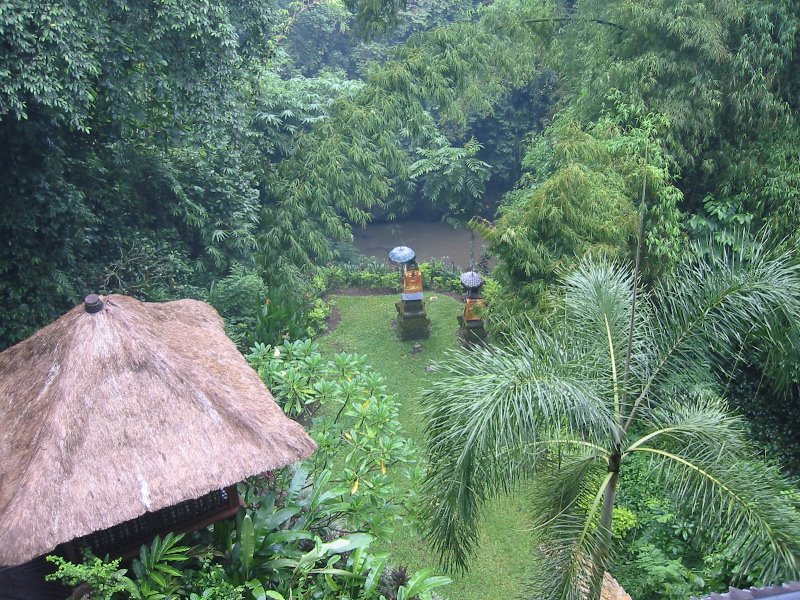
Most of the great villas are on or near the beach. Most tourists go to Bali for the beaches. But there are places in the mountains and up near Ubud, the kind of cultural center of the island. Ours overlooked the mighty Ayung River (the photo above was taken from my bedroom terrace) and we never saw another foreigner anywhere nearby for the 3 weeks we were there. We never did find the "village" on a map and it had an impossible, unpronounceable name. It's between Denpasar and Ubud. That link gives all the details, amenities, prices, etc. I'll get into the reasons why I think Bali is the best overall place I ever visited in the next couple of blogs.