Search This Blog

Showing posts sorted by date for query tangier. Sort by relevance Show all posts

Tuesday, January 15, 2013

New York Times: The 46 Places To Go In 2013


I don't want to ruin it for anyone, but #46 is... Paris. Like after you've been to Burma's Mergui Islands, Republic of Congo, Ningxia (China’s answer to Bordeaux), Houston, Delhi, and Pecs (Hungary). And Marseille-- which comes in as the #2 destination of the year! "Whether you travel to eat or shop, surf or ski, new adventures await," this week's Travel Section promised. OK, but if you're looking for any good ideas about where to go... well, I should be fair. There are some. But you have to be discerning enough to remember that they're recommending Paris because "it has a new allure: a green and walkable Right Bank."
Where once there was just a busy road, there are now alder trees, native Seine grasses and wide walking and cycle paths, all due to a 35-million-euro beautification project led by Mayor Bertrand Delanoë. Wooden furniture to stretch out in has been installed along the banks, where visitors can relax while taking in the view of Notre Dame Cathedral, and five adjoining islands in the river are being turned into “floating gardens.” Across the river, ambitious steps are being taken to transform a nearly 1.5-mile stretch of the Left Bank free of cars by this spring, with 11 acres of new green space between the Musée d’Orsay and Pont de l’Alma.
The recommendation right before Paris, Casablanca, is the Moroccan destination of choice. Not mine, though. I've been to Morocco over a dozen times and to Casablanca several but... Fez, Marrakech, Essaouira, Taroudant, even Tangier all go before Casa, even if it has lovely architecture, North Africa's tallest towers and is "developing one of the most interesting modern art scenes in the Arab world." To be honest, the reason I do like going to Casablanca-- usually to catch a flight somewhere else-- is because it boasts one of the most spectacular seafood restaurants in the world, Le Port de Pêche, a hidden gem most people who get their travel advice from the New York Times would probably miss ("scary" location on the docks). But-- with a discussion of the relative merits of the art, architecture and cuisine saved for another day-- I think most tourists would get a bigger kick out of Taroudant than Casablanca.

And the Times' #1 destination for the year? Rio. OK, I want to go there too. But I don't know if my reasons are related to the Times'. South America's first Apple store? Gimme a break!
Fifty-three years after Brazil’s federal government decamped to Brasília, and decades after São Paulo took over as the country’s business capital, Rio is staging a comeback. With the 2014 World Cup and 2016 Summer Olympics (plus an oil boom) providing the impetus, the tropical city perhaps most famous for its Carnival hedonism is on its way to becoming a more sophisticated cultural hub. In January, the Cidade das Artes, or City of the Arts, was inaugurated as the new home of the Brazilian Symphony Orchestra. On March 23, Casa Daros-- an outpost of the Zurich-based Daros Latinamerica Collection-- will open in a renovated 19th-century building with an exhibition of Colombian artists. March will also mark the opening of the Rio Museum of Art in Praça Mauá, a once decrepit port area now being revived. (The Santiago Calatrava-designed Museum of Tomorrow, also in the port area, is scheduled to follow in 2014.) Shopping, a Rio obsession, got a boost in December when the luxe VillageMall opened; it will soon house the city’s first Gucci outlet and South America’s first Apple Store. Special events also dot the coming year’s calendar, including the Catholic Church’s World Youth Day in July, the biennial Rio Book Fair starting in late August, and September’s Rock in Rio. And, of course, there’s soccer: the finals of the Confederations Cup, considered a dress rehearsal for the World Cup, will be held in a completely overhauled Maracanã Stadium on June 30.
Some of the more worthwhile suggestions include Accra (Ghana), Mongolia, Bhutan, Amsterdam (yes, the Stedelijk and the Rijksmuseum are finally reopening), the Yucatán, Porto, Istanbul and Koh Phangan (where a German tourist was partially devoured by a shark last time I was there. They also recommend Kalpitiya, Sri Lanka, not one of the incredibly beautiful island's best destinations by any stretch of the imagination, and the Falklands, although why someone would go there rather than Tierra del Fuego is as hard to fathom as what rhyme or reason went into the list of 46 to begin with.

Monday, December 10, 2012

Cadillac Commercial Through Morocco's Atlas Mountains At The Dadès Gorges


I started visiting Morocco in 1969 and I've been there over a dozen times since. At some point it can't just be about laying around Marrakesh, Essaouira, Tangier and Fes. So some years ago I set out across the Atlas Mountains south of Marrakesh and discovered Taroudant, which is kind of what Marrakesh was like in the 1960s before it became so cosmopolitan. I loved it and kept going back. From there we'd set out for Tiznit and even Sidi Ifni further south and east and then, eventually for Ouarzazate, Zagora south and west and even Mhamid right at the edge of the Sahara, the last stop before the 2 month camel ride to Timbuktu.

I just saw the Cadillac ad above with the driver going through the Atlas Mountains at the Dadès Gorges. We did hire a camel driver and his son to take us out into the Sahara Desert... but not as far as Timbuktu, which we did eventually get to-- in a jeep. As for the curving passes of the High Atlas... oh yes; we did that, several times in fact. But once was a time I'll never forget. We weren't going nearly as fast as the Cadillac in the ad-- nor did we have nearly as good a vehicle-- but we were descending pretty briskly when... no more pavement. The asphalt suddenly gave way to gravel.

You know what happens when the asphalt suddenly gives way to gravel? It had never crossed my mind 'til then either. But we spun right out of control and headed for one of those drops you can see in the Cadillac ad. In fact, the bottom of that gorge is filled with cars and trucks that did go over during the years. I'd like to say it was my reflexes and skillful driving that saved us-- and it may have been; who remembers anything but the sheer terror? But I think it was just luck. The car came to a stop an inch from the deadly drop. Within seconds a dozen old Berber men appeared out of nowhere and were swarming all over us, as though they came out of the sides of the rocky crevices. Each one wanted to touch my heart. For luck I guess.

Nothing much in M'Hamid but flies, sand and camels

Saturday, May 26, 2012

Can Music Change The World... In Morocco?


It's very rare that I meet a Moroccan who has traveled more extensively through his country than I have. I started going there in 1969-- drove a van from Germany and went all over the country, from the northeastern kif-growing regions of the Rif down to Marrakech and Essaouira. After a dozen trips, I've long since lost count. But I've expanded my horizons and have traveled way south of Marrakech, from Tiznit and Sidi Ifni in the West to Ouarzazate, Zagora and M'Hamid on the edge of the Sahara sand dunes. And, yeah, we even headed out across the Sahara towards Timbuktu by camel... although we didn't get very far and eventually got to now-inaccessible, rebel-held Timbuktu a few years ago by jeep... from Bamako.

Anyway, I've been almost everywhere in the country and I really love it-- and always recommend it. And Morocco has always been especially alluring for bohemians, rebels, and misfits, including, of course, musicians. The first time I was in Essaouira it was with Jimi Hendrix. Many years later I was relaxing in the courtyard of an old friend in Tangier-- someone who had first introduced me to Gnaouia music-- when I realized that the courtyard was pictured in the Steel Wheels album. That's because they recorded part of it in 1989 right where I was sitting. But this weekend the Washington Post ran a story about musical trouble in the magic kingdom. With the Tuaregs in control of the Malian Sahara now, kidnapping tourists and enslaving anyone they can get their hands on, Morocco's music festivals aren't going to have any more competition from the Festival au Désert. But that doesn't mean it's all smooth sailing.
Morocco’s glittering Mawazine international music festival wraps up this weekend with performances by Mariah Carey and Lenny Kravitz, after nine days of showcasing the North African kingdom’s cool factor-- even as dissident Moroccan musicians are imprisoned for their anti-establishment lyrics.

The 11-year-old “Rhythms of the World” festival in the capital Rabat has always highlighted Morocco’s contradictions as the country spends millions to lure top world artists to perform at generally free concerts, while much the country remains mired in poverty.

In past years the festival has been attacked by Islamists for inviting gay performer Elton John in 2010 and by activists for the cost of attracting Shakira and other high profile acts in 2011, but this year the theme of protest is freedom of expression.

Just a week before the festival began, Human Rights Watch slammed Morocco for sentencing a rapper to a year in prison for lyrics deemed insulting to police-- a common theme in rap music elsewhere in the world.

“Morocco hosts one famous international music festival after another each spring, but meanwhile it imprisons one of its own singers solely because of lyrics and images that displease the authorities,” Sarah Leah Whitson, Mideast director of the group said in a statement. “Morocco should be known as a haven for world music, not for locking up singers with a political message.”

Moroccan rapper Mouad Belghouat, known as El-Haqed, or “The Enraged” was convicted on May 11 of “showing contempt” to public servants with his song “Dogs of the State” about police corruption. He is known for his political activism and vitriolic songs attacking social injustice, the monarchy and corruption.

A week later, dissident poet Youssef Belkhdim was convicted of attacking police-- a charge he denies-- at a sit-in he organized in support of Belghouat and sentenced to two years in prison.

The two men belonged to Morocco’s pro-democracy February 20 movement that last year brought tens of thousands into the streets protesting corruption and calling for political reform.

The extravagant sums spent on the Mawazine have been a mainstay of the movement’s slogans. Festival organizers maintain that the Mawazine’s estimated $7 million price tag is worth it because it improves Morocco’s image abroad and gives people at home access to music from around the world. The festival is funded largely by corporate sponsors with strong ties to the state.

“It’s a celebration. It’s a celebration of the city, a celebration of Morocco and it reflects a bit Morocco’s good life to the world,” said program director Mahmoud Lemseffer. “It is a vehicle to present the image of our country, of its hospitality and tolerance.”

Tens of thousands attend each of the festival’s eight venues which present Arabic music, Moroccan music, music from sub-Saharan Africa as well as international acts, which this year included Evanescence, the Scorpions, Gloria Gaynor, Nigel Kennedy and Jimmy Cliff.

Most of the acts have free sections open to the public and on Tuesday, families strolling along Rabat’s Bouregreg river stopped to listen to Beninian songstress Angelique Kidjo belt out classics from South African diva Mariam Makebe and talk about the struggle against apartheid.

But for critics, there is irony in punishing artists at home while hosting international ones known for their support of freedom of expression. Lenny Kravitz, for instance, has striven in song after song to confront America’s tortured attitude about race.

“I think that people should really say what they feel-- everybody has the right to speak their mind, you see how things change in places where people were once condemned,” said Kravitz at a press conference Thursday when asked about politics in music. “When I was in Brazil a couple of years ago, I was talking with (musician and activist) Caetano Veloso who dealt with that same thing, who did jail time-- and now he has made a difference.”

Salif Traore of the Ivorian band Magic System said that for African artists, speaking truth to power and freedom of expression is what their music is all about.

“We in Africa, we say that artists, musicians and singers are the eyes, ears, and mouths of the people,” he told The Associated Press, when asked about his views on the El-Haqed case.

Rachid el-Belghiti, who heads a national anti-Mawazine campaign, also contests the government’s assertion that it’s supporting culture in Morocco with this festival, countering that it’s really just about making the country look good abroad.

He said the Mawazine, which is run by a close confidant of King Mohammed VI, eats up the lion’s share of corporate sponsorship so that little is left for other festivals around the country.

As millions are being spent to lure in big name acts, local theaters and dance schools around the country are closing down because of a lack of funding.

“A country which puts its artists in prison simply for expressing themselves with their voice or their instruments cannot pretend to support culture,” he said. “That’s impossible.”

And, by the way, the Rabat music festival is totally commercial and strictly for squares and the one-percent. The hipster festivals are the Gnaoua World Music Festival in Essaouira and the newer Festival des Musiques Sacrées du Monde in Fez. When the king is finally overthrown, the last bastion before he flees to one of his European estates will be Rabat.

Saturday, November 27, 2010

Is It Dangerous To Use Drugs In Morocco?


The first time I visited Morocco, in 1969, it was my first trip to the Third World... or anyplace really exotic. It made me realize that Europe was not all that different from America, at least by comparison. I fell in love with the country, the food, the sights, the sounds, the smells, the way of life. And I stopped counting the number of times I've been back once I hit the dozen mark.

That first time I went, I had a bit on an ulterior motive: drugs. I wanted to buy a kilo of cheap kif (their version of hash) in the Rif Mountains around Ketama, smuggle the stuff back to London where I could pack it up well and send it to America, where an accomplice could sell it and help me finance a trip I was about to take to India. That worked out fine-- not just because the deal was smooth all around but also because Ketama and the Rif were pretty different from the rest of Morocco and really interesting. But I've never been back in the 40 years since. I'm more attracted to the urban experiences in Fez, Marrakech, Tangier, even Taroundant and Essaouira. And I don't use drugs any longer; my drug karma is all over now. Inshallah!

Kif is widely available in Morocco-- and one of the country's biggest sources of income-- and sometimes it seems that everyone is smoking it. But it's illegal, if, more or less, tolerated. Although less so than even a decade ago, it's hard to take a walk around without someone offering you some kif. And there are cafes in most places I've been where Moroccans are sitting around smoking kif in hookahs while sipping sugar with some mint tea in it. But if a tourist flaunts it-- like by smoking a joint while walking around a city-- it could be real trouble. The police don't come looking for tourists to bust but they do react when you wave it in their faces. (It's like homosexuality. It's illegal but no one is trying to bust any tourists for it.) However, if you do wind up being arrested, the best thing is to pay a bribe (baksheesh) fine on the spot. Otherwise, you could wind up in jail for ten years.

People ask me all the time if Morocco is a safe place to visit. I certainly think it is-- and I've written about the subject-- but when it comes to drugs, is any place "safe?" Today an American icon, 77 year old country singer Willie Nelson, was arrested in his home state, Texas, because officers at a police check point smelled pot, searched his tour bus and found 6 ounces.
"It's kind of surprising, but I mean we treat him like anybody else," [Sheriff Arvin] West said.

"He could get 180 days in county jail, which if he does, I'm going to make him cook and clean," West said.

"He can wear the stripy uniforms just like the other ones do."

Probably less likely to happen in Morocco-- a far more interesting place to visit in any case. And is this stoner music, or what?

Saturday, September 11, 2010

Tangier, Morocco, Rolling Stones... Paul Bowles


There are many timeless qualities about Morocco, timeless and charming, but it's a very different place now than it was the first time I went in the summer of 1969. Right now I'm putting the finishing touches on a trip there-- there have been a dozen since the first one-- and this time it'll basically just be to rent a house in Marrakesh's old city for a month... take some day trips to Essaouira, west on the sea and down over the High Atlas to Taroundant, two of my favorite smaller cities in Morocco. We're flying directly into Marrakech from London, something I don't think was possible in the '60s. I recall always either driving there or taking public transportation from either Casablanca, where Mococco's big international airport is, or from Fes.

The first time I went, though, it was in my VW van and we took a ferry from Algeciras in the south of Spain, a wonderful way to arrive in Morocco for the first time and gradually feel everything change-- the sights, sounds, smells-- between Europe and Africa. I had an idea that Tangier was like the Times Square of Morocco, a place to be avoided until you were hip to the hustles of the country. We took the boat across from Algeciras to Ceuta, still part of Spain, and then drove to Tétouan and the southeast to Rabat, missing Tangier entirely. After spending all of July traveling around Morocco we felt savvy enough to exit via Tangier. It wasn't for years until I really started liking the city and only then because I had a friend who lived there and who was able to introduce me to its secrets.

This weekend, the NY Times has a travel guide to getting lost in Tangier, Tangier in the high summer, in fact, something I've long learned to avoid. I love the "getting lost in" concept though.
Tangier seemed a good starting point. Not only does it have a magnificent medina that holds out the promise of geographical bafflement, but it is itself also lost in time and space. Since antiquity, Tangier-- at the mouth of the Mediterranean, roughly nine miles from Spain-- has been a gray zone between Africa and Europe, never quite belonging fully to one or the other, though controlled, for greater or lesser spells, by Carthaginian, Roman, British, Spanish, Portuguese, French and Arab forces.

Today, Tangier is known in America thanks in no small part to Paul Bowles, the novelist and composer who settled there in 1947, and the Beat Generation who followed him in search of cheap, exotic living (and, as William S. Burroughs said, “for the boys and the hashish”). For a few decades, Tangier was a playground for the wealthy and the literary-minded, but by the 1980s it was crumbling and dismal. When I told a friend who had visited in 1998 that I would be there more than a week, he was appalled.

Although the first time I went to Morocco I was hanging out with Jimi Hendrix, down south in Essaouira, the Rolling Stones-- and especially Brian Jones-- went there earlier than I did and got me interested in the place. Ironically it was at my friend Absalam's house in Tangier that the Stones recorded part of Steel Wheels in 1989. Good documentary from a Stones' trips to Morocco:


Tip: if you decide to go, reading Paul Bowles' The Sheltering Sky is more important than any guide book

Sunday, June 27, 2010

Travel Safety-- WE ARE Passengers Not Prisoners


I want to share a little website with you than my old friend Ian put together, Passengers Not Prisoners. I think any traveler will relate to it. Ian's an anger-management and conflict resolution counselor and lecturer. He's way into violence prevention and is always on the road speaking at shelters, schools, hospitals, clinics, and drug-treatment programs. (He's also a record producer and concert promoter.) This is the intro he wrote for Passengers Not Prisoners:

“(Don’t) stay in your place.”

Freely exercise the right to travel, and more fully know your world and that it is almost invariably a safe place. The vast majority of the people on the planet are not benevolent, they are simply indifferent to you.

The world is not becoming more dangerous, it is becoming safer. A person was six times more likely to be murdered in the Middle Ages than today. It is just that today, through the mass-media, we hear about more instances which leads to a distorted sense of jeopardy.

People invariably only attack one category of victims: those that they feel deserve it. Out of the over 6-billion people alive today, they have better people to harm than you so the key is to not give them a reason to do it. (Even among those incarcerated for violent crimes, in study after study it has consistently been found that less than 6 percent of them can be clinically classified as sadistic.)

Aggression is communication, arguably the first act of communication. All individuals, no matter how wrong they may be, at the moment of action believe that they are right. Counter-attacking only leads to an intensification of conflict and a greater sense of isolation and opposition. Empathy (emotional understanding of others) and education are the most potent antidotes to softening adversarialism.


I've been traveling since I was 16 years old, when I tried to hitch hike to Miami Beach from Brooklyn to spend Pessach with my grandparents. Two years later I succeeded in hitching to Los Angeles, where I stowed away on a ship headed for-- in a roundabout way-- Tonga. I still haven't gotten to Tonga... but I'm workin' on it. Meanwhile, all of what Ian is talking about is the kind of stuff I've experienced first hand-- walking around in "wild" places, from Timbuktu and Cairo, East Jerusalem, Tangier, Kandahar, Katmandu, Tehran, East Berlin (back in the day), Mexico City, the slums of Bombay, Calcutta, Istanbul... and, yes, it all seemed mighty safe.

On the other hand, sometimes it seems like the ruling elites are discouraging travel and drumming up divisiveness across the world. Ian addresses it as Homeland Insecurity:

A fundamental confusion seems to have occurred. The government and the entire transportation industry exists because of us. They work for us (the citizens), we do not work for them. The harassment and systematic subjugation of innocent and law-abiding individuals must stop.

Positive change almost always fails because of the inability of a system to admit its own failure, instead amplifying the intensity of what it is already doing rather than truly changing course, and, thus, compounding the original error.

Raise the bar higher and the competition inevitably rises as well. Feeling secure does not equal true security. Some risk will always exist. We will never have (…and never have had) total world peace. All that we can strive for is ever-increasing relative peace. 80 percent of the resources should not be spent attempting to control the ultra-exceptional (i.e., far less than 1 percent of instances) that by their very unique and extreme nature are unpreventable.

Clearly, the next terrorist attack will come from within the system designed to prevent it. As the system grows larger and the number of employees goes up, so does the exposure, as well as standards and ability to supervise going down.


UPDATE: Airline Food-- Worse Than You Thought

It's kind of been a truism of air travel for decades that the food isn't too good-- although in international first class it kind of is. But do the roaches and bacteria know first class from steerage? FDA inspectors found a host of health violations in recent inspections of the 3 major airline catering facilities (serving Delta, American, United, US Airways and Continental). The conditions for the food prep were rated "unsanitary and unsafe."
The FDA reports say many facilities store food at improper temperatures, use unclean equipment and employ workers who practice poor hygiene. At some, there were cockroaches, flies, mice and other signs of inadequate pest control.

Sunday, May 09, 2010

Planning A Trip To Morocco


Yesterday I booked my flights from L.A. to Marrakesh. Roland said it'll be his 5th trip there. It'll be my 14th! The first time I went I drove. Not from L.A.-- from Germany, where, in 1969, I had purchased a VW camper van, which became my home for several years, and drove around Europe, wound up in Spain, and then took a ferry, with the van, from Algeciras to Ceuta. (Algeciras is at the bottom of Spain and you can get a ferry to Ceuta, a lonely Spanish colony they haven't given back yet, or directly to Tangier, which is what I've always done since that first trip. Except when I take a plane-- which is what I'm doing this time. No carefree two-three months to drive around Iberia and Morocco this time-- just 3 week conventional holiday in Morocco. And in the old days, you had to more or less fly to Casablanca and then get to Marrakesh or Essaouira from there.

Now it's almost convenient to just fly directly to Marrakesh. I say "almost" because it's still a small regional airport and not many international flights-- other than charters-- go in and out. I found one on a subsidiary of Royal Air Moroc, Atlas Blue, which I had never heard of. But it flies from Heathrow to Marrakesh. The only thing I'll miss about Casablanca is Le Port de Pêche, one of my favorite seafood restaurants anywhere, a consolation for anyone who is forced to travel to an otherwise must-to-avoid (more or less) Casablanca.

Anyway, today's New York Times Travel Section is all about Morocco. The raison d'etre for all that space is a music oriented piece on Essaouira, the wonderful seaport on the Atlantic Ocean I discovered after Marrakech back when I first started coming to Morocco. I knew Jimi Hendrix a little from New York and he was there too, taking a rest before going to play at the Isle of Wight Festival (where I was headed as well). Essaouira was a lot sleeper then than it is now. And now-- every June-- a guy I met years and years ago hosts a big (5 day long) music festival. It highlights gnaoua music which is a mixture of African and Arab musical traditions.

Unlike festivals staged, à la Woodstock, in muddy, middle-of-nowhere pastures, or worse, in vast, overheated football stadiums, the Gnawa’s setting, in a small, friendly and almost impossibly picturesque, wind-cooled seaside city, is as magical and mesmerizing as the music.

Roland's pissed off because the article on Eassouira doesn't mention any of the really great seafood restaurants that make the city one of the culinary capitals of the country. I'm delighted; the fewer tourists who have those places on their agendas, the more room for us when we're back the in a couple months. I'll do a more comprehensive guide to Essouira restaurants when we're there, meanwhile, suffice it to remember that it's the home of nutty, delicious argan oil.

Sunday, May 31, 2009

Preparing For Danger In Foreign Travel-- Is There Anything To Worry About In Bali?


Most of the e-mails I get about this blog ask me how safe it is to travel to Morocco or Mexico or India or Mali... even Buenos Aires. It's safe, it's safe... almost every place is safe-- if you take the same kinds of common sense precautions you would take as a matter of course everywhere you go outside of the gated community.

Today NY Times writer Nicholas Kristof did a column on evading bandits in foreign countries. I've encountered my share of them too-- machine gun toting militia in Afghanistan in 1969, dacoits in Kerala in 1970, hippie-hating Texas Rangers near Waco in 1967, small time hoodlums, more annoying than dangerous, in Tangier, Fez and Marrakech almost every time I've been to Morocco, a crooked landlady in Buenos Aires in 2006... Luckily I missed the domestic terrorism incident outside a church in Wichita, Kansas today (inspired by Republican Party propagandist Bill O'Reilly on his Fox TV terrorism show).

Kristof has 15 tips "for traveling to even the roughest of countries-- and back:"
1. Carry a “decoy wallet,” so that if you are robbed by bandits with large guns, you have something to hand over. I keep $40 in my decoy wallet, along with an old library card and frequent-flier card. (But don’t begrudge the wallet: when my travel buddy was pickpocketed in Peru, we tried to jump the pickpocket, who turned out to be backed by an entire gang ... )

2. Carry cash and your passport where no robber will find it. Assuming that few bandits read this column, I’ll disclose that I carry mine in a pouch that loops onto my belt and tucks under my trousers.

3. Carry a tiny ski lock with a six-foot retractable wire. Use it to lock your backpack to a hotel bed when you’re out, or to the rack of a train car.

4. At night, set a chair against your hotel door so that it will tip over and crash if someone slips in at 4 a.m. And lift the sheet to look for bloodstains on the mattress-- meaning bed bugs.

5. When it gets dark, always carry a headlamp in your pocket. I learned that from a friend whose hotel in Damascus lost power. He lacked a light but was able to feel his way up the stairs in the dark, find his room and walk in. A couple of final gropes, and he discovered it wasn’t his room after all. Unfortunately, it was occupied.

6. If you’re a woman held up in an isolated area, stick out your stomach, pat it and signal that you’re pregnant. You might also invest in a cheap wedding band, for imaginary husbands deflect unwanted suitors.

7. Be wary of accepting drinks from anyone. Robbers sometimes use a date rape drug to knock out their victims-- in bars, in trains, in homes. If presented with pre-poured drinks, switch them with your host, cheerfully explaining: “This is an American good luck ritual!”

8. Buy a secondhand local cell phone for $20, outfit it with a local SIM card and keep it in your pocket.

9. When you arrive in a new city, don’t take an airport taxi unless you know it is safe. If you do take a cab, choose a scrawny driver and lock ALL the doors-- thieves may pull open the doors at a red light and run off with a bag.

10. Don’t wear a nice watch, for that suggests a fat wallet and also makes a target. I learned that lesson on my first trip to the Philippines: a robber with a machete had just encountered a Japanese businessman with a Rolex-- who now, alas, has only one hand.

11. Look out for fake cops or crooked ones. If a policeman tries to arrest you, demand to see some ID and use your cell phone to contact a friend.

12. If you are held up by bandits with large guns, shake hands respectfully with each of your persecutors. It’s very important to be polite to people who might kill you. Surprisingly often, child soldiers and other bandits will reciprocate your fake friendliness and settle for some cash rather than everything you possess. I’ve even had thugs warmly exchange addresses with me, after robbing me.

13. Remember that the scariest people aren’t warlords, but drivers. In buses I sometimes use my pack as an airbag; after one crash I was the only passenger not hospitalized.

14. If terrorists finger you, break out singing “O Canada”!

15. Finally, don’t be so cautious that you miss the magic of escaping your comfort zone and mingling with local people and staying in their homes. The risks are minimal compared with the wonders of spending time in a small village. So take a gap year, or volunteer in a village or a slum. And even if everything goes wrong and you are robbed and catch malaria, shrug it off-- those are precisely the kinds of authentic interactions with local cultures that, in retrospect, enrich a journey and life itself.

I'm not vouching for any of that, although in my preparations for a rapidly approaching trip to Bali and Thailand, I did dust off my "decoy wallet." Most of my preparations for Bali, though, are even more mundane. The best time to visit: dry season is between April and September, although last time I was there, it was November and December and it may have been more muggy than it is in June and July but I recall it being pretty uniformly gorgeous every day. I know I swam every day too.

I would have rented the same house I rented last time but it isn't available this year. So I asked a friend of mine who lives there to find me something similar-- away from the tourist hellholes on the south coast, up near Ubud closer to the center of the island. He came up with the Villa Di Abing. I made sure the cook can work with vegans and raw foodists-- the house actually has a dehydrator and a VitaMix!-- and then I booked my ticket, bought some sun block and we're ready for our trip. (The villa has a security guard.)

Saturday, August 04, 2007

ME AND MATT DAMON IN TANGIER


When I first drove down to Morocco from Spain in 1969 I had heard enough about Tangier to think I should avoid it. We took the ferry from Algeciras to Ceuta (a cheaper alternative than Algeciras-Tangier). Ceuta is technically part of Europe-- the last Spanish enclave in Morocco, just a couple hours drive northeast of Tangier. We headed for Tetouan instead, avoiding Tangier entirely. At least for a while. We drove all through Morocco, loving it-- I've been back a dozen times since-- and then decided we were old Moroccan hands enough to brave the weirdness of Tangier. I must have picked up my preconception about Tangier from meditations on Paul Bowles' most brilliant novel The Sheltering Sky-- although they were strictly my own meditations, Bowles having loved Tangier so much that he decided to live there... forever. It didn't take me long to start liking it either.

Yesterday I went to see The Bourne Ultimatum, which takes place in Moscow, London, Madrid, New York and... Tangier. I've never been to Moscow but the movie didn't evoke anything special for me geographically in the other cities-- except Tangier. The scenes-- shot on location, of course-- were beautiful, action-packed, exciting and realistic real and I recognized almost every spot they shot.

The last time I was in Tangier, December, 2005, I was already thinking about starting a blog and I took some notes and pictures and wrote it up. These days I wouldn't think about leaving Tangier out of a Moroccan itinerary. It's a sophisticated, exotic and unique city, very different from any other place in the country. The energy is powerfully kinetic-- young and vibrant and bursting at the seams. It's pretty cosmopolitan and very much it's own thing.

Here's some footage of two chase scenes shot in Tangier.

Saturday, April 07, 2007

GET TO FES BEFORE THEY OPEN A MCDONALD'S-- THE NY TIMES JUST FEATURED IT


The first time I went to Morocco, the 60s, it was all about the Marrakech Express. And once you got there, there were the gentle charms of Essaouira, not all that far down the road. On that first trip, before the Jamaa el-Fna was a parking lot during the day, Morocco and Marrakech were synonymous to me. I had driven my VW van down from Spain, taking a ferry to Ceuta and studiously avoiding what I thought would be Tijuana-like Tangier (a city I came to love in later years). We spent most of our time in Marrakech and Essaouira, slept in the van every night. But we also managed to visit many of the country's other main towns on that trip. I had a terrible case of dysentery when we got to Fes and I remember spending all my time in a camp ground outside of town.

I've been back to Morocco eleven times since then. And Fes has long since replaced Marrakech as my favorite city, although Fes has gotten a lot tamer and less dangerous feeling lately and Marrakech seems to have gotten cooler again, more like the way it was in the 60s. Fes, though, will always be exotic, basically because Fes is a functioning medieval city with streets too narrow and with too many steps for motor vehicles. Sunday's New York Times features it and calls it The Soul of Morocco. The title fits although you could ask almost any Morocco-hand and they'll think that title refers to Marrakech. The Times relied on a Fassi partisan, "a craftsman and cultural entrepreneur," Abdelfettah Seffar, to give them the lay of the land:
“Fez is really just the medieval city that it was,” Mr. Seffar went on, contrasting his hometown with its fast-developing jet-set sister and rival, Marrakech. “We are a little scared of what Marrakesh has become. Fez is the soul of Morocco. It’s the last bastion of what Morocco really is.”

Faded but stately, crumbling but proud, the walled city of Fez might well be the largest and most enduring medieval Islamic settlement in the world. It is indisputably Morocco’s spiritual and cultural heart.

You need only watch the daily procession of candle-toting mourners entering the tomb of the city’s founder, Moulay Idriss II — believed to be a great-great grandson of the prophet Mohammed — to feel the city’s connection to its past. A glance at the ninth-century Karaouine University, widely considered the world’s oldest operating institution of higher learning, reaffirms the impression.

As Marrakesh has opened to Tropezian swimming-pool clubs and branches of Ibiza night spots, Fez has turned ever deeper to its history, renovating architectural masterpieces and creating new festivals devoted to the city’s rich culinary and musical traditions.

Saturday, January 06, 2007

WHAT'S BETTER-- RENTING YOUR OWN PLACE OR STAYING IN A HOTEL?


I think the first time I figured out that, generally speaking, renting a place was better than staying in a hotel was 1970. I rented a house for a couple of months on the beach in Goa. Once I figured out the function of the herd of pigs on the property, everything was smooth as silk and I settled in for a nice leisurely stay in my very first post-college home-of-my-own. It took me about 3 days to convince myself that I was actually a Goan and start, relatively speaking, integrating myself into the pulse of the community. I don't recall ever seeing a hotel in Goa although I'd hear from the hippies and other travelers who came to our beach-- the one that was 30 steps from my front door-- that there were hotels.

When you're staying in a place for less than a month, renting a place is tough. After my 10th trip to Thailand I finally figured out that a secluded villa on Phuket was way more what I was looking for than a berth at even the nicest of hotels. I don't think I ever put on any clothes for weeks at a time. And then a couple years ago I rented a villa overlooking the Ayung River in central Bali. Except to go pick up a friend who was staying at the Ritz, I never even visited the tourist ghetto on the island and, as far as I could tell from my vantage over the Ayung, I was indeed the only non-Balinese on the entire island.

These days, whenever I can, I always rent an apartment or a house rather than stay in a hotel. So, when planning my trip to Argentina a few months ago I was delighted when Lieber, an Argentine waiter at my favorite raw foods restaurant, told me that renting apartments was a very normal thing to do in Buenos Aires for anyone staying at least a week. Perfect! I found what looked like a reputable rental agency that specializes in dealing with foreigners and quickly found an apartment in the part of town (Recoleta) everybody was telling me was the safest and best located.

The apartment was perfect, right on Posadas, across the street from the Four Seasons Hotel-- a light, airy, well-kept one bedroom, with a living room, dining area and kitchenette, fully supplied with everything from sheets and silverware to a free phone for local calls, Wi-FI, a doorman and daily maid service. And the price? Prices vary based on location, size, all that stuff, but generally it costs for a week what you would pay for a night in a comparable hotel.

The agency I used was BytArgentina and I couldn't find anything online about them being unscrupulous or anything like that. My experience with the agents I used on Bali, BaliVillas, was superb and I just assumed-- uh oh-- that BytArgentina would be as good. They weren't-- and I mentioned what went wrong in a story I did a couple weeks ago about safety and scams in Buenos Aires.

In this case, the company (or perhaps the owner of the apartment, more likely), shrewdly not accepting credit cards, only cash, managed to separate me from $500. I had no recourse other than to suck it up. Something similar had happened to me in Tangier decades ago at the El Minzah Hotel (best in town), a $100 travelers check having been removed from the safe behind the reception desk! Left me with a bad taste in my mouth, but, after trying a couple of less grand hotels, I wound up back at the El Minzah a few times since. I know for sure I'd never rent an apartment through BytArgentina again (nor from Graciela Ujaque, the owner of the apartment). Would I rent an apartment in Buenos AIres again? 100% yes. Let me tell you why.

Aside from getting a sense of belonging to a culture that most hotel guests can never experience, there are some tangible reasons I like to get my own place. I don't eat junk food and I take breakfast seriously. Even in NYC, where I do stay in a hotel, I always get one with a kitchenette. That way I can stock up on healthy goodies (fruits, nuts, etc) and on breakfast goods (blueberries, melons, papayas, lemons...) and have a place to store them and prepare them conveniently. It is virtually always much less expensive to rent your own place than to stay in a hotel. And it's far more personal.

Not everyone agrees, of course. One of my friends found my luxurious villa (with 4 servants-- including the best cook on the island of Bali-- and a swimming pool) akin to camping out. She was eager to move to the more... sterile environment of the Ritz. (I talked about that syndrome a little when I discussed the Park Hyatt in Buenos Aires a few weeks ago.) Some people, maybe most, would prefer to be pampered and to have everything done for them, something more likely in a hotel. Me, I like going to the local markets and shopping for day to day stuff. You start to feel the rhythm of the town's life. Last time I stayed in Marrakesh, I gave up on the Mamounia and stayed in a riad instead, sort of halfway between a hotel and an apartment; well, not halfway, but we definitely had the feeling of being part of the neighborhood.

Wednesday, January 18, 2006

OMG! HOW DID I FORGET SEVILLA!! (I DIDN'T)


Seville has been one of my favorite places in Spain since I started visiting that country in the late 60s. Except for the times that I was strictly on business in Madrid or on a short vacation in Barcelona or Ibiza (while I was living in Holland), I always went out of my way to include Sevilla in my itinerary. The capital of Andalusia has a unique and beautiful ambiance that very clearly marks it as special and alluring. In December we took a train to warm and sunny Sevilla (and Cordoba) on the way from chilly Madrid to Morocco. The express from Cordoba takes 45 minutes.

I had decided to make the big hotel splurge for this trip Sevilla's Alfonso XIII, a hotel that was built specifically (in 1928) to be the grandest and most luxurious hotel in Europe. Nearly 80 years later and it still is truly awesome.
Sometimes it seems as though all the grandest sights of Sevilla were placed around the hotel-- from the beautiful Guadalquivir River to the Cathedral (the world's biggest gothic structure and the 3rd largest church in Europe) to the breathtaking 14th century Alcazar, Europe's oldest royal residence still in use. The rack rates are prohibitive (starting at around $500 for a double) but the Alfonso is a Westin Hotel and my old corporate travel agent was able to work wonders with a great discount and a spectacular upgrade. Everything about the hotel bespeaks value for your money, something I like. I mean it went beyond the most beautifully and luxuriously appointed rooms of the whole trip; the Alfonso even has the best, most professional, knowledgeable and empathetic concierge we ran into on the trip.

Everywhere you look within walking distance from the Alfonso is just spectacular. We ate up the tourist sites like the Cathedral and especially the Alcazar and loved walking around the Barrio de Santa Cruz (the old Jewish ghetto that is now a charming, vibrant functioning medieval town within the city). If you want the best in Seville, there is no other choice besides the Alfonso. Restaurant-wise, on the other hand, you have a lot of great choices-- chefs that are serious about catering to regular clients, not thinking about how to feed transients. On a couple of past trips I had tried the Egana Oriza, probably Sevilla's best eatery, and loved it but this time we decided to decided to give a less well-known place a shot. The Poncio (Calle Victoria 8 in the Triana District) is on the other side of the river and a bit of a trek by foot-- but that's partly why we chose it. Both of us love walking around cities and feeling the pulse of daily life.

The chef, Willy Moya, came to our table and we talked for a while about what we wanted in a general sense and he was able to recommend an incredible dinner for each of us. He's an inventive and brilliant chef and this was one of our best meals in Spain. Roland is still raving about some wild baked ice cream and olive oil concoction he scarfed down and was swearing he had just had the best wine in his life (although he tended to say that about every meal). I was pretty surprised that the cost was about half of what a meal like that is in a comparable Madrid restaurant.

The main bus stop is walking distance from the Alfonso and we took the bus to Algeciras to catch the ferry to Tangier. It was all easy to arrange and completely hassle-free.

Monday, January 16, 2006

ARGAN OIL IS DELICIOUS AND HEALTHY-- AND ONLY AVAILABLE IN SOUTHERN MOROCCO


Not all of my friends are big travel freaks like me and Roland. I remember when my sister came to visit me in Amsterdam when I was living there in the mid-70s. She was like 20-something and I think it was her first trip outside of the U.S. I can't swear to this but I think she stayed one night and hightailed it back to Brooklyn. Years later I can remember telling two old friends, Ken and Tony, the former now NYC's most celebrated restauranteur and the latter the son of a wildly successful author of paperback romance novels, how Thailand was the most incredible place I had ever been and regaling them with stories of all that incredible place has to offer. They seemed particularly interested in the charms of Patpong, Bangkok's once notorious red light district (which now has more in common with Disneyland than Hell), and soon were winging their way over the big, blue Pacific. Ken called me from The Oriental Hotel, traditionally considered the best hotel in Thailand and a perennial contender for Best Hotel in the World (a presumption that will be duly examined once I start writing about Thailand). "What kind of a joke is this?" he demanded. Was he pissed! They must have seen some doody in the street or something else that infuriated them, made them feel insecure and angry and caused them to return to the safety of lovely clean California the next day. The horrible fiasco strained our relationship.

Some people love foreign travel for the foreignness and exoticness and they actually love trying foreign foods. (Rumor is true that one will find McDonald's in places like Paris, Tokyo, Casablanca, Moscow and even in Tuscany, not to mention Oulu, Finland and at the U.S. concentration camp at Guantanamo in Cuba.) One of the joys of travel, for me at least-- maybe second only to meeting people and exchanging ideas, etc-- is eating food from other countries. Here in the U.S. we all certainly love the U.S. versions of Italian food, Chinese food, Mexican food and French cooking. Yummy, right? Believe me (please, please, please), it's even better when you eat it the way it was meant to be eaten. And that doesn't even begin to talk about the joys of Thailand's royal court cuisine or of the unique cuisine of southern India (with their iddlis, thorans, avials, poottu, olens... things you won't find in the typical American curry house), nor of the delicious cuisine of Morocco which is as sophisticated and unique as the ancient cooking styles of China.

I never get enough Moroccan food and our favorite Moroccan bloggers, Samir, El Glaoui and Zany cover the bases authoritatively and with panache at The View From Fez, an absolute must read for anyone who is planning a non-fasting trip to Morocco. But the very foreignness of strange cuisines, as appealing as they are for me, repel some people and keep them from travel. It astounds me.

A few weeks ago Roland and I were stumbling around the Tangier medina around 8 PM. We were taking a 6 hour train ride to Fes the next day and I wanted to get some bananas and pecans to take along as a snack. We found a likely little grocery with a great display of all kinds of nuts. No pecans though; the proprietor had never heard of them and I figured they just didn't have 'em in Morocco (until I later found loads of them in Marrakech). Anyway, one thing lead to another-- as it so often and so fortuitously does when you're open to it-- and pretty soon the proprietor was having us try and compare this kind of date and that kind of dates and these nuts and those nuts. It was a joy and eventually he pulls out a plain unmarked bottle and beckons us to smell and then taste the murky-looking oil within. The smell was phenomenal and the taste... almost life-changing. It was argan oil.

One of the undying memories everyone who drives north from Essaouira will always cherish will be his first glimpse of an argan tree. That's because every branch, heading up to the sky, will be loaded with... goats. I'm not kidding and I swear I didn't use photoshop on the picture above! To me the argan tree was always primarily about the incredible climbing tree goats first and the amazing wooden things made in Essaouira.

Last night Roland came over and he was watching some ballgame in the living room while I was writing about the deprecations of George Bush, Tom DeLay and other Republican crooked politicians on Down With Tyranny. As I finished I suddenly remembered I had something really wonderful in the kitchen that Roland didn't know about. "Close your eyes. I want you to smell something." He resisted for a minute and then, assured I didn't have a prank in mind, he inhaled, first tentatively and then greedily. He sprang out of his chair yelling "argan oil" and demanded a teaspoon of it.

It tastes scrumptiously nutty, especially the roasted stuff and it is really healthy, reducing LDLs (bad cholesterol) in the blood, and providing essential fatty acids and lots of omega-6 and vitamin E. Today I had a long talk with the manager of Erehwon who had never heard of it but promised to see if he could order some. The bottle I smuggled into the states won't last forever!

Friday, January 13, 2006

RIADS, THE NEW OLD THING IN MARRAKESH ACCOMMODATION


A riad is an urban house situated in the medina or kasbah. It isn't a random loosely defined lodging but one whose plans and arrangements are rigorously codified. Since Moroccan architecture is more inward looking and given to isolation and intimacy rather than showing off, a riad is a private, cloistered place of escape from the busy swirl outside its thick walls. A riad is organized around a central square courtyard, often decorated with zelige (traditional mosaic patterns) centering on a fountain and orange or lemon trees. 4 paths intersect in the middle. The central courtyard is usually surrounded by an arched colonnade giving access to the living rooms and kitchen. More sleeping areas are constructed on the upper floors, creating a covered arcade around the patio with balustrades running around each story. Traditionally roof top terraces use awnings to protect against the sun; great place for a meal.

Marrakesh is the riad capital of Morocco-- and they are more than giving the hotels a run for their money. A concierge in Tangier told me he was trying to book a room for a client who was going to Marrakesh the following week and there was not one room available anywhere in town! Europeans and forward-looking Moroccans have been buying up stately old homes, restoring them to their original splendor and turning them into riads. Their thick walls protect the inhabitants from the heat or the cold and most of the outside noise and hustle and bustle. More often than not, you find them along a derb (narrow alleyway) with no access by car.

This was my 10th visit to Marrakesh but the first in a riad. It so beats hotels I don't know where to begin. I guess the 2 things that impressed me most of all were how personal the service was and how integrated you feel in the rhythm of the media which you feel like a resident of. In the past I've stayed at the the Mamounia Hotel, easily the best hotel in the country, and always a contender for best hotel in the world. It was famous for being a home-away-from-home for European aristocrats and for Winston Churchill. The chilly, aloof, snooty service still seems to be expecting Churchill-- and we did see Mick Jagger's ex, Jerry Hall there on New Years Eve when we went over to see if the gardens were still as gorgeous and lush as we remembered them (they were)-- but... well, you're more likely to be hanging around a busload of Belgian housewives on holiday than anyone with a von or van in front on their name. The last time we stayed there Roland left some considerable amount of cash in the inside pocket of a suit jacket inside the wardrobe (never a good idea but I guess he felt safe in "the best hotel in the world"). We were at dinner for 90 minutes and when we got back, the cash was gone. It isn't like he left it on a bench at the bus station. I mean how many people had access? But the hotel management was aggressively unhelpful and when we called the police, the hotel became downright nasty. Beautiful rooms, beautiful gardens, rapidly accelerating rates and not a place I'd ever stay again. So... weren't we happy to find that riads had sprung up all over the medina and were reputed to be offering as wonderful an experience as the Mamounia!

There seem to be riads at many price ranges. I read about them online and found one that looked like it would be good for me, the Riyad el Cadi-- and did I ever come up with a TOTAL WINNER! Maybe there are better riads in Marrakech but I will probably never find out because I loved the el Cadi so much I'll always go back. Their website and this general riad site have good descriptions and details. But after the utterly impersonal service at the gorgeous (and formerly very personal) Palais Jamai in Fes, the wonderful total service/family atmosphere of the el Cadi was perfect. Anyone looking to get away from impersonal hotel service and arm's length relation to the life of the country should try a riad. In a way it's total immersion as well as a somewhat authentic Moroccan style of accommodation, offering a haven of tranquillity in the midst of the medina. They are pretty much all architectural treasures, that will give you an insight into tradition, culture and craftsmanship. The el Cadi's art collection is really beautiful and displayed everywhere.

The riad concept is taking off in Tangier and starting in Fes. Essaouira has 'em-- although I didn't pick as well there. If you're planning a trip to Morocco, I urge you to do a little research and think about riads instead of hotels.

Thursday, January 12, 2006

IS MOROCCO A SAFE PLACE TO VISIT?


When I announced to my friends that I was going to Morocco for a few weeks in December and January, almost all of them were wary. Everyone knows I have a penchant for the kind of exotic travel that leaves most Americanos flat, but to march voluntarily into the maw of the beast??? Well, first off Morocco's pro-Western monarchy is much-loathed by primitivist and fundamentalist backers of groups like Al Qaeda and, indeed, Casablanca suffered a suicide bomb attack in May, 2003. It wasn't as damaging as the ones in New York, Bali, Madrid or London but something like 40 people died and 100 were injured. Over 2,000 people have been arrested. Velvet gloves and smiley faces or not, Morocco is a police state and a dictatorship; you don't want to run afoul of the Man in that country. Is it safe? Is New York? Is London? Is anywhere?

As for the Moroccans, they seem extremely pro-American, at least as far as I could tell. Virtually everyone I met had nothing but disdain for the Bush Regime, of course (I mean name a place that doesn't other than, perhaps, Israel, Utah and the Old Confederacy) but in terms of American culture, American ideals, and, more to the point, American people, the Moroccans are all thumbs up.

Unlike the French, British, Spanish, Portuguese and (almost) the Germans, Morocco never had a colonial problem with the Americans. Morocco was actually the first country in the world to officially recognize U.S. independence and official relations have always been good. There's a natural affinity between Moroccans and Americans. And, a little bonus, of all the Arabs anywhere, the Moroccans seem by far the least hostile towards Jews. (One Moroccan I met on this trip told me, with more pride than accuracy I think, that the first government of independent Israel was comprised mostly of Moroccan Jews.) When we first got there and people would ask where we are from I would always say "California in America." At first Roland would grimace and ask me if I was trying to get us killed-- since there are relatively few Americans traveling in Morocco and people assume when they hear English that you're a Brit-- but after a couple of days worth of huge, sincere smiles at my answer, even Roland admitted that, despite what they feel about Bush, Moroccans like Americans.

A friend of mine in the Bali tourist industry told me last year that an average American on vacation in Bali will spend five times what an average European, Japanese or Australian will spend there! I have no reason to believe the figure is substantially different for Morocco. And that kind of spending makes a lot of friends. The owner of a fancy restaurant in Marrakech told me that Americans were the only consistently good tippers, and this in one of the most esteemed restaurants in the city. (When we ate there it was full of French tourists. When the owner asked me how I liked the salads, I was extremely enthusiastic and before I could readjust myself in my seat, a complete encore of the dozen little plates of salad arrived at the table. I didn't notice that on any of the French-occupied tables around us.)

I'll tell you why I rate Morocco as a relatively safe place for tourists. It's the exponential growth of the middle class there. Morocco is a pretty rich country. Unfortunately all the wealth has been concentrated in a very few hands. Under Hassan II things started loosening up and now under his son Mohammed VI, things have really taken off. A Moroccan friend of mine told me it's because of the relaxation in once prohibitive rules about mortgages and borrowing. But whatever the reason, there appears to be a Moroccan middle class that is a lot bigger and a lot more influential than there was on any of my previous 9 trips to the country.

Marrakech might have once been scary for a typical tourist. Today Marrakech is a pretty cosmopolitan city that is very much part of the "international scene." I heard a report on the BBC about the fastest growing real estate markets in the world. I don't recall them mentioning London or Paris or Los Angeles. It was all about Shanghai and Singapore and... Marrakech! Fes still has a way to go, but even Fes, once the scariest and most forbidding city in the country, is pretty tame. Tangier has been tame far longer, but it seems very much a user-friendly blend of East-Meets-West these days.

I've been to every remote region in the country, from the kif "badlands" up in the Rif Mountains to Sidi Ifni, Ouarzazate, M'hamid and all through the High Atlas. I've always felt pretty secure and an easy-going. Exotic, yes; dangerous, nah.


UPDATE: U.S. BUILDING TORTURE PRISON IN MOROCCO; COULD SPELL BIG TROUBLE

I'll stand by what I've said about the natural affinity between Moroccans and Americans and what a safe environment I've found on my trips to Morocco. However, I found some cause for alarm in today's SUNDAY TIMES (London). "The United States is helping Morocco to build a new interrogation and detention facility for Al-Qaeda suspects near its capital, Rabat, according to western intelligence sources. The sources confirmed last week that building was under way at Ain Aouda, above a wooded gorge south of Rabat’s diplomatic district. The construction of the new compound, run by the Direction de la Securité du Territoire (DST), the Moroccan secret police, adds to a substantial body of evidence that Morocco is one of America’s principal partners in the secret 'rendition' programme in which the CIA flies prisoners to third countries for interrogation."

This isn't good news for Americans thinking about visiting Morocco because it could make tourists into targets in the minds of extremists and radicals. Non-official media in Morocco have accused the government of turning Morocco into "the CIA's dustbin."


UPDATE: APRIL, 2007-- SOME SAY THE THREAT OF TERRORISM IN MOROCCO IS VERY REAL

Morocco is not immune from a general terrorist threat in the Islamic world. And some say intricate political considerations have kept Morocco from effectively protecting itself from the scourge. Sadly, it might be something for you to take into consideration when making travel plans. Today a couple of suicide bombers blew themselves up in an attack on the U.S. consulate in Casablanca. This was hot on the heels of lethal bombings in neighbouring Algeria in which 33 people were killed by a group claiming affiliation to al-Qaeda.

One day after the latest attacks the U.S. government warned of a high risk of violence against U.S. citizens in Casablanca and advised Americans to stay at home. "The potential for violence against American interests and citizens and other Western targets remains high in Morocco," is how the State Department put it. The Khaleej Times warns that "Establishments which are readily identifiable with the United States are potential targets for attacks." Today's L.A. Times seems most concerned about the coordination of attacks in Algeria, Tunisia and Morocco with al-Qaeda. On the other hand, my friend Alisse just got back from a week in Fes-- which she loved-- and she didn't pick up on anything that seemed remotely threatening.

Wednesday, January 11, 2006

TANGIER-- GATEWAY TO MOROCCO


I'm finally finished unpacking and guess what I found! 3 pages of notes that I took when I decided to start this blog while I was in Tangier. Well, it's not the first post like I planned on it being, but, hopefully you'll get an idea where I'm coming from and an idea about Tangier too. The day before I started thinking about a blog, Roland and I were wandering around the Tangier medina and kasbah. It was my 10th trip to Morocco, probably my 6th or 7th to Tangier and I didn't recognize much-- a flicker or a glimmer here, a flicker there. And not because it's all changed or something; the memory ain't what it used to be (even though I take this great holistic memory stuff my friend Lou recommended, Juvenon.) Anyway, Roland has a great memory and he navigated us up hills and through passageways. "Don't you remember this (mega hill)"? he demanded.

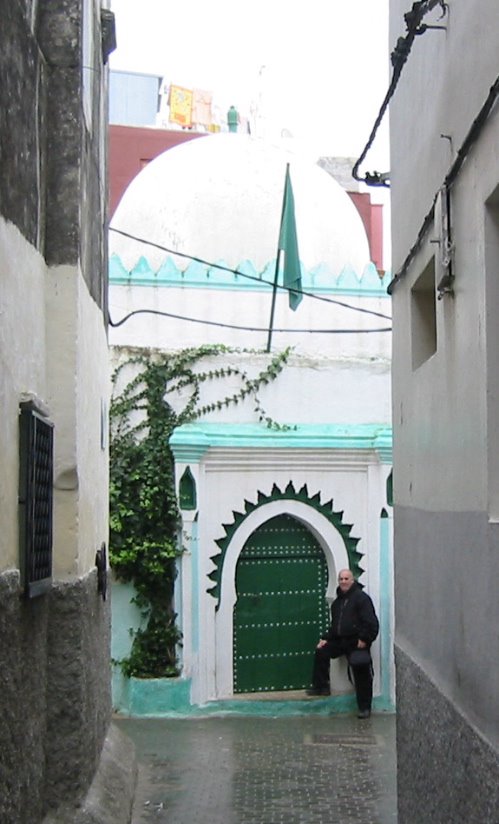
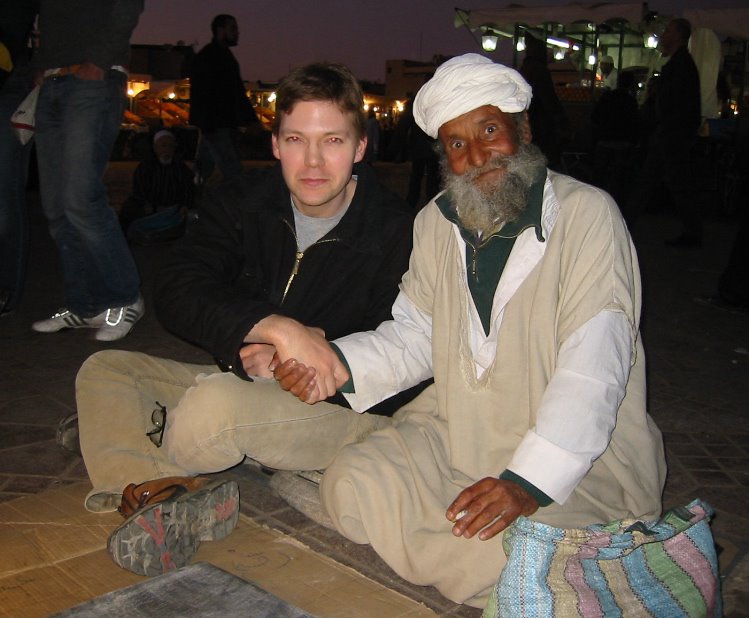
"Uh... no. Are you sure we went this way last time?" He was-- and we had. (Eventually I recalled; it just takes longer these days.) The hill leads right up into the Place du Kasbah, the place where the kasbah begins with the police station and my friend Absalaam's  little cafe (which I've only seen open exactly one time. It was closed.) Now how the hell are we gonna find Absalaam's house? Roland was undaunted. He even remembered the awesome ancient door. We both had a memory of a small, pastel mosque Matisse had painted a block from Absalaam's. (That's it with me in the photo.)

The first time I came to Tangier it was 1969. I had heard lurid things about the city-- it had a bad reputation back then, a holdover from the International City days-- and I avoided it on the way in by entering via an Algeciras ferry to Ceuta, the bit of Spain that is still left in Morocco. Dull, sleepy place, but we headed south from there and by-passed Tangier. A month later, we did enter the city of sin on the way back to Spain. It didn't impress me but I didn't give it a chance. It wasn't for years that I grew to really like Tangier. But not remembering much is what gave me the idea for starting the blog. I told Roland and he loved the idea-- and he never thinks anything is a good idea.

Allow me a quick detour from Tangier-- as though this really were the first piece in a brand new blog (instead of the seventh in a 5 day old blog)-- and I'll give you a few details about my traveler background. I hit the road for the first time in the mid-60s when I was just a kid. I think I had just turned 15 when I hitchhiked from Brooklyn to Miami Beach to visit my grandparents for Easter-- or tried to hitchhike. I got picked up by the New Jersey Highway Patrol and they made my pissed off father come and pick me up at the police station. In Bumfuck, NJ (which was like Georgia or Virginia as far as I was concerned). I figured I was gonna get a beating but instead he or my mom gave me the busfare to go down to Miami in style the next day; maybe even the same day. I lost my virginity behind the Jacksonville Greyhound terminal. I don't remember much-- a lot of black: big black tires, big black face... and I kind of blacked out when I um... you know (this isn't a porn site, so we'll leave it at that). She was so sweet and cool and friendly and I was such a nerd. I don't know if she told me her name. If I had this blog then, I'd know now.

I only spent 2 nights in Tangier this time. The ferry was like 6 hours late but we were lucky because it hadn't crossed in 3 days because of stormy weather. It only took 90 minutes once we left Algeciras. I always used to love the gradual approach from Europe to Africa, the sights, the sounds, the smells, the feeling of excitement. I didn't really feel it this time. It was drizzly and overcast. We stayed at the place I always stay there, the only decent place, the El Minzah Hotel. Some Scottish aristocrat got it going in 1930, Lord Bute. It's actually gotten quite a bit better since the last time I was there. There's even a business center on the second floor with 2 super-fast Dells ($5/hour, which is really expensive for Morocco but I didn't know that yet). It's a 5-star hotel in a country where stars are very relative; the hotel owner is probably married to a relative of the Minister of Stars. But it is the best hotel in Tangier, which is, after all, a slowly improving but still shabby port at the Northwest tip of Africa, a place of intrigue and desperation where people from Africa (all over the world, actually) come to try to smuggle themselves into Spain and the EU, where the streets are paved in gold (relatively). Some people say it reminds them of Tijuana. I'm sure it seems to some like the whole continent of Africa would like to come in order to cross over to the good life in Europe. And it's a place where the livers of that good life can cross over and have a quick look-see how the other 90% of the world lives. Someone once told me most visitors to Morocco just come for a day and never get beyond Tangier. That's a shame.

The concierge at the El Minzah told me that almost all their guests stay for one night. There hadn't been any for 3 days because of the ferry. Tangier's not really a destination any more-- at least not for more than a night-- which must be frustrating for the people running the hotel, although they seem to be trying to make the best of it. There's still an underlying seediness about it that you won't find in a real 5-star hotel but at least I don't think they'd steal a $100 travellers check left in the safe behind the reception (the way they did about 20 years ago when I stayed there once). Now they don't even have a safe behind the reception-- and I don't bother with travelers checks anymore anyway. I feel confident enough now, after almost 4 decades of travel, to keep my cash in the pockets of my relatively tight jeans.

A couple months ago when I tried booking our room on the net, the hotel was anything but receptive. Not only did my correspondent have no interest in agreeing on a decent discount, he also said we would have to participate in an extravagant Christmas Eve dinner if we booked a room. I pointed out that Expedia.com was offering much cheaper rates and he claimed they don't honor Expedia's bookings. The El Minzah, 5 stars and all, ain't much, but the drop down to the next level hotel is a far drop indeed. I booked through Expedia-- 1,125 dirhams (like $120) for a double room, breakfast included. They honored the booking and the price.

The pleasant surprise in Tangier was the restaurant scene. It's one of the few cities where there is a Moroccan middle class accustomed to going out to eat enough to support real restaurants that don't just cater to tourists. Tourist restaurants are always horrible-- bland, over-priced, pathetic... all decor and show and never anyone striving for excellence in the kitchen. The guide books all claim that the El Korsan in the El Minzah is the best restaurant in town. It's exactly the kind of place I do my best to avoid. We managed to find two really excellent restaurants we ate in. One was somewhat touristy, but reasonable and definitely oriented towards ala carte ordering, rather than forcing you into a gigantic feast, Raihani's. A little further from the tourist area we found a fish restaurant which catered 100% to Moroccans, the Andalus. It was so delicious-- real salt of the earth kind of place, very friendly and unpretentious and ridiculously cheap. Harira for 5 dirhams, not 60 or 80, for example. Hmmm... I'm drooling just thinking about the fish tagine I had!

Tuesday, January 10, 2006

TOLEDO ISN'T A BAD PLACE, BUT IF FROMMER THINKS THIS IS THE BEST CITY IN SPAIN, I'D LIKE SOME OF WHATEVER HE'S SMOKING


I've lost count of the number of times I've been to Spain since the 60's. I love Spain-- the people, the culture, the language, the food, the history... Reading FOR WHOM THE BELL TOLLS in high school, right after seeing Picasso's "Guernica" at the Museum of Modern Art for the first time, helped me understand that the political right has always been and will always be the mortal enemy of humanity. Even when the fascist monster, propped up by American post-War hegemonists, was still in control, I used to love visiting Spain. (I even had my first UFO experience there some time in the '70s.) So in planning out my vacation in Morocco I was eager as can be to include a week in Spain.
I figured we'd fly into Madrid, kick some jet-lag, eat some great food, walk around El Prado, and then make our way down to the Algeciras-Tangier ferry via Cordoba and Sevilla.

Roland got all gung-ho on Toledo, so I squeezed that into the schedule too. I mean, how could I resist this rationale: Frommer-- "If you visit only a few Spanish cities in your lifetime, make beautiful, romantic Toledo one of them." Now that sounds like a pretty strong endorsement and it's so close to Madrid, a really easy day trip.

It's a nice city, probably worthwhile, nothing really wrong with it. But the Toledo Chamber of Commerce must have hired Jack Abramoff to get to Frommer for that quote! Toledo is worth a couple of hours, if you've spent enough time at El Prado, the Museo Centro de Arte Reina Sofia, the Thyssen-Bornemisza Museum, and if you've wandered over all the neighborhoods of central Madrid and if you've already spent lots of time in the real treasure cities of Spain, like Cordoba, Sevilla, Barcelona and Granada. I enjoyed the Pamplona running of the bulls more and Ibiza was a way better experience too. But, hey, Toledo is ok-- kind of cold in December and desolate/lonely and... well, everything was closed and all you see is gaggles of camera-toting tourists...

We took the train; it's about an hour or so and the station was an easy walk from out hotel in Madrid. We had lunch in a beautiful setting, the highly-rated Hostal del Cardenal, "Toledo's best-known restaurant," according to Frommer, who even refers to a "chef." Although the restaurant is in the lovely hotel, that location is the best thing that can be said about it, and the idea of calling whoever is preparing the food a "chef" is patently absurd. This restaurant is a tourist feeding facility with nothing whatsoever to offer in terms of culinary sophistication (especially in light of Madrid's restaurant scene, one of the absolute most magnificent in the world). Del Cardenal reminded me of what I don't like about Venice: the food is for tourists who come and go and who don't really have to be catered to because the next day they'll be somewhere else. So you get a somewhat gentrified version of slop.

The Alcazar and the Cathedral were better but they don't hold a candle to what you see and feel in Cordoba or Granada or Sevilla. Toledo is better than mediocre but Frommer must have had a hot date there or something to rave about it the way he does. I'll write up some stuff about the places we loved-- Madrid, Cordoba and Sevilla-- in the next few days.

Monday, January 09, 2006

NEVER BE AFRAID TO TRAVEL ALONE (UNLESS THERE'S SOMETHING TO BE AFRAID ABOUT)


I've probably thought about this more than most. Starting back when I was 13-- and attempting to hitchhike down to Miami Beach to visit my grandparents for Easter (they called it Pessach)-- I've been taking to the road alone. A few years after that, I hitched from New York to California to stow away on a boat so I could go live on Tonga. (I never made it past L.A.'s San Pedro harbor.) And then a few years later I drove to India by myself, spending around 2 years traveling through Turkey, Iran, Afghanistan, Pakistan, India, Sri Lanka and Nepal.

First off, you're never really alone that much. I mean when you're hitching, there's a driver and he's picking you up because he wants to talk to someone. And when I was driving through Europe and Asia I always had a crew of people to help me pay for gas and all. And, best of all, traveling alone more or less forces you to meet people, one of the greatest joys of travel.

More recently I've done a lot of more conventional traveling with friends like Roland or Craig. In 2005 I rented a villa on Bali and invited 3 of my friends, Rebecca, Brad and Craig to join me. And last month Roland and I went to Spain and Morocco. Roland is a great travel buddy and travel is probably the bondingest thing between us. We've been all over the world together: London, Paris, Rome, of course, as well as more off the beaten tracks kind of destinations like Calcutta, Kandy, Chiang Mai, Abu Simbel, Cappadocia, Corleone (on Sicily), the Mekong Delta... and, all over Morocco, not just Tangier and Marrakech, but to places like Sidi Ifni, Tiznit, Taroudant, Zagora and on into the Sahara (by camel). The traveling alone thing came up when I saw him off after almost 3 weeks at the Essaouira bus station. He was headed for Casablanca, London and his job back in L.A. and I had a few days on my own.

The first time I was in Morocco was 1969 and I went with my girlfriend Martha. We had been in college together and each of us was very much a full-fledged individual. Each could say or do whatever we wanted without the other feeling that he or she was being defined. Suddenly when we were on the road I was not an individual but one half of an entity called "Howie + Martha." Oh, did I not like that! I had graduated and she had another year left. I drove her up to England; we went to the Isle of Wight Festival, heard Dylan sing "I Threw It All Away" (which I was very conscious-- in a fatalistic and melancholy way-- I was doing) and then she flew home and I drove to India, no longer a fraction of anything.

Back to Roland. I'm sure I'll never find a better travel companion. He loves adventure, is practically fearless, likes poking around off any beaten path, eats foods not many red-blooded Americans would ever consider (sober)... all that kind of stuff. After his bus took off in Essaouira-- a city I've loved since I was there at the same time as Jimi Hendrix in '69-- I started walking back to my hotel and thought, "well, now I'm alone. Is that good?" It sure was!

Even when you travel with the greatest traveling companion (like Roland), you always have to make all these little compromises. He hates the sun, for example. I love the sun. But if a mediocre restaurant is closer (less sun) and an awesome restaurant is further, meaning walking in the sun, he always wants to eat in the mediocre one. Laugh... but that happened in Essaouira. We both love Chez Sam's, certainly long the best restaurant in town, way at the end of the docks, as picturesque as you'll get and delicious food. But just a little bit closer is a restaurant that is not mediocre in fact but excruciating-- Le Coquillage. It exists only to service the one-day bus trippers who come to poke around Essaouira from Marrakech or, worse, Agadir. The service is abysmal and the food is... well, like food anywhere if no one is worried about repeat customers. But it meant less walking in the sun. (The third seafood restaurant on the beach, the Chalet de la Plage, also a fave of both of us, was already closed but that one is almost as good as Chez Sam-- and highly recommended, although not for lunch when the bus tours are around.) Anyway, pardon the tangent. The point was that sometimes you just don't feel like compromising all the time, or even taking someone else into consideration. And since Roland dislikes people almost as much as he dislikes the sun... and yours truly LOVES meeting people on the road...

So, anyway, he's gone and the first thing I do is go right to the hotel I always used to stay at, Hotel des Iles. (We had decided to stay someplace else this time and I found what looked like a charming place on the internet, a "riad" called Lalla Mira, which claims to be a kind of health-food hotel. It tuned out to be a pretty gross tenement kind of joint and I moved out the next morning, to the sterile luxurious Sofitel Thalassa Mogador, the kind of character-deficient place I usually avoid. But, after a night at the Lalla Mira I wanted something clean and comfy and a little upscale and Mohammed behind the desk made me a GREAT deal-- really great-- whereas the even fancier hotel in town, the Heure Bleue Palais, was inordinately expensive and unwilling to offer a discount.) The reason I walked over to the Hotel des Iles was because Roland and I hadn't been able to find an old friend of mine who had a shop. The problem was that there had been only one street with shops in that part of town 10 years ago and now there were a dozen. Street after street had been turned into pretty identical shopping streets. Roland usually remembers how to find things but he had noreal interest in helping me find my friend anyway. But once he was gone, I just decided to retrace my steps-- from 10 years previous-- starting at the door of the Hotel des Iles. I turned off my brain and let my feet take me there. It worked. He has two kids now and lots of ideas as usual-- from an olive and argun oil museum to a line of handmade Berber handbags for women. Fun to see him again and catch up a little. And once I found his shop I was able to orient myself and find all the places I always liked most in Essaouira. More about that anon.

Sunday, January 08, 2006

OLD CITY FES AIN'T SO SCARY NO MORE


Traditionally the main entrance to Fes-el-Bali (Fes' old walled medina) is through the beautiful Bab Bou Jeloud. Two things were "missing" when I strolled over to take a look a couple weeks ago. One was the large... birdcage in a corner of the square where the captured crown prince of Portugal was once displayed as he slowly died of starvation; and the other was the truly intolerable myriad of uber-aggressive "guides" (angry, unemployed young men with major chips on their shoulders). The scourge of tourist tranquility, the hordes of these pests are pretty much... gone (as they were even earlier from Tangier and Marrakech). I think Fes was the last hold out.

An aside here. Roland and I were once walking around in the late afternoon, wandering aimlessly in the vicinity of the Bab Bou Jeloud when a particularly obnoxious, snarling guy insisted that we couldn't walk around without him. The discussion quickly degenerated into him cursing and screaming at us and calling us Jews and Americans and whatnot; very threatening. When a cop appeared out of nowhere and grabbed him we were very relieved; our relief turned to mortification when the copy commenced beating him savagely. But I guess why we didn't see him or any of his colleagues on this trip.

There are now signs posted throughout the labyrinth that makes up the old city, marking sites and routes. I mean, it could be Rome or Dublin almost. It is no longer the forbidding, scary place it has always been reputed to be. We never even felt intimidated to not walk around late at night. We wandered around anywhere we wanted for 3 days essentially unmolested. Maybe the Fassi saw the benefits tourism have brought to Marrakech, but something-- maybe aggressive police action-- has made Fes' medina a lot more comfortable for tourists-- and a lot more profitable for bazaris. It isn't Disneyland yet and you won't see Ma and Pa Kettle ambling around alone yet, but that's probably coming soon. I definitely saw a lot more European families walking around freely.