Search This Blog

Friday, May 19, 2006

BLOGGIN' FROM MARRAKESH... SORT OF


I just got a letter from an old friend, Dave, who is visiting Morocco with 2 other mutual friends, Jo and Cindy. It's the first time in Morocco for each of them. He wrote to me from the Riyad El Cadi, the fantastic townhouse in Marrakesh where Roland and I stayed last December. Dave said it was ok to turn his letter into a blog.

I'm writing this to you under the lemon trees in the central courtyard of the riyad el cadi.  As I type, the electrifying moan of the afternoon call to prayer is starting to swell across the medina. We arrived last night after a flight from Amsterdam. I am staying in your room, the Piscine, and Josephine and Cindy are in the Maison Bleu.

Thanks so much for recommending this place. It's absolutely lovely. And they light up when we mention "Howie".

Here's a little excerpt from of my diary. The longer entry spent a lot of time describing our arrival on the edge of the Jamaa El Fna and the walk to the Riyad -- a scene you know well enough, so I'll spare you that bit and cut to early this morning...

As I have for the last week, I slept like an old dog. Me, who's used to three or four hours at a time, sleeping for six and seven. Very odd. What's surprising here is that you're in the middle of this incredibly dense neighborhood that stretches out at least a couple of miles in every direction from you and at night it's just dead silent. I had a crazy dream about being caught up in some very intense religous mystery (along the lines of the Da Vinci Code I think -- although i haven't read it) chasing people through all these little corridors and stairways, being warned to stop asking questions by some people and pulled into dark doorways by others who would confide some mysterious bit of secret information. I woke up quite disoriented to the sound of the morning call to prayer at 5, followed by a really amazing concert of bird calls of every description. Needless to say, it took me a while to feel like i was really awake and really here.

At breakfast this morning a fellow named Hassan from the hotel spent about a half an hour with us talking about what we wanted to see and do, and then marking routes and destinations on the impossibly complicated map of the old city -- the Medina.  A bit later we set out on our way, deciding to go visit an antique-dealing friend of Hassan's who he said was not more than 3 minutes walk up the alley. Within a minute and a half we were totally lost. I can't really describe the scene, and I know that sooner or later you just get used to it and start to get your bearings, but at first it's just sort of mind-blowing,  Turn a corner and you're in the middle of a little vegetable market where a man is selling red onions, a woman has two little piles of apricots, a moped is honking its way through the busy crowd, an old old man is leading a donkey pulling a cart full of animal hides and then another man more or less pulls you into his doorway to show you his blanket factory. Before you know it, he's led you down a dark, dark corridor and into a ramshackle room where ten or twelve men are working on looms, weaving these incredibly vibrant colored yarns into blankets and rugs. And the guy is offering you tea and talking about America and saying "you are welcome here" and about how he'll make a special price for you. It's at once stunningly beautiful, squalid, intimidating, annoying, funny and seemingly so damned authentic that the modern cynic in you can't possibly believe that it could possibly be authentic at all. I think this is the thing that, in my first day here, has suprised me the most. You travel around a bit and you start to believe that every place is more or less the same.  London is not that different from Los Angeles... Amsterdam... Chicago...  even China which in a lot of ways really blew my mind.  What's surprising is how much alike they all seem to be. You begin to expect to be able to feel more or less at home anywhere. Then there's this place which makes you realize that the world is still a lot bigger than you are. Today, wandering through the maze of markets, it made me feel quite naive. And that, in turn, made me feel vulnerable, and for a second, a little uneasy. And then again, everyone is remarkably friendly and funny. A man in a shop asked me if Josephine and Cindy were my two wives. I laughed and he laughed and he told me I must be a Berber and that he'd give me 12,000 dirhams for the pair of them and we both laughed some more.  I guess the Berber are the butt of a lot of jokes here.  A few minutes later, in another stall, Josephine was considering buying some old tins.  She pulled me in to talk to the seller who was asking 400 dirhams and he asked me to tell him my price.  When I said she would pay 200 for them, he looked and me and said I must be Berber. I said, "Berber? Why? Because I'm cheap?" To which he replied, "Cheap!  Yes." And laughed.

Yesterday I had to abandon the girls and retreat to the Riyad after I couldn't absorb any more shopping.  A couple of hours later they returned with a tale of Josephine nearly getting into it with a passive agressive t-shirt seller who, after apparently some time spent chatting, offering tea and showing the goods, felt that her price was insulting.  He said something along the lines of "Are you a little crazy in the head?" and at some point put the shirts in a bag and threw them at her telling her, "Fine! Just take them American. Just take them for nothing."  I sort of wish I'd seen it and then again I'm really glad I wasn't there.

Today I think we're headed to some gardens and a supermarket.

Oh, and we had a wonderful dinner at El Fassia last night.

Anyway, thanks again Howie.  We feel a little like you're here with us.


UPDATE: 36 HOURS IN MARRAKESH-- TOO EXPRESS

Today's NY Times is right about one thing: Marrakesh is cool. Their vision of why... kind of superficial. Hey, but superficial people have a right to discover cool places too (and destroy them for everyone else).

Wednesday, April 26, 2006

VISITING NEPAL AGAIN-- STILL KIND OF LIKE SHANGRI-LA


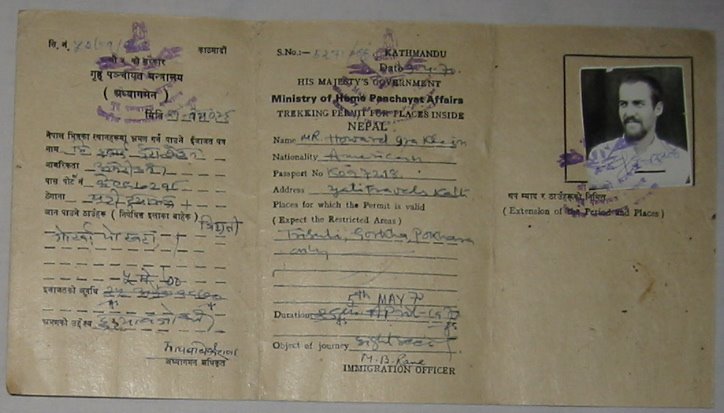
When I left London in my VW van in 1969 my goal was Nepal. The combined allure of the Himalayas, Shangri-la and Buddhism had been knocking around in my drug-addled brain for all my teenage years. Between Nixon in the White House and American troops in Vietnam, I figured mankind had no future and I better get to Nepal now or I'd never see it. 1969 was also the year I started the long, hard process of kicking drug dependence. By the time I got to Nepal in 1971 I had pretty much kicked drugs-- although, for sociological reasons, how could anyone possibly resist sampling the hash parlors along Hippie Street? I didn't. But after that I really did kick drugs.

Anyway, my 2-3 months in Nepal became part of my personal lifestory and the wondrous tales about climbing in the Himalayas and about how primitive and backward and peaceful and enlightened I found Nepal were things I talked about a lot. A few of my more intrepid friends wanted to go. And some did. Many years later, when I was living back in America, Nepal was as much a dream for Roland as it had been for me when I was his age and it didn't take much for him to convince me that we should go visit Kathmandu. Today when I woke up and saw the violence in the streets I felt very sad for this peaceful, enlightened, beautiful little corner of the world.

It's funny, I remember more specifics about my 1971 visit than I do about the more recent trip! Although a trip to a place like Nepal has always got to be exciting, I think I remember 1971 more clearly because I drove, I had no money-- my van literally rolled down the last Himalaya into the Kathmandu Valley and I had not a cent to my name-- and I had no choice but to be close to the ground and open myself up to all sorts of adventures.

I guess the two most memorable specific events I recall-- both vividly-- fall into this category, even more than trekking to the base camp of Mount Everest! One involved happening on a neighborhood "hootenanny." Each square block in Kathmandu surrounded the neighborhood temple and at night the baker and the candlestick maker and everyone else would come out and play transcendental music on the temple portico into the wee hours. Those nights will be with me forever. Unfortunately, so will the other adventure. As I was driving back to India after a few months in Nepal, in preparation for a return to Europe after a couple years driving around Asia, I had to ford a stream. My van-- which was both my home and my transportation-- started floating downstream. Some truck drivers lasso-ed me and pulled the van to safety.

In the 90's when Roland and I went, we flew and we stayed in hotels. A great time for sure. But... well, nothing is ever the same. We flew into Bombay (now Mumbai) in late November on Delta, which was a decent airline back then (now it completely sucks, ripping off and cheating its customers in a desperate and pitiful struggle to stay alive). We stayed at the Taj, the grandest and most venerable hotel in Bombay. It's laden with history and antiques and it's right on the water next to The Gateway. It was the hub of some kind of upper class social life, although I recall rooms being around $200. At one point the electricity went out for a long few hours, a drag because ac is a must and we were on a high floor. But poor Roland was in the shower when the power went out and suddenly raw sewage started coming out of the spigot. And Roland is a very fastidious person. He'll never forget that; I'll stick with the Nepali hootenannies.

I don't want to make this a blog about India so I'll cut to the chase. We flew to New Delhi, hung out for a few days and then took a Royal Nepal Air flight to Kathmandu. It's a short, cheap flight, like about an hour. The hotel, The Yak and Yeti, sent a car for us. It was a souped up Hyundai-- like a low-rider deal-- driven by a couple of kids playing rock music cassettes. It was already night but it felt kind of like going home for me-- and I could feel how excited Roland was as we drove into town. So different from the first time I was there-- right after they had paved a road in honor of the crown prince's marriage-- but there is still something timeless about the Kathmandu Valley that I picked right up on.

I could only dream of places like the Yak and Yeti when I was a poor hippie in a van. It seemed like a paradise inside paradise. But, although a contender for "best hotel" in town, it's kind of a dump. Durbar Marg is a kind of upscale area but it doesn't have a lot of personality. Fortunately it's an easy walk to anyplace you could ever want to go in town. We had booked in advance and negotiated a bit and I think we paid something like $125 for both of us and got an upgraded room. The hotel doesn't have much character, just mostly a faceless grand Asian hotel... but this is Nepal and nothing is too grand (except the temples). Anyway, it was worth the dough and we couldn't wait to hit the streets-- me to recapture my 70's adventure, Roland to experience first hand what he had heard about for years.

Neither of us got what we were looking for, of course. But it was actually pretty awesome. We headed over to the Durbar Square area which is honey-combed with temples. The streets were dark and empty and we both got right into the exoticness of it. The packs of stray dogs wandering around didn't make us feel that great but we definitely knew we were in a foreign place, a very foreign place.

The food in Nepal is ok-- kind of like Indian food but cruder. We never found anything amazing but it was all ok. I had a recollection of having eaten in a fancy, yummy place called Boris' when I was a kid. I think it is now called the Chimney Room of the Yak and Yeti and it was founded and run by a Russian émigré name Boris. It's neither fancy nor yummy, except by Nepali standards. They serve Russian food of course. The best Japanese restaurant in town, Fuji, is also very modest but the food was decent and it was very inexpensive for a version of fine dining. Other than that we stuck to modest Nepali restaurants and to the hippie expat hang-outs in Thamel. It's not a foodie place.

It is a great, amazing, phenomenal walking around place. And that's what we did for 10 days. December in the Himalayas... brrrrr... right? No. It's in the Valley and very temperate-- sort of like California weather almost. We stuck mostly to Kathmandu, Patan (an ancient suburb) and Bhaktapur, also nearby. Each one was more wondrous and fantastic than the next-- just magical. The whole place is a living museum. The past is still living and breathing and coexisting with today and every narrow alley and every square is a unique and exotic world.

Because I had talked about it for so long, Roland insisted that the first thing we do the first morning was to go to the legendary Monkey Temple. Turns out, only I called it the Monkey Temple. It is actually the most venerable temple in Kathmandu and it is known as Swayambunth Stupa. Its a little out of town on top of a forested hill with hundreds of stairs to the top. When I was first there the monkeys were pretty wild and threatening. They're a lot tamer now. But it's still quite the schlep to the top; there's a way to drive to the top around back but that's for pussies. Supposedly it's 2,000 years old. The place is crawling with pilgrims (not tourists) and the top is temple upon temple upon shrine upon shrine. It's was amazing-- and totally worth the exhausting climb. We went to a million temples in Nepal but Swayambunth Stupa was our fave.

A close second was the temple complex on Durbar Square in Patan. We loved Patan; it's even more remote from western civilization that Kathmandu itself. We couldn't get enough of it. We traded our airline toiletries kits for thankas. Durbar Square has a royal palace, the Monkey God temple (Hanuman) and temple after temple, each one fascinating and beautiful. We flipped over the Krishna Mandir but there had to have been a dozen at least and it was completely amazing and engrossing.

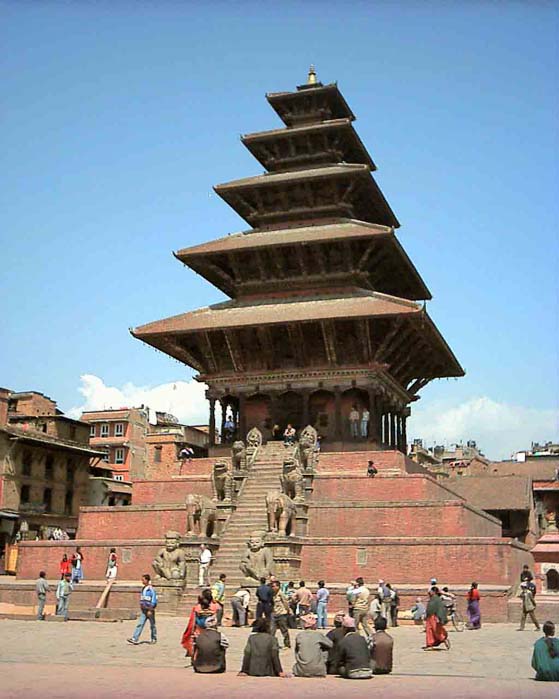
The next day we went to Bhaktapur, a little further away-- not just geographically, but further back in time as well. It was like going into ancient history, even more so than Patan. (By the time Kathmandu was seeing almost cosmopolitan in comparison). It's about an hour from Kathmandu. We took a bus there for less than a buck for both of us and a taxi back for about $5. The Durbar Square there is more open and has less temples but one is amazing-- a 5-tiered pagoda, Nyatapola.

We did some shopping although didn't really buy much. I picked up another Tibetan rug at the refugee center near Patan and we had fun learning about thankas and buying some and trading for some. Mostly we just loved interacting with the people in their environment. One day we took a bus out to Nagarkot for a spectacular view of the Himalayas and some walking and one of the most amazing sunsets I've ever seen. There's a bus from Bhaktapur and it takes a couple hours and costs about a buck. You'll never forget the sights you see from Nagarkot, especially if you hike about a mile out of town to a place where you can see Everest.

Saturday, April 15, 2006

FEAR OF FLYING? ANOTHER BUSH CRONY PREPARES THE GROUND FOR DISASTER-- THIS TIME AT THE FAA


Airplanes and Bush just never were a good mix. First he was a disaster as a disgruntled, mostly AWOL semi-member of the Texas Air National Guard. Even worse-- for America-- Bush's pig-headedness about paying attention to President Clinton and his outgoing administration's dire warnings regarding the dangers posed by Al Qaeda were contributory to the catastrophe of 9-11. And now Bush is setting up an airline catastrophe that could be even worse! Even Bush's rubber-stamp congress can nip this one in the bud.

Right in line with the Bush Regime's seething hatred for working men and women exercising their rights to collective bargaining, as of last week, the Federal Aviation Administration (FAA) has broken off contract talks with the National Air Traffic Controllers Association (NATCA) that would have saved taxpayers, $1.4 BILLION over the next five years.

Air traffic controllers (ATCs), for those who don’t follow aviation, are the folks who guide planes the second they leave the gate to your destination.  Their job is one of the most stressful in the world yet they remain dedicated and hardworking public servants. They’ve been negotiating with the FAA since September 2005.  According to FAA Administrator and Bush-appointed crony Marion Blakey, the FAA wants a “fair” contract that would save taxpayers money.  What part of $1.4 billion in savings Ms Blakey and Bush don't get no one quite understands.

If that’s not bad enough, here’s something else I didn’t realize. So the FAA broke off contract talks and submitted a contract to Congress. If Congress doesn’t act within 60 calendar days-- and we know how lazy and unwilling to put in an honest week's work these people have been for the last 5 years-- the FAA gets to impose their contract on NATCA-- take it or leave it.

So in other words, these dedicated controllers are forced to take whatever the FAA gives them (and, from what I'm hearing from my sources, it's a steaming pile of crap). To make matters worse, the FAA’s version actually penalizes veteran controllers for staying-– creating a situation where it makes more financial sense for eligible controllers to retire than to stay in their vital jobs. By end of 2007, 1 in 4 controllers-– over 4,000-- could retire – and the problem would increase for the next five years by which time over 40% of current controllers will actually be penalized for staying in their jobs.  

BTW, it takes 3-5 years to train an air traffic controller. Unlike most jobs where you can fill the spot immediately with someone new, ATCs take months (and sometimes a year) to learn new positions.  The aviation system is already experiencing a staffing crisis which you can read more about here. Although it may not have dawned on this particular incompetent Bush crony with a fancy job, penalizing veteran controllers if they come to work certainly won’t help the situation. 

I hope this is all getting you as pissed off as I am. That's because, like I said, this could be nipped in the bud. If you go to this site it'll help you contact your congresscritters and tell them to get off their duffs s-- BEFORE this turns into another Bush disaster.

Remember, these are the professionals who landed almost 4,500 airplanes within a matter of minutes on September 11th. And they're the same people who lost their homes and belongings during Hurricane Katrina, Rita, and Wilma but stayed at work to make sure others were lifted to safety – they are heroes. Don’t we owe it to them? Or is it just Bush playing President on Air Force One that deserves a safe flying experience? John Carr, NATCA's president has a cool blog you might want to check out-- entertaining and informative.

Saturday, April 08, 2006

EGYPT-- MORE THAN JUST THE PYRAMIDS?


I have to admit, Egypt has always been a destination I've dreamed of, like since I was a kid even. I mean, in our culture-- replete with Bible stories, mummy movies, Napoleon, Israel, hi-tech aliens building pyramids, Cleopatra-- how could it not be? And if you've been following this blog at all, you've probably figured out that Roland and I have always been looking for cool and challenging places to go experience. Egypt sounded really exotic to us both and we finally made it over about a decade ago.

We planned to spend about a week in Cairo and a couple weeks roaming the country (including a Nile cruise to Aswan). Although it didn't seem so at the moment, some real misfortune for everyone else turned into a break for me and Roland. Just as we were leaving L.A. in November a bunch of religionist fanatics slaughtered a busload of tourists from Switzerland or Austria and Japan. It was really a spectacular horror show with scimitar-wielding terrorists chasing unarmed tourists through the ruins and mercilessly slashing them to death. It was a bloody slaughter; 5 dozen were murdered. Egypt, one of the world's biggest tourist destinations, immediately emptied of tourists. And they stopped coming (at for a couple weeks). I feel terrible for the Austrians and Japanese, of course; I mean what a way to go! But... well, Roland and I pretty much had Egypt to ourselves. I mean it was just us and the Egyptians, who, except for the scimitar-wielders, are an extremely generous, friendly and gracious people.

Example of how this worked: the cruise. Normally these big boats are packed-- hundreds of people (including brats) running around making noise and slowing everything down. And the cabins are tiny little cells. I mean really, really tiny. The giant ship had a full crew (which included an Egyptologist) plus me, Roland and two sprightly old Brits returning to London from a lifetime of foreign service in Oman and seeing Egypt on the way home. That's right; instead of a couple hundred tourists we were four. The first result was that instead of Roland and I having to share one of these tiny cells, we each got our own tiny cell. Still horrible but an improvement. Later the Egyptologist explained to us that no tour group in his experience on the Nile had seen as many things as we had. That's because normally the tour goes as slow as the oldest and most crippled turtle-like member. The 4 of us were all really into seeing everything-- and we did.

We flew to Cairo on TWA direct from L.A. They're out of business now. Some guy from the Warner Bros affiliate picked us up at the airport and whisked us through an otherwise annoying customs rigmarole and hassel-hell. We checked into Le Meridien on Roda Island right in the center of town connected to the Corniche by its own bridge, and got a great room with a balcony overlooking the Nile. Good hotel with the best views of Cairo in the city and not expensive at all (although it probably is now). On the way back we decided to stay in the Sheraton in Dokki, a little bit away from the hectic part of town but still convenient. It was pretty inexpensive too, although I have a feeling that all the prices were down because of the recent brutal murders of all the tourists.

Food in Egypt is definitely nothing to write home about. It's amazing that such an ancient culture doesn't have a unique cuisine, like China or Morocco or Turkey. But they don't. It's kind of garden-variety Middle Eastern. The restaurants were non-descript from a culinary perspective, although the food was ok. On the cruise there was always the very boring, semi-bland choice of "chicken or fish."
If you've looked through my blog, you're no doubt aware about how I delight in the cuisines of the countries I visit. Scratch Egypt off that list. There was not one memorable restaurant in almost a month! Even the lavish ones the Warner Bros affiliate people brought us to served food that was just slightly better than mediocre. This was definitely not a food trip. It was a tombs trip.

In Cairo the biggest deal is, of course, the Pyramids. And were we in luck on that score! You know the guy always on CNN whenever they do a story on mummies or anything old in Egypt-- Dr. Zahi Hawass? Well, one of the musicians, Andy Paley, in a band on Sire Records, where I used to work, was friends with some well-known American Egyptologist, a Rockefeller no less, and through this guy we had an introduction to Dr. Hawass, then Governor of the Pyramids (now Secretary General of the Supreme Council of Antiquities). This turned out to be a golden key to the most amazing visit to the Pyramids imaginable.

Dr. Hawass treated us to a tour usually reserved for heads of state. He literally closed down the Great Pyramid and made everyone else wait while we had it to ourselves! It's pretty awesome. Most things don't live up to expectations; that one did. He said we could sleep in it if we wanted to. We didn't at the time but now I'm sorry we didn't take him up on it. We didn't climb any pyramids the way Bush just did in Chichen Itzen in Mexico last week, looking like a pansy. We didn't because a U.S. marine climbed up and fell off and died; so it's forbidden now. Afterwards he showed us a small, locked up pyramid that no one is allowed in except Charles De Gaulle and other people they wanted to impress. They don't want general traffic in there because of breathing. Next door they had a little museum with an ancient ship with a bunch of mummified pharaoh's servants on it. The Sphinx, on the other hand, was covered in scaffolding and seemed to be crumbling into the sand. Roland claims they were injecting silicon into it.

The other stuff in Cairo we went were the Egyptian Museum, which was like an over-stuffed warehouse but still amazingly interesting; El Azhar Mosque (the spiritual center of Old Cairo where, unlike the Moroccan mosques, all are welcome); the 12th Century Citadel and the Muhammed Ali Mosque (an incredibly magnificent Turkish-style mosque also known as the Alabaster Mosque and unrelated to boxers); and the City of the Dead, basically a gigantic cemetery with hundreds of thousands of people living in it.

After a pleasant enough week in Cairo we took an Egypt Air flight to Luxor to meet our Nile ship. Luxor is really spectacular (although it took some effort to put all the screaming, terrorized Austrians and Japanese being hacked to bits by the terrorists out of our minds). The temples, big and small, and burial areas in the outskirts-- The Valley of Kings and The Valley of Queens-- were mind-boggling and themselves worth a trip to Egypt. We stayed on the ship and they took over the routine, starting with the Temple of Karnak-- the heart of the Amon cult and one of the most spectacular sites either of us has ever seen... anywhere. After seeing it, the also incredible-- albeit much smaller and less grand-- Temple of Luxor wasn't nearly as breathtaking and memorable. We wound up going back to the Temple of Karnak for a cool touristy sound and light show the next night. The boat stayed tied up on the dock for a few days-- a floating hotel/restaurant for us, while we explored the Luxor region. It was really amazing. We were supposed to sail north to Dendara to see the Temple of Hathor, the goddess of love, but the Nile was too low so they kept us in Luxor longer-- which was fine with us-- and gave us a gift certificate for a night at the Hilton Hotel in Taba on the Sinai.

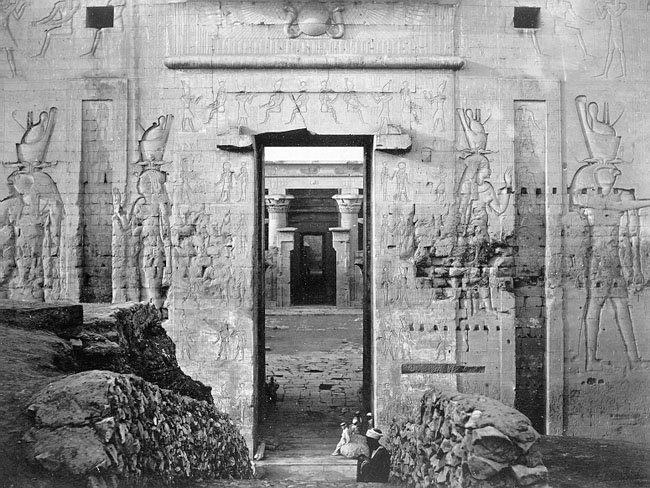
It's 140 miles from Luxor to Aswan and this was the heart of our trip. We (me and Roland and the two old Brits) stopped everywhere and did everything. First stop was Esna, a tiny ancient agricultural town-- we were in rural ancient Egypt now-- with an awesome little temple dedicated to Khnum, the ram-headed god. On the other side of the river and 30 miles away is Edfu. By this time we felt really comfortable on our ship and we had taken over the sound system and were playing Velvet Underground tapes as we watched ancient Egypt float by. The Temple of Edfu, the holiest site of Horus, the falcon god, is the most intact temple we saw on our whole trip. In some ways this was the one, the one where it was easiest to fantasize that I was an Egyptian living a thousand years before Christ. I wasn't in the real world any longer.

Next came Kom Ombo, the site of the temple to Sobek, the crocodile god. Roland loved it. I felt I had seen enough temples by then and I hate and fear crocodiles anyway. I was also getting bored with the crappy food on the boat and I was happy when the boat Egyptologist told us if we wanted to we could go for a camel excursion into the Libyan Desert to visit an old Coptic monastery. We all jumped at the chance and we had a truly remarkable day, although Roland picked up some accursed Arabic phrase that made my nasty camel run off whenever he shouted it.

Our last stop was Aswan, best known for the Aswan Dam, of course, but there are some pretty cool things to see there too. I think the last thing we did as part of our organized cruise was to take a falucca to Elephantine Island and Kitchener's Island to visit the gardens. It was very beautiful and peaceful and helped feed my fantasy about living 3,000 years ago. We checked into the Pullman Cataract Hotel, famous as the site of the film Death on the Nile and very beautiful-- Moorish in style. It's a luxury hotel but it was inexpensive and not really all that luxurious. Like everywhere in Egypt, the food was mediocre.

On a lark we decided to go see Abu Simbel, way down near Sudan, the gateway to Africa. We flew there from Aswan on ZAS. Most people fly in for a few hours and fly out with the same group. We were the only ones who stayed. The town gets lively when the planeful of tourists arrives and then gets real sleepy when they fly back in the evening. We loved being the only ones in this very primitive African town. We found a basic hostel to stay in. There were no real hotels. I don't recall any real restaurants either and we traded a farmer a pen for some tomatoes. The Temple of Rameses was as spectacular and awe-inspiring as the photos lead you to believe it is.

We wound up flying back to Cairo and I let Roland talk me into taking a night bus through the Sinai to Taba (to use our gift certificate and cross over and visit Eliat). We went to visit Jerusalem too-- and spent Christmas Eve in Bethelhem where tradition says Jesus was born, but that part of the trip is for another time.

UPDATE: Egyptian Roads

They should be avoided when possible. Christmas week, 2010 and a bus crashed into a truck, killing 8 American tourists, injuring 21 others, going from Aswan to Abu Simbel. Better to fly.
The crash took place early Sunday as the tourists were traveling from Aswan to Abu Simbel, the site of an ancient Egyptian temple.

Road accidents are common in Egypt because of bad roads and poor enforcement of traffic rules. An estimated 8,000 people die in car accidents annually in the country.

Saturday, April 01, 2006

BANGKOK IS VERY FAR AWAY-- BUT THE FOOD MAKES THE TRIP WORTHWHILE: A GUIDE TO FINE DINING


When I was 15 I hitchhiked across the country-- from Brooklyn to Los Angeles. I was on my way to Tonga but I never made it past San Pedro Harbor. I got all the way to L.A. in less than a week and most of the trip was in a nice new Cadillac driven by a sailor named Howard (like me) for a rich man moving from Philly to L.A. (also named Howard; but I never met him; he flew). Howard, the sailor, was a bullshitter but I didn't know what that meant at the time. As we were driving across Texas he told me he had eaten Chinese food in Peking and Canton and Shanghai but that the best Chinese restaurant in the world was in Amarillo and we would be there in an hour and have lunch there. Coming from a Brooklyn I was, of course, a connoisseur of Chinese cuisine. That's when I discovered Howard was full of it. I didn't have to taste it-- it was like canned Chungking or something-- before I realized I'd been had. As soon as I saw the baskets of rye bread (with butter) on the tables I knew what was in store for me. I suppose if I hadn't grown up in a Jewish neighborhood, where Chinese food was more common than gefilte fish or latkes, I might have fallen for Howard's nonsense.

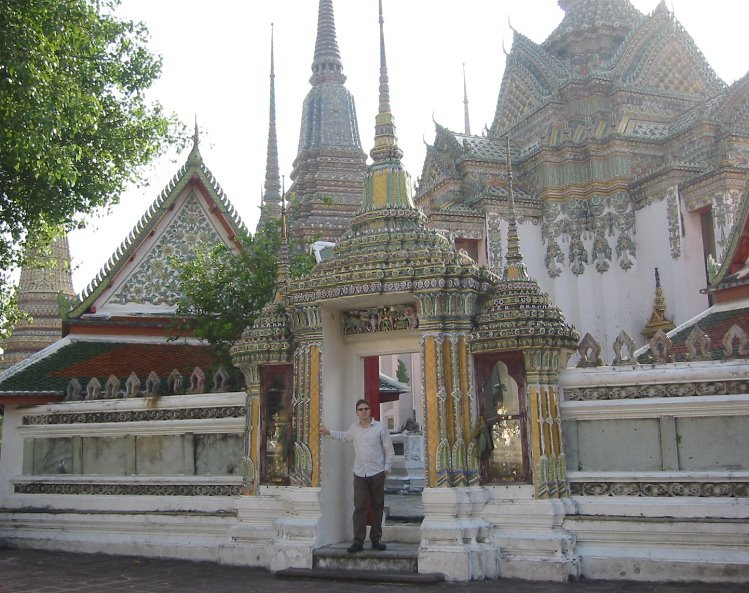
Now, unless you live in one of the 4 or 5 biggest American cities you might be clueless about Thai food. But I'm not going to steer you wrong. In fact starting this blog began as an idea for doing a restaurant guide to one of my favorite cities in the world: Bangkok. I lost track of how many times I've been there sometime after the tenth time. And one of Bangkok's big draws for me is the incredible cuisine. Bangkok has wonderful restaurants serving food from all over the world, everything from nutritionally worthless, cardboard-tasting American fast food to exquisite sampling of haute cuisine from Switzerland, Italy, China, India, Vietnam. They even have Mexican food now. I'm just going to write about Thai food today.

Cumulatively, I've spent months and months in Thailand. I'm an adventurous eater and I love to eat. So, of course, I've searched out the best Bangkok has to offer in the way of restaurants. And they do have a lot to offer! If you like fresh, flavorful, spicy food, chances are you'll like Thai food. If you like bland and unstimulating food, this isn't the cuisine for you though. Early on I learned about something called "Royal Court Cuisine." The recipes have traditionally been closely guarded secrets and the only genuine royal court cuisine chefs all learn how to cook in the royal palace kitchens. I'm not sure how much of that is myth and how much is fact, but I can tell you that there are only a small handful of restaurants serving the exquisite and unique delicacies that make up this kind of cooking. In the last couple of decades more and more of the recipes have crept out onto menus of some of the tourist restaurants, especially in the luxury hotels and these days you can experience a royal court cuisine dish without too much trouble.

For as long as I can remember my favorite overall Thai restaurant has been Bussaracum, always perfect even as it moved its location time and again over the years, from a classic old Thai mansion to a hotel to another old house to an office building. It's always my first culinary stop when I get to Thailand. It was my introduction to Royal Thai Cuisine. It is academically authentic and very serious about what it presents-- oh, and mouth-wateringly delicious. The prices are extremely inexpensive for a tourist eating in a first class restaurant. And even a budget-restricted tourist can easily afford to try this place-- especially the incredible all-you-can-eat buffet lunches. It's a nice healthy walk from all the big river side hotels-- about a third of the way to Patpong, the Disneyland-like, family-oriented red light district that so many western tourists delight in-- and is just down Pan Rd from the big Hindu temple on Silom. The food you'll find here is not food you'll find on the menus of western Thai restaurants (or in the non-Royal Court Cuisine restaurants that are on every street in Bangkok). It looks stunning and tastes even better than it looks.

One of the old locations for Bussaracum is the Dusit Thani Hotel at the foot of Silom at the end of Patpong (Rama IV). It's the most Thai of all the big luxury hotels and although they have a variety of restaurants to fit the taste of any visitor, the Benjarong is a Royal Thai Cuisine restaurant that is nearly as good as Bussaracum. It's quite a bit fancier (great for a date or an anniversary or something like that), maybe a bit less a stickler for the culinary traditions, but still completely delicious and well worth a visit. The Benjarong is an exception to my rule about avoiding hotel restaurants. That's because it's a great restaurant that happens to be inside a hotel rather than a restaurant a hotel happens to have so it can feed its hungry, undiscerning guests.

Newer and a bit more geared to tourists, but still wonderful and worthwhile, is the Blue Elephant. It's in an old Thai house a few blocks from the Chao Phraya hotels. When I was in Bangkok I sometimes worked out of the Warner Bros office there and it is just next door to the Blue Elephant. The restaurant is more concerned with being a first class international restaurant than with the specific and traditional intricacies of any schools of cooking. That said, it definitely gets it right anyway. It's perfect for someone a little nervous about going "too native" too fast but who still wants a taste of what's best in nouvelle Thai cuisine. They definitely take liberties with the traditions but everything they come up with is fantastic and unique in a fusiony kind of way.

I always stay in one of the hotels on the Chao Phraya River but the Sukhumvit area is another part of Bangkok very popular with tourists and it's the part of town most Western expats live in. The best restaurant I found in the sprawling area-- and a contender for best haute cuisine in Thailand-- is Baan Khanitha, a restaurant as sumptuous and traditional in its decor as in its delicious dishes. The food is very traditional and tends to highlight some of the best regional Thai traditions as well as the Royal Thai Cuisine. Some say the chef has made too many concessions to the palates of tourists but I'm usually sensitive to that and I found the food excellent.

One place I just discovered for the first time on my last visit is a simple-looking contemporary restaurant called Patara, not far from the Blue Elephant. (I stumbled on it when the Blue Elephant was too busy and I had neglected to make a reservation.) I think its an offshoot of the great Thai restaurant of the same name in London-- except this one is a lot less expensive. In fact, of all the fine-dining experiences in Bangkok, I think this one is the least costly. The service was particularly friendly and less reserved than in most of the always great service you receive in good Thai restaurants. They tend to serve food that is inventive and unique-- but always delicious. Its obvious that there is a mind behind everything that is sent out from the kitchen, a mind that is eager to please and even astound. I found myself going back again and again.

Another restaurant I discovered by accident-- a block from Bussacarcum-- is a very traditional Thanying, also worth a visit, even if the cuisine is less exciting and less innovative than some of the others I mentioned above.

Good Thai food is always fresh and healthy. The cuisine is very vegetarian-friendly and if your eating preferences run towards seafood and vegetables, you'll be very happy anywhere in Bangkok. There are a number of really good specifically healthy-food restaurants these days, restaurants that use organic food and that cater to health-conscious clients. My fave is Amaranth, in the Sukhumvit area. You can take people there and not mention it's health-oriented and they'll just think they're having a delicious meal. I haven't tried it but I hear the same is true of Anotai. Here's a list of a few dozen veggie and health-type places in Bangkok. But if you want to keep it to "fine dining," you'll never go wrong at Amaranth.


UPDATE: RAW FOOD IN BANGKOK

A friend told me about a new raw-- like in living-- food restaurant in Bangkok: Rasayana Café. I can't wait to try it. But not this year. This year I'm going to Mali and I have a lot of trepidation's about the... cuisine.

Friday, February 24, 2006

GUEST BLOG: NEW ORLEANS LIVES!


Michael Snyder is an old friend of mine from San Francisco-- as well as a talented writer, discerning critic and celebrated raconteur. He's the Around The World Blog go-to person for all things New Orleans. And he just returned from there and wrote up a report anyone interested in visiting post-Katrina New Orleans will want to read.

New Orleans Lives!

Make no mistake.
 
It's more than a bit broken. But New Orleans and its people are unbowed, and I had a tremendous time there this past weekend.
 
Yep, I'm back in San Francisco after my usual early-Carnival sojourn to the Big Easy. It was exhilarating, exhausting and left me feeling a little melancholy. And I wouldn't have missed it for anything.
 
The areas of town that are geared to entertainment -- the French Quarter, the Marigny and the Garden District -- are fine, although you can see evidence of repairs in progress, and some places (such as the Acme Oyster Bar) have yet to reopen due to personnel shortages. The first parades ran (albeit a little scaled-back) with a slew of cuttingly satirical, and brutally-topical floats, and beads and doubloons a-flying; the parties rocked, especially the annual all-night bash at Jamie's warehouse (a wild menagerie of fun-loving, incredibly creative people in beautiful, sexy and/or hilarious costumes); the food was exquisite (i.e. dinners at Irene's, Adolfo's and NOLA; beignets at the Cafe Du Monde; and some libations to delight: Restoration Ale and Carnival Bock from Abita, and the Chocolate City Stout from Crescent City Brewhouse); the Krewe of Barkus doggie parade went off without a hitch on Sunday afternoon as canines and their owners, done up in hilarious fashion to reflect this year's theme "The Wizard of Paws," strolled the Quarter to appreciative crowds; and my friends -- those who stayed or returned, and those I only just met -- were as gracious, warm and welcoming as ever.

I don't want to forget the music and clubbing I did: There was some eloquent small-combo chamber jazz from pianist Ellis Marsalis, the patriarch of the musical Marsalis clan, at Snug Harbor; techno-house dancing at Oz; the Bob French & Friends jam session Monday night at Donna's with the great Kermit Ruffins -- the Satchmo of the modern era -- sitting in on trumpet and vocals, and the brilliant humorist and comic actor Harry Shearer kicking back at the bar; and an ass-whuppin' midnight show by Nashville Pussy (X-rated, trailer-trashy Deep South metal-punk) at the best rock club in the Quarter, One-Eyed Jacks.

A mordant sense of humor was in evidence, no matter where you went. The Krewe of Carrollton dubbed its parade "Blue Roof Blues," in reference to the omnipresent blue tarps that FEMA used to cover houses left open to the elements by the storm; they recycled old floats to fit the "blue" theme. So, to pay tribute to the Blue Man Group, they took a float that was previously used as a tribute to Gandhi, completely spray-painted the bald figure at the front of the vehicle in a rich shade of blue and -- Voila! Hairless spiritual sari-wearing pacifist becomes freaky, post-modern performance artist!

And the novelty T-shirts, at souvenir shops from Bourbon to Decatur, were particularly prickly: a "Girls Gone Wild" shirt with the meteorological symbol that represents a hurricane duplicated under the names "Katrina" and "Rita"; a FEMA shirt that spelled the acronym "Federal Employees Missing Again"; a New Orleans Police Department shirt that said "Not Our Problem, Dude"; New Orleans Mayor Ray Nagin, Louisiana Governor Kathleen Blanco and Jefferson Parish President Aaron Broussard depicted as the Three Stooges; and my favorite, which takes the poster art for the recent film "Willy Wonka & the Chocolate Factory," and replaces star Johnny Depp's face with Ray Nagin's, alters the background to a post-Katrina NOLA skyline, and the title to "Willy Nagin & the Chocolate City -- Semi-Sweet & a Little Bit Nuts." Anger transformed to humor.

This is not to diminish the tragedy. Parts of the city are devastated. For instance, I made it over to the periphery of the Ninth Ward, and even now, it looks like a bomb went off and laid waste to everything. Although it will take years (and a much better series of levees) before those neighborhoods are back to something approaching they're previous condition (or hopefully, something better), there are clean-up crews and builders who are toiling every day with the determination to resurrect and improve upon that which was destroyed.
 
New Orleans will survive, and it's ready to accommodate those who love it, or will love it if they visit. It's a national treasure, and it needs us. I encourage any and all of you to go there and support the most unique, exotic and seductive metropolitan area in North America.

 There are a few more days left until Mardi Gras. And how about Jazz Fest in April? It's coming up, and it's a music-lover's dream. I'm just sayin'...

Sunday, February 19, 2006

USE PARSIMONY IN PACKING BECAUSE THE AIRLINES LOVE TO LOSE YOUR BAGS. DELTA AIRLINES: "LOST LUGGAGE IS US"


When Nixon was being impeached I decided to end my self-imposed exile and return to my native country, the U.S. of A. (Also I was worried because, after 4 years in Amsterdam, I had started dreaming in Dutch and that felt a little uncomfortable). Anyway, I had been away from home for nearly 7 years. I flew home with 2 bags. I never fly with more. You know why? That's all the airlines allow you to carry on. And I ain't checking nothing with those luggage-losing losers.

It's true that I have a natural disaffinity for waiting around for luggage to be unloaded. On the other hand, there's something kind of sexy to sit down on the plane with no bags to worry about. That's so trumped though by the odds that the airline will lose your bags and put you through the misery incumbent with that nightmare. What are the odds?

Well, they're worst if you fly Delta. Of the 81 million unfortunate souls who found themselves flying on the absolute most horrible of all the big U.S. airlines, over half a million Delta passengers had their luggage go missing. In fact the U.S. airlines lose 10,000 pieces of luggage PER DAY! (Suprisingly, it's even worse in Europe.) This problem has been getting worse and in 2005 over 3.5 million passengers of all the domestic airlines reported missing bags-- a 20% increase over 2004. Many of the lost bags eventually find their way back to their owners, though not before spoiling a trip and often damaged.

I'm not the only person who has noticed this and now, more than ever before, overhead bins are over-stuffed and late-arriving passengers are often t a loss about what to do with their carry-ons. A few weeks ago I was flying back to L.A. from Atlanta and the attendant-- in first class where there was once a time when they were trained better-- seemed to take great delight in the predicament of the passenger across the aisle from me who couldn't fit his bag in the overhead. "You have to check it," she smirked with a self-satisfied, rotten look. I could see he really didn't want to and I offered to help. I thought the attendant was going to have us both arrested as potential terrorists and I would swear that smoke came out of her ears when I showed him that if he turned the bag around the bumpy part with the hardware would face the roomier back end of the compartment and the door would close. I mean, this is what she should have told him. Instead she just stomped off in a huff to wherever they turn Delta attendants into such miserable wretches.

People handle the fear of losing luggage in different ways. I have started taking less. I've long found myself over-packing anyway. I mean how many times do I have to travel to third world countries before I learn that I don't really need a suit and tie? I remember once badgering poor Roland to be sure to bring his Hugo Boss sports jacket on a trip to Egypt. He just acquiesced to shut me up. Turned out some fundamentalist psychopaths slaughtered a busload of Austrian tourists at Luxor and Egypt instantly emptied of Western visitors. Except me and Roland. We had one f those fantastic Nile river boats that normally hold a couple hundred people to ourselves (+ a couple of old Brits on the way back to London after a lifetime of service in Oman). Roland never wore his sports jacket once but it came in very handy for him on a bus ride across the Sinai one night when he used it as a pillow against the filthy greasy window of the bus. I think I'm finally starting to carry less clothes, although I now bring along so many nutritional supplements that it almost balances out. (I've even come up with ways to lessen that load a bit lately.)

Sunday, February 12, 2006

A TOURIST IN SAN FRANCISCO... KIND OF


Lately I've been stuck. I know I have more to write about Bali and, of course, I need to get going on Thailand. And I've got a yen to write about Egypt and Cappadocia... but every time I sit down at the computer Down With Tyranny beckons louder and I wind up doing the Paul Revere thing and writing about encroaching fascism under George W. Bush. But I'm not writing at a computer terminal right now. I'm writing on the back of a corporate executive summary for a board of directors meeting I'm on my way to. I'm at the Burbank Airport at the Southwest Airlines terminal on my way to Oakland, about an hour away, as the (big) bird flies. My meeting, in San Francisco, starts in about 3 hours. To me, Bali and Thailand and Abu Simbel sound a helluva lot more exotic and interesting-- as least as tour destinations-- but I know San Francisco is one of the most popular travel destinations on earth. So I'm not going to let the fact that I lived there for the whole of the 80s stand in the way of me dealing with this short trip as a kind of travelogue.

Preparations were easy. Southwest has lots of flights between Burbank (convenient and less hideously encumbered with hassles than LAX) and Oakland (almost as hideously encumbered as SFO but still a bit more convenient, especially for arrivals. Leaving... well I'm convinced that whichever bureaucrat who runs security there either is bucking to be the most gratuitously obnoxious security czar of any secondary airport in the country-- or is just the reincarnation of some concentration camp kapitan with some unfinished issues to work out.) And the fares are cheap and the airline amenable to discounts for early bookings.

And the hotel... well, when I was president of Reprise Records and TimeWarner was picking up the tabs, I got used to staying at suites in the Ritz-Carlton. Now I'm either traveling on my own dime or, as today, on the dime of a much (much) smaller company and their corporate discount is with a boutiquey hotel owned by Kimpton, The Triton. The location is great-- downtown, a couple of hops and skips from the Chinatown dragon gate-- and I was able to walk to every meal and every meeting and to the Museum of Modern Art. Besides which-- its a pretty good hotel. Rooms start at $149 and work their way up depending on things like supply and demand and room size. (I'm jumpin' ahead a little but they have these cool, cool suites-- starting at $239-- each designed by the celebrity for which it is named: Jerry Garcia, Santana, Woody Harrelson, Red Hot Chili Peppers, Graham Nash...) It's a rock'n'roll hotel and it feels very comfortable in a pleasantly eco-friendly, artsy, odd-ball kind of way. There's great music in the lobby and elevator (sounds like my iPod), very friendly, down-to-earth service, bold, vibrant colors and fabrics and loopy furniture everywhere, bizarre art, a masseuse and a tarot card reader in the lobby and a wine hour every evening... very San Francisco contemporary. Sumptuous luxury like the Ritz? No. Comfortable, efficient and friendly? BIG TIME!

Friday night after the meeting that was the raison d'etre of the trip, 2 old pals, Sandy Pearlman, who I know since 1965, and Michael Snyder who I first met in the late 70s when we were co-writers on the BERKELEY BARB, joined me for dinner at Piperade a Basque restaurant at 1015 Battery. None of us had been there before although the chef-owner, Gerard Hirigoyen, is an old friend and has founded an old fave of all of ours, Fringale. Piperade is much better. Gerard has always been a sublime chef but years and years of perfecting it has culminated in one of San Francisco's great foodie havens. The menu is mind-blowing and unique (but only hints at what your palate is about to experience. (A few weeks ago I wrote about a Basque superstar restaurant in Madrid, el Amparo, widely acclaimed one of Europe's best. Piperade was far better-- and far more healthful (and far better priced).

All 3 of us were completely sold when our 3 tipiak (small plates) arrived: dungeness crab salad "Txangurru" with basil, roasted pepper and mango; piquillo peppers stuffed with goat cheese, pine nuts and golden raisins; and grande white beans with chopped egg salad and boquerones (sort of like anchovies). The flavors were distinct and vibrant and I kept thinking how I should have just made a dinner of an assortment of these incredible appetizers (about $10 each). I stopped thinking that when the handiak or big plates, came. Michael has filet of monk fish with braised fennel, carrots and lemon-cumin relish. Sandy and I each ordered braised seafood and shellfish stew in red pepper sauce. Let me just say that I do not remember the last time I took up a spoon to scarf down the last of any sauce left after I had eaten my meal! So did I really, really like Piperade? I brought 2 other friends, Jimmy and Maureen there for dinner the next night!

Saturday, February 04, 2006

THAILAND IS A REAL TOURIST PARADISE. BUT IS IT ALSO A FASCIST DICTATORSHIP ? WELL... IS GEORGE BUSH'S AMERICA?


My original impetus for starting the Around The World Blog was that I wanted to write a restaurant guide of Bangkok. I still haven't gotten to Thailand, but, of course, I haven't forgotten. I was thinking I'd finish up on the series I'm doing on Bali and then get to Thailand after that. But this morning I got an e-mail from a friend in Thailand, T., and it... shall I say inspired me to write something about one of my favorite places on earth. I can't believe that the first thing I'm going to write about Thailand, a place I've been to a dozen times, is going to be something negative. Not just something negative but something that barely even impacts on tourists in any way at all-- at least not directly.

If you've been following this blog at all, you may have noticed that I rarely mention the politics of any of the countries. I save that kind of stuff for Down With Tyranny, my political blog. But T's letter got me thinking. I was in Thailand several times when Thaksin Shinawatra, the current prime minister, was running for office. He's a Thai version of Italy's Silvio Berlusconi, the richest man in the country, a populist who thinks rules and laws are for other people, not for him. His elections, particularly his re-election one year ago, were rife with fraud.

T. wrote that "In Thailand the PM spent the past two years re-shuffling the army [he put in his less than qualified cousin as commander-in-chief], destabilizing the courts, bribe-packing the senate, rushing through odd loopholes; and now, he just sold the national satellite, phone company and BBC to Singapore-- All profits in his pocket, all legally within the newly minted laws. And no chance of a last minute coup or even election to put it all right."

Thaksin always gets compared to Berlusconi-- a whiff of fascism-- but lately people are also seeing a resemblance to George W. Bush. Like Bush's Republican Party, Thaksin's Thai Rak Thai party once again proved Stalin's famous dictum: "It isn't who votes that matters, it's who counts the votes." And in 2005 Thailand had an awful lot in common with Florida and Ohio, with plenty of Katherine Harrises and Ken Blackwells. Last year even as mild-manner a bunch as CNN accused him of being a dictator and in July the very establishmentarian ECONOMIST wrote "THAKSIN SHINAWATRA'S shrillest critics have long depicted him as a dictator and a bully. Now the Thai prime minister has the legal powers to live up to the insults. An emergency decree signed into law on July 17th allows him to detain suspects without trial, tap phones, ban public gatherings, expel foreigners and censor media reports that could adversely affect state security, peace or public morality.…"

Bush's catastrophic (non)-response to Hurricane Katrina, the grotesque incompetence of the lackeys and cronies around him, was also something that everyone compared to Thaksin's response to the tsunami that devastated so much of southern Thailand. The American Prospect talks about how Thailand's corrupt and incompetent dictatorship really has impacted on the lives of its citizens. The writer, Josh Kurlantzick talks about a recent trip to Thailand
"when the country was threatened by a major outbreak of avian (bird) flu, which was spreading across Asia at the time. As with the tsunamis-- and with the previous SARS epidemic in 2003-- Thailand’s increasingly authoritarian government, run by Prime Minister Thaksin Shinawatra, initially denied that anything was wrong. Thailand’s neutered press and civil society, threatened by the government and co-opted by Thaksin, whose family has bought into important media outlets, essentially played along with the bird-flu cover-up. Civil servants also said little, even as the crisis worsened. (Over the last four years, Thaksin has replaced or retired most independent thinkers in the government.) And even when the government began to admit the scope of the virus (after several Thai children had already died), Thaksin had created such a culture of top-down rule that important officials seemed paralyzed, unable to decisively launch a cull of potentially infected birds."

Everyone who goes to Thailand who I ever met come away thinking about the Thai people as the sweetest, kindest, most polite and accommodating people they've ever met-- and with good reason. So it's difficult ti imagine these smiling, gentle, peaceful, easy-going Buddhists as having anything to do with fascism. It's a juxtaposition that doesn't compute. But it's a very rich country with an awful lot of very poor people-- and not a whole lot of very, very rich ones. Thaksin represents the interests of the latter and has been very adapt at placating the former with empty verbiage. The unique Thai social contract is fraying around the edges a bit.

OK, that's it for politics and Thailand for me (although I just did find this really interesting post from a Thai website called Fringer on which Mr. Fringer has also been very viscerally struck by the rather unpleasant similarities between Thaksin and Bush and their authoritarian propensities). From now on I'll just be reporting on how much I love Phuket, how much I used to love Koh Samui (pre-airport), how much I love Bangkok, Chiang Mai and every single place I've ever been in Thailand.


APRIL 4th UPDATE: THAKSIN STEPPING DOWN!

Last night the odious Tom DeLay said he would resign from the U.S. House of Representatives. Now it turns out the equally corrupt Thai Prime Minister is also bowing to public pressure and leaving office. Sunday's elections-- even as rigged as they were-- dealt Thaksin a stunning blow. If only George Bush would follow suit!

Wednesday, February 01, 2006

EATING IN BALI-- YUM, YUM


One of my favorite things about travel, as I explained in my Morocco blogs (here and here) is eating. I love trying new and exotic foods, especially natural, healthy stuff that so many traditional societies are still into. Wait 'til I write about the eats in Thailand, but even from what I wrote about food in Sri Lanka, you probably could guess that spicy, tropical foods turn me on big time. And Bali and I were made for each other!

I had never been to Indonesia when Rebecca, Brad, Craig and I went to Bali last spring. But, though Indonesian cuisine is not that well known in the U.S. yet, I spent nearly 4 years living in Amsterdam, where Indonesian restaurants are as common as Chinese restaurants are here. And, with lots of vegetarian specialities and delicious and subtle-- and not so subtle-- spices, I was always a big fan. But there's another reason I might not be a perfect tour guide to the intricacies of Balinese cuisine. Almost all my breakfasts, lunches and dinners were prepared by the incredible Wayan, a first class chef who "came with" the villa we rented. So the kind of restaurant tour guide I'm planning to write for Bangkok isn't going to translate that well for Bali. On the other hand, in all cultures, the best food is fresh, home-cooked food-- and fresh home-cooked food is all I ever ate in Bali.

Don't get me wrong; if you want the worst and most unhealthy garbage man has ever eaten in history, you can find it in Bali: Burger King, McDonald's, Pizza Hut, Kentucky Fried... that crap is all crowded into the tourist ghettos down south in the relatively hideous sprawl of Kuta, Sanur, Legian and more up-market Jambaran. And Balinese restaurants per se don't actually exist. Eating out is note a balinese custom. There are Javanese and Chinese restaurants and restaurants in general-- at least in the way we think of restaurants in the West-- really are just for (wealthy; if you got there, you're wealthy by south Asian standards) tourists. The Balinese eat mostly at home. The Javanese and other Indonesians who live and work on Bali eat in padangs (Sumatran restaurants that serve lots and lots of very spicy small dishes like tapas and only charge you for what you eat) and warungs (a small roadside eating stall/coffee-shop-gossip place) and in night markets.

Before we left for L.A. I faxed Wayan my dietary complexities-- fresh vegetables, fruits and fish, no sugar, no canned stuff, nothing made with flour and light on the #1 staple of Balinese eating: rice-- and only brown rice at that. Seemingly effortlessly she was able to adapt that to traditional Balinese and Indonesian cuisine. The food she served, three meals a day, was always astounding delicious, as well as healthy. I can barely remember all the delicious new fruits she introduced me to at breakfast everyday: jackfruit (which I couldn't get enough of-- especially cooked in savory dishes), campedak (which is I think what pirates referred to as breadfruit), mangosteens (my favorite of all, something that I still dream about), rambutan, sakaya, durian (a delicious but smelly fruit I remember from my days in India), snake-fruit, starfruit... as well as lots of more familiar things like mangos and papayas and oranges pineapples, bananas... Breakfast was always such a joy in the incredible dining room open to the world, overlooking the Ayung river, birds singing away. Balinese life is very integrated with the outdoors. It took me-- insect-phobe that I am-- about 2 minutes to get over all my retiscence and embrace it completely. Every day after breakfast I would sit down with Wayan and go over the two cook books (with color pictures) she has, one for Balinese cuisine and one for Indonesian cuisine and pick out dishes for lunch and dinner. Then she'd go shopping.

Indonesian cuisine, which is more sophisticated than Balinese cooking, has obvious influences from India, China, the Middle East-- Indonesia is overwhelmingly Muslim, although Bali is a majority Hindu island-- and even Europe and Japan. The food tends to be spicy-- and unless you make it clear that you don't want it that way-- very spicy. I like the "very" part. Rice (nasi) is the center of most meals, although I did fine without it. Nasi goreng and nasi campur are, respectively, fried and plain rice mixed with... whatever. Sate is a big deal too-- grilled, skewered meat or shrimps dipped in delicious spicy peanut sauce. Gado-gado is something almost anyone will love-- vegetables smothered in peanut sauce.

It was tempting to eat every single meal in the house because I was sure no one would come close to Wayan's meals, not to mention the fact that I knew everything would be healthy. But, of course, I had to try a couple restaurants, right?

My instincts were right. Home cookin' is always better! And Wayan is even better than most home cooking! There's no way we weren't going to try the restaurant that is supposed to be the best in Bali, Mozaic in Ubud. The chef is Chris Salans from the French Laundry in the Napa Valley, a spectacular restaurant. The patio-dining environment was exquisite and the food-- perhaps the best restaurant food in Bali-- was good... but not even close to Wayan's. And Mozaic is really expensive! We also tried the Cafe Lotus, a longtime tourist classic in the center of Ubud. It was ok-- just tourist food though. So in Bali too... there's no place like home!