Search This Blog

Showing posts sorted by relevance for query mali. Sort by date Show all posts

Saturday, November 26, 2011

Visit Ancient, Exotic Mali? Safety Revisited


Amanar restaurant, smack in the center of Timbuktu

Almost 3 years ago to the week, I posted a story I wrote from Mali, How Safe Is Mali For American Tourists? At the time, I concluded that it was very safe and I even made light of the State Department prohibition on Peace Corp volunteers traveling to Timbuktu or anywhere north of there-- not that really is anything other than the vast wastes of the Sahara Desert north of there anyway. But Timbuktu is one of the best destinations in Mali and a major reason to travel to that country. Turns out, though, the State Department knew what they were talking about. Four tourists were kidnapped from a central Timbuktu restaurant, Amanar, in broad daylight and one was executed when he refused to get into the kidnappers' truck in front of the restaurant. The dead man was German and the three now missing are from Sweden, Holland and South Africa. The government of Mali ordered a plane to evacuate foreigners back to Bamako, the capital.
Until a few years ago, Timbuktu was one of the most visited destinations in Africa, but it is now one of the many former tourist hotspots in Mali that have been deemed too dangerous to visit by foreign embassies because of kidnappings by the local chapter of al-Qaida.

Friday's incident comes after two French citizens were grabbed in the middle of the night from their hotel in the Malian town of Hombori on Thursday. French judicial officials have opened a preliminary investigation into their kidnappings.

Neither kidnapping has yet been claimed by al-Qaida in the Islamic Maghreb, or AQIM, whose members have kidnapped and ransomed more than 50 Europeans and Canadians since 2003.

If Friday's kidnapping is by AQIM, it will mark the first time they have taken a hostage inside of Timbuktu's city limits. Thursday's kidnapping would be another first-- the first hostage taking south of the Niger River.

In October the State Department issued a new travel alert warning against all travel to the north of the country due to kidnapping threats against Westerners.
The Department of State notes that the U.S. Embassy in Bamako has designated northern regions of Mali as "restricted without prior authorization" for purposes of travel by U.S. government employees, contractors, grantees, and their dependents.  Prior to traveling to these areas, U.S. government employees in Mali are required to have the written approval of the U.S. Ambassador to Mali. This designation is based on the presence of AQIM, as well as banditry in the region. This restriction does not apply to travelers who are not associated with the U.S. government, but should be taken into account when planning travel. The restriction is in effect for the regions of Kidal, Gao, and Timbuktu.

U.S. citizens are specifically reminded that these areas include the Timbuktu site of the popular Festival au Desert music festival, as well as the sites in the regions of Kidal and Gao where many other musical and cultural festivals are traditionally held between December and February. It should be noted that-- in addition to the potential terrorist and criminal threats-- these festivals are located in particularly remote locations, and the Malian authorities would have extreme difficulty rendering assistance should an emergency occur at any of them.

And it isn't only the U.S. State Department warning tourists away from Mali. European countries have been telling their nationals since April that Mali is too dangerous to visit.
• We advise against all travel to the northern provinces of Mali. This includes the provinces of Kidal, Gao, Koulikoro (north of Mourdiah), Ségou (north of Niono), Tombouctou (including the city of Tombouctou (Timbuktu)), Mopti, and areas bordering Mauritania east of Nioro in the Kayes province.

• There is a high threat from terrorism in Mali. Terrorists have been involved in kidnaps in the region, on a number of occasions leading to the murder of the hostages.  We believe that further kidnap attempts are likely.

• On 19 April the Embassy of France in Bamako (Mali) alerted its nationals of a “very high risk” of being kidnapped in Mali and Niger particularly between the city of Mopti and the border with Burkina Faso.

• There have been reports of kidnap threats against westerners attending festivals in Mali.  The festival in Anderamboukane, which takes place in an area of Mali that we advise against all travel to was postponed earlier in the year due to security concerns. In 2009 a British national who attended this festival was subsequently kidnapped and murdered. Bookings are already being taken for 2012 festivals in areas of northern Mali to which we currently advise against all travel.

Tuesday, February 07, 2012

Mali Disintegrating Into Civil War


Normally when I say I've been to Mali, the only people who have ever even heard of it are tropical disease specialists. Even when I say "Timbuktu," and people recognize the name in a vaguely "Madagascar" sense, they don't know it has anything to do with Mali. And, as a matter of fact, soon it may not. When I visited Mali in December 2008, I had a few brief run-ins with the fearsome Tuaregs. We hired a guide in Timbuktu, Mohammed, who was a Tuareg, although he seemed more like a college student than a Tuareg. He brought us up into the Sahara to a Tuareg desert encampment where we could trade stuff we didn't need to bring back to the States-- everything from cans of sardines and rolls of toilet paper to my fancy REI trekking poles-- for the worthless junk they wanted to get rid of.

In one of my "How Safe Is?" posts from 2008, I talked about the Tuaregs a little.
Roland and I were traipsing around Sanga last week-- a place so foreign to the American experience that one would have to be on another planet to find something more exotic-- when we ran into a gaggle of American Peace Corp volunteers on holiday. They're stationed around West Africa, mostly Mali and Burkina Faso I gathered, and the State Department and U.S. Embassy in Bamako have decreed that no Peace Corp volunteers are allowed to venture north of some imaginary line (like around Mopti, I think), which means no Timbuktou. They said it is too dangerous because of Tuareg bandits on the roads-- and that the local airlines, C.A.M. and M.A.E., are too dangerous (i.e., non-compliant with FAA guidelines) for Americans to fly on-- so that their employees could not go to the northern two-thirds of the country.

We spent a few days in Timbuktu, which gets bad-mouthed by most tourists as not worth the trip. They're wrong. Timbuktou is fascinating and exotic and if it doesn't live up to your dreams of the 13th century or to Paul Bowles' Sheltering Sky, get real and open up to what actually is being offered there. As for danger... there's nothing remotely dangerous, other than a difficult road getting there, the bad exhaust fumes from motorbikes in town and the fucking mosquitos (we've just given up on not being bitten; it's not possible. Just learn to love the Malarone.)

We were waiting for a couple hours for the ferry to take us across the Niger on the way to Timbuktou and the settlement there is a Bella one. Until 1973's epoch drought nearly wiped out the Tuareg's camels and herds, the Bella had been their slaves. In 1973, basically because the Tuareg couldn't feed them anymore, they emancipated them-- although I have heard that there are still some small services that many of them still render to their former masters (like when there is a wedding or something). Anyway, this Bella settlement was all festive and bustling like all the villages we visited in Mali, when a couple of pickup trucks filled with Tuaregs pulled up to the bank of the river. Suddenly things got much quieter. Many of the little children seemed to disappear. It reminded me of a scene from Star Wars when some alien warrior people dropped by a space cafe. Anyway, the Tuaregs were pretty well-armed with swords and daggers and God knows what else and they don't seem to smile much; no chatty bonjours and they certainly don't ask you for a Bic or an empty water bottle or candy. The Tuareg War ended in the mid-90's though and they seem to be peaceable enough (except around Kidal) and way in the northern Sahara where Mali, Algeria and Mauritania share vast trackless wastes. In Timbuktou, they were certainly easy enough to get along with.

In fact, one of our most memorable adventures was when our guide, Mohammed, took us out into the desert one night to meet some Tuaregs who had just come from Araouane to trade for millet. They were also open to trade for the stuff we no longer needed-- mostly stuff Roland had picked up at the 99 cent store before coming here-- like a pair of cheap extra sunglasses-- as well as my REI walking sticks, half a dozen cans of sardines, shaving kits from Air France, a t-shirt, a roll of toilet paper, organic mosquito repellent that seems to attract mosquitos, etc. We got some nice Tuareg "silver" bracelets, a pipe and an agate necklace-- and had a long Tuareg tea ceremony before this whole thing got started... all by the light of the moon and stars. The Tuareg basically live their lives by the light of the moon and the stars.

At the end of last year, events in Mali forced me to reconsider and recommend that travelers take Mali off the itinerary-- too dangerous for tourists now. The Tuaregs are on the warpath. That was about random kidnappings of tourists. Now we're talking about a civil war. The problem is that Tuareg mercenaries who had been hired by Qadaffi have returned to Mali... with state of the art weapons, better weapons than the Malian armed forces have. And they want their own country, Azawad.
[President Amadou Toumani] Toure blamed freshly-armed fighters returning from Libya for attacks on military patrols outside the northeastern town of Aguelhoc, which has become a flashpoint in the struggle between the military and the rebels.

The military was "unable to enter Aguelhoc where elements of Al Qaeda in Islamic Maghreb (AQIM), a group of former fighters from Libya and a group of deserters from our army were well positioned," Toure said, according to the state-run L'essor newspaper.

"The fighting was hard and we lost men, and equipment was destroyed."

The growing insurgency is also raising concerns in Washington, which sees the small, poor nation as an important ally against AQIM, the sub-Saharan al Qaeda group.

"The situation is unpredictable and instability could spread. Private citizens have not been targeted, but the MNLA has indicated via its websites that it intends to conduct military operations across northern Mali," the U.S. State Department said as part of a new travel warning issued last week.

State Department spokeswoman Victoria Nuland condemned the rebel attacks, saying Saturday that "the United States is deeply concerned by continuing incidents of violence."

The influx of fighters returning from Libya has re-energized the Tuareg insurgency, which seeks to wrest control of three northern regions, according to the global intelligence firm Stratfor.

"Mali has experienced perhaps the most significant external repercussions from the downfall of the regime of Libyan leader Moammar Gadhafi," it said in a recent analysis.

Gadhafi endeared himself to Malians by funding the construction of a popular mosque in the capital Bamako, and helped pay for a Malian government complex that remains under construction.

He is also accused of backing the Tuaregs in Mali and Niger during the 1990s.

So it came as no surprise that Malian Tuaregs willingly went to Libya to fight for Gadhafi as he fought to keep hold of the reigns of his regime which crumbled in August, Libya's new government has said.

After Gadhafi's death in October, heavily armed Tuareg fighters began returning home and launching attacks on the Malian army, Mali's government said.

The nomadic Tuaregs, who are considered an indigenous tribe in the region, are spread across Mali, Libya, Algeria, Niger and Burkino Faso.

In Mali, the Tuareg have long called for the creation of an independent state-- and have risen up against the Malian government a number of times since the 1960s.

The latest uprising began to take root late last year but gained momentum in January when the rebels began attacking towns in northern Mali.

The Malian army clashed with rebels in the Timbuktu region last week, killing 20 people, taking a dozen prisoners and seizing vehicles and weapons, according to the country's defense ministry. It reported no casualties on the government side.

But the rebels claim to have either attacked or seized at least six towns in recent weeks, including some in the Timbuktu region, according to its website. The claims appear to be supported by reports by the International Committee of the Red Cross that thousands have fled the region ahead of fighting.

So now Mali, one of the poorest countries on the planet, has 22,000 refugees feeling the latest Tuareg outbreak into neighboring countries, all of which are just as poverty-stricken. And if they capture one of the major towns for real-- a Kidal, Gao, or even Timbuktu, it will turn into a real catastrophe. Desperately-needed foreign aid groups are packing up and leaving. Meanwhile the tourists kidnapped in November... no one has heard a thing-- other than Al-Qaeda's north African branch threatening to kill them all if the military tries to rescue them. So, let me reiterate: no travel to Mali. Tuscany is nice and I bet there are some bargains to be found in Greece. And you can listen to Bassekou on CD or on YouTube:


UPDATE: Getting Worse

Officially the Tuaregs, the warlike nomadic "Blue men" of the Sahara, gave up slavery in Mali, where there are nearly a million of them (half the world's population of Tuaregs) in 1973. Supposedly. Whenever I came upon groups of Bella-- the former slaves-- and a bunch of Tuaregs came by, the temperature would drop precipitously and everyone would stop talking. Women and children would disappear. Something was cooking and it sure wasn't kosher. It appeared to me that the Bella in the Tuareg encampment we visited were slaves. I know Mali's neighbors to the east and west still have slaves. Neighboring Niger finally outlawed slavery in 2003 but something between 5 and 10% of the population are still slaves. The Tuaregs consider it their right to hold slaves and they don't tend to recognize national governments. And now they've declared their own country in northern Mali, Azawad-- already a human rights crisis out of control. In the best of times there's no actual rule of law. Republicans should move there and see how they like it.
The UN refugee agency reported Friday that more than 44,000 people have fled into neighbouring Mauritania, Niger and Burkina Faso.

The Malian Army is trying to fight back and it's looking more and more like a full scale civil war everyday. They are desperate to keep the rebels from capturing one of the larger towns in the north-- Kidal, Gao or Timbuktu-- but AP reported that Tuareg rebels attacked Hombori, a town in the south, killing the village chief and ransacking the town for weapons.

Sunday, January 13, 2013

Mali's Tourism Industry Devastated-- And The Overflow Is Wrecking Burkina Faso's Tourism As Well


I've visited a lot of countries that are tough for tourists these days: Afghanistan, Pakistan, Iran, Egypt, Greece, Sri Lanka, Palestine... but none as tough as Mali. The restaurant on the banks of the Niger in Ségou in the video above... Roland and I sat on that terrace. I was in Mali for about a month in the winter of 2008. Since then it has been consumed by a civil war, which has torn the country in half and immersed it in bloodshed. Foreigners are routinely kidnapped. When we were there, the tourism sector was exploding. Wonderful, charming boutique hotels-- rather than the ugly soul-destroying chains which would have come later-- were popping up everywhere and a growing stream of foreign visitors were helping fuel an economic resurgence, especially in Timbuktu. Timbuktu has now been wrecked by anti-Sufi fundamentalist jihadis, who have destroyed the city's historical treasures and cultural heritage.

The Tuaregs are in full-scale rebellion against the central government-- and have declared independence-- because, like the Southern rebels in the mid-1800s here in the U.S., they want to preserve their "special" way of life: slavery. The Tuaregs are a brutal, savage people, like American southerners, with an Ayn Rand perspective on how to work and play with others. "Others" are meant to be their slaves and they tie he whole ugly, inhuman package up with a phony religionist fundamentalism. In the future, this will be a picture of the Tuaregs of Mali:


When we visited Mali we laughed at the Peace Corp volunteers who were prohibited by the State Department from visiting Timbuktu and the whole northern part of the country. We were lucky; that's all. No one in their right mind goes anywhere near that part of Mali these days. In fact, no tourists go to Mali anymore at all.
Since the coup last March that split the country in two and left the north occupied by al-Qaida-linked rebels, and the kidnapping of a French citizen in November, France has enlarged the "red zone," a no-go area for its citizens that now stretches from Mali's northern borders with Mauritania and Algeria to the north shore of the Niger river in Ségou-- almost three-quarters of the country.

Other foreign embassies followed suit and warn against all travel to Mali, leaving the tourism sector-- Mali's third biggest revenue generator-- "almost dead," according to Ousmane Ag Rhissa, the tourism minister.

In 2011 almost 200,000 tourists visited the country, each spending at least $100 (£62) a day; barely 10,000 visited last year.

"The impact is pretty severe," Rhissa said. "Since there are no more tourists coming, there is no income generation."

The government has written off as unrecoverable more than a quarter of the targeted revenue for 2012. Spending plans have been slashed and the suspension of donor funding in the form of budget support and project aid has caused a state budget shortfall of $782m (£488m).

This has exacerbated shortages caused by the Sahel food crisis. Rising gas and food costs-- a 100% increase in the price of millet in the last year-- are making it harder for struggling businesses to keep afloat.
And last month, The Economist reported that tourism throughout west Africa is getting hairy. Neighboring Burkina Faso has taken an influx of Malian refugees but now they have their own troubles devastating their small tourism industry.
An army mutiny in 2011 prompted foreign embassies to turn their travel warnings to red. Then in January this year, 37,000 refugees from neighbouring Mali flooded across the border to escape their country's political crisis. The collapse in Mali's tourist industry has been even more damaging. The country has long been a highlight of travel in West Africa. Tour operators got people to Burkina Faso by tagging it on to a trip to Mali. With Mali now off-limits, the bottom has fallen out of regional tourism.

Rerouting circuits to other nearby countries is the obvious solution but this is difficult. Neither Niger nor Côte d’Ivoire is particularly secure. Togo is small and undeveloped. Benin's tourism infrastructure is improving, but it lacks the mythical appeal of Timbuktu and the Dogon Country.

That leaves Ghana. On paper it is the ideal travel companion to Burkina. Its beaches complement Burkina’s landlocked terrain. The slave forts provide insight into an important page of modern history. The bustling metropolis of Accra, Ghana’s capital, offers a glimpse into what the future of Africa looks like, less evident in Ouagadougou, Burkina’s sleepy capital.

But Ghana is Anglophone, and French-speaking Burkina-- like its former colonial power-- has not taken to English. Local guides rarely speak English well enough to shepherd visitors around. They also need an international driving license to drive in Ghana-- unnecessary in its Francophone neighbours-- and vehicles require a special registration permit. Both of these must be renewed every year.

Those in the business say that Burkina’s tourism authorities should do more to promote the country as a safe destination and foster links with Ghana. For many 2012 has been their worst year. One hotelier decided to go back to his native France to work through the summer season to make ends meet. But with a military intervention proposed in Mali next year, things will only get tougher for Burkina Faso.
Meanwhile France is coming to the rescue, even bombing the legendary city of Gao, deep inside rebel-held territory. And starting tomorrow so are Mali's African neighbors. Hopefully, they'll be more successful than this automated news report:


France itself has beefed up domestic security in anticipation of Islamist terrorism at home. Britain has pledged to help France logistically (as has the U.S.) and the Islamist rebels say that the war against "the Crusaders" is just beginning. "This is a holy war. The deaths are normal," said Sanda Ould Boumama, spokesman for the rebel group Ansar Dine, which is linked to al Qaeda. "Our fighters are prepared to die for our cause," he told CNN by phone. People aren't hearing much about the Tuaregs and their role-- their desire to hold slaves again-- primarily because the Western powers want to turn them against their Islamist allies and don't want to demonize them in the press. Pretty sick!

This report makes more sense, is more up-to-date and more comprehensive:

Saturday, November 28, 2015

Mali Is So Totally Unsafe To Visit-- Don't Even Think About It


When I worked at Warner Bros, I visited our French company as often as I could and I usually would go see a band at the now infamous Bataclan Theatre. I saw some of our French bands play there-- like Les Negresses Vertes-- but once to see the Queens of the Stone Age, who were the progenitor of the Eagles of Death Metal. I wanted to see them play live because they covered a Romeo Void song I had an interest in (above).

Even when I went to Mali a few years ago there was a music component-- a trip out to Quizambougou to watch Bassekou Kouyate finish recording his second album. We were staying in Bamako, where I saw Bassekou play a live show at the French Cultural Center, and where, most recently a group of Daesh-related terrorists shot up the Radisson Blu Hotel and took over 100 guests hostage, killing 18 of them as well as a security guard.
The attack on the Radisson Blu hotel in the Malian capital Bamako, which killed 19 people, is the latest terrorist act on an African continent now stricken daily by fundamentalist horror and obscurantism.

Despite billions of dollars pledged to address this scourge, terrorism thrives in Africa due to the failure of states, the plundering of resources, and endemic corruption. Al-Qaeda, Al-Shabaab, Boko Haram, and more recently the Islamic State of Iraq and Syria (ISIS) have engaged in deadly and constant destabilization in the hope of extending their power.

...The recently released Global Terrorism Index confirms this increase in violence. Boko Haram is ranked the deadliest organization with 6,644 deaths in 2014, compared with 6,073 for ISIS. Even as it loses ground to the Nigerian army, Boko Haram has multiplied its attacks, primarily against markets and public gatherings. Regular attacks in Mali and Kenya suggest that Al-Qaeda and Al-Shabaab will continue contributing to this violent one-upmanship.

Opening the second Dakar International Forum on Security in Africa on Nov. 9, Senegalese President Macky Sall reiterated his call for more resources. However, addressing terrorism in Africa demands more than financial means. According to him, the framework of intervention based on U.N. peacekeeping operations, to which his country is a major contributor, needs to adapt. The urgency of the situation requires fighting rather than simply maintaining peace.
Above and beyond the State Department's warning to Americans about travel, Mali was singled out even before this latest attack as a place to stay away from, a real shame in light of what an incredibly unique and fascinating place it is for American tourists. (That Radisson Blu, didn't have tourists but business people staying there.)
The U.S. Department of State warns U.S. citizens of the risks of travel to Mali. We especially warn against travel to the northern parts of the country and along the border with Mauritania because of ongoing military operations and threats of attacks and kidnappings targeting westerners. Mali faces significant security challenges because of the presence in northern Mali of extremists and militant factions. The potential for attacks throughout the country, including in Bamako, remains. This Travel Warning replaces the Travel Warning dated January 13, 2015.

Violent extremist and militant elements, including al- Qaeda in the Lands of Islamic Maghreb (AQIM), Ansar al-Dine, the Movement for Oneness and Jihad (MUJAO), and al-Murabitun are present in northern Mali. While these extremist elements have been mostly dislodged from the major population centers of Gao and Timbuktu, they continue to conduct attacks targeting security forces in and around these locations.

During the past year, there has been an increase in attacks targeting the United Nations peacekeepers of the Multidimensional Integrated Stabilization Mission in Mali (MINUSMA). Rocket attacks targeting MINUSMA camps in various northern locations were reported. In addition, separate violent incidents involving suicide bombings, explosives, and land mines have occurred. The majority of these incidents resulted in numerous injuries and casualties.

Terrorist groups have increased their rhetoric calling for additional attacks or kidnapping attempts on westerners and others, particularly those linked to support for international military intervention.

While the security situation in Bamako and southern Mali has been relatively stable, on March 7, there was an armed attack on La Terrasse, a nightclub in the Hippodrome area of Bamako, in which a French citizen, a Belgian citizen, and three Malian citizens were killed. The Government of Mali has increased security in the capital, but the potential for additional attacks targeting Westerners in the capital city and throughout the country remains. Police harassment and violent crime in Bamako persist, including several armed carjacking incidents, one of which resulted in the death of a French citizen.

...The U.S. Embassy reminds U.S. citizens of the potential for terrorist activity throughout Mali. U.S. citizens are urged to exercise caution, be alert to their surroundings, and avoid crowds, demonstrations, or any other form of public gatherings when visiting locations frequented by westerners, in and around Bamako. Periodic public demonstrations occur throughout Mali. While most demonstrations are peaceful, a few have become confrontational. U.S. citizens throughout Mali should develop a personal security plan. We recommend you vary your daily routine, and travel only on main roads to the extent this is possible. Malian security forces regularly update security safeguards, including checkpoints and other movement control measures, without prior notice.
They also warn about unsafe domestic air flights and Ebola.

Bamako doesn't have much to offer, other than a good restaurant-- if it's still open (which I doubt). But the really great things to see in Mali are accessed through Bamako via insecure roads. As much as I loved Djenne, Timbuktu, the Dogon country and experiencing the birthplace of the blues, there's nothing that would get me there at this point. In fact, today there was another terrorist attack, this one up north in Kidal, where UN peacekeepers were targeted and several were killed by mortar shells.


Friday, July 13, 2012

No News From Mali Is Good News These Days-- Letter From Mopti

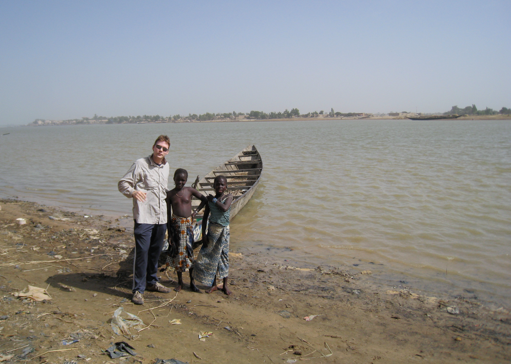
Roland finally found a couple of Bozo ladies to pose for a photo

The thing I liked most about visiting Mopti, Mali's second largest city, wasn't actually in Mopti but nearby. Mopti is a stereotypical seedy African river port. Just outside of it-- as though in another world entirely-- are Bozo fishing encampments which couldn't have possibly been any more primitive a thousand years ago. We rented a boat and went up river 'til we came to an island with some thatch-roofed huts, a Bozo village. Roland and I walked around for an hour, taking photos, poking around. No one paid us any attention whatsoever. Nothing-- neither positive nor negative... nothing.

In town we stayed at the most beautiful hotel in Mali, French architect Amédé Mulin's boutique establishment La Maison Rouge. I've been wondering how the small hotels have been faring now that the country is engulfed in civil war. I know they're all shut down and destroyed in Timbuktu, who has been taken over by slavers and religious fanatics but things in Mopti are just bad, instead of horrendous. The hotel is closed but the most recent letter I got from Amédé is mildly optimistic. He's been in France but he was just back to Mopti for a visit. I'll share a few paragraphs:
I have found that the hotel was generally OK, though degraded by lack of maintenance of the building and the first rains. 6 employees were still in office. The cook resigned during my absence, the mason and his maneuver worked in general maintenance during the month of April and ceased operation in May and June Power cuts, although nearly constant, have not damaged the stock of freezers. The plant has recently commissioned two new groups, the power cuts have almost ceased. Banks are always closed and government in part.

The team is demoralized by the closure of the hotel, the gloom in the city, lack of opportunities and stagnation of the political and security situation in Mali, a certain feeling of abandonment. Some began to develop other activities, such as the cook who has returned from Burkina Faso, or the wizard ruler who would also resign.

We met a few days ago to review the call for support. Staff hoped to reopen the hotel, after listing the charges of the hotel operation estimated at over € 1,500, given the lack of cash and revenue prospects, given the attendance of other catastrophic hotels remained open to Mopti and Sévaré, we agreed that it was reasonable to remain temporarily closed.

The staff, however, has pledged to work towards a quick reopening if special request rental, important booking or processing in offices or rented house in a project... [I]t is unlikely that we have reservation requests. The hotel will remain closed unless major reservations. We hope the situation will evolve positively, particularly in terms of security, so that projects and humanitarian actors can work in good conditions and create economic activity.

It is always possible that the board of the UN Security eventually bow to the many requests for a military intervention that would transform de facto humanitarian hub in Mopti, recreating a certain dynamism to the hotel sector, waiting for the Mali again become a tourist destination.

I don't imagine tourists-- at least not American ones-- will be returning to Mopti (or anywhere in Mali) any time soon. There were very few Americans when Roland and I were there a couple years ago but between the kidnappings and violence and the destruction of everything of historical value (other than in Dogan country down south), the country is being completely avoided by international tourists. There was a decent analysis of the situation at AllAfrica.com this week. It looks like the split between the Tuaregs and the al Qaeda faction has widened... into chasm. I always find it bizarre that no one ever brings up that the Tuaregs capture people and enslave them. I guess that's considered to barbaric to even mention.
'Islamist rebels' have been blamed for a campaign of plunder in Timbuktu this week, but who exactly are they and what do they want?

As momentum builds outside Mali to launch some kind of military intervention into rebel-held territory, the conflict in northern Mali has grown increasingly complex in recent weeks. Even as reports of rampaging Islamists in Timbuktu proliferate our news bulletins, however, the complexity of the conflict has been steadily ignored.

It has been several months since rebel groups wrested control of Northern Mali from government forces. One group, a Tuareg tribal militia known as MLNA, was armed by former Libyan leader Muammar Gaddafi and fought for him during in the Libyan war last year. When Gaddafi fell, the MLNA raised guns for their old cause-- a state of their own. They are ethnic nationalists, embittered against colonialism. And as the MNLA gathered their forces, they formed an alliance with other militias in Northern Mali, all of them rebels with separate causes-- but, crucially, a common enemy.

One of these groups, Ansar Eddine (Arabic for helpers of the faith), has been described by commentators as the Taliban of the Sahel. This is the group currently in control of the town of Timbuktu, a city that once was the hub of cultural and intellectual pursuits in Africa.

The MNLA captured Timbuktu without a fight after the Malian army abandoned the city. A day later, however, Ansar Eddine drove out the MNLA, and has held the city ever since. Andrew Lebovich, a Washington DC-based researcher on the Sahel, says that although Ansar Eddine was formed late last year, its leader, Iyad Ag Ghali, has long been a power broker in northern Mali. Analysts say Ag Ghali's importance as a leader lies more in his kinship and tribal roles in northern Mali than in his new-found role as the leader of a so-called Islamist faction. Ag Gali has repeatedly fallen out with the MNLA, who accuse him of humiliating them.

The MNLA, then, was drawn into conflict with Ag Ghali. Crucially, though - and unlike the MNLA - Ansar Eddine's Islamist credentials have increasingly been linked to the Al-Qaeda branch in west Africa (AQIM)."Reports indicate that Ag Ghali has grown more religious in recent years, but initially Ansar Eddine appeared no different to the MNLA," Lebovich tells Daily Maverick.

Other analysts say Ag Ghali has emerged as a committed Salafist in recent years, and declared his intention to put all Mali under Sharia law-- angering the MNLA, who disagree with his interpretation of what the identity of the new Malian state should be. Negotiations between the two factions have been futile. What is becoming clear is that Ansar Eddine does have stronger links with Al-Qaeda in the Islamic Maghreb than previously suspected. "There is a general belief that much of the support lent to Ansar Eddine came from AQIM," Lebovich says, noting that this includes weapons, money and ideological support. There is, however, very little credible information on the exact nature of the influence of AQIM on Ansar Eddine.

Ag Ghali's embrace of the Salafi brand of Islam is significant to understanding Ansar Eddine's rampage on the heritage of Timbuktu in the last week. Salafists believe that any innovation from the original version of Islam, as practised in the Arabian Peninsula in the time of Mohammad, is akin to polytheism-- blasphemy. Now that Ansar Eddine has firm control over Timbuktu, they've started to purge the city of its religious relics and destroy historic cultural sites deemed blasphemous.

Great mosques and mausoleums to local saints-- of unique architectural design-- were erected in the 15th and 16th century, and the city is home to a long tradition of a local Sufism, which is an Islamic mystic tradition.

It's little wonder, then, that this campaign has been compared to the Taliban's 2001 destruction of the Buddhas of Bamiyan.

As international condemnation of the destruction of United Nations world heritage sites in Timbuktu grows, so, too, do the calls for international intervention in northern Mali. Lebovich, however, is sceptical of the prospects of international intervention taking place, let alone succeeding. "Everyone knows that international intervention will be very difficult. This is one of the harshest climates in the world, infrastructure is poor, international interventional may not be favourably received in Mali and then it's not clear what these groups actually want," he explains.

Attempts by regional body ECOWAS to negotiate with rebels in northern Mali have yielded nothing so far. As one negotiator put it, "We're in talks at the moment, but obviously they're not going well because we want different things." Rebels with separate causes defeated a common enemy, but now it remains to be seen which cause will trump the other.

The rebel insurgency in northern Mali began as yet another expedition in the life and times of the Tuareg people to win sympathy from the world.

But while the MNLA will win some sympathy for being victims of Ansar Eddine, in the end, the prospect of broad international support for a Tuareg state is now in tatters, much like Timbuktu.

The two factions are now fighting for real and the al Qaeda Islamists have driven the Tuaregs out of Gao, the other big prize after Timbuktu. The third "city," Kidal, is also under their sway. The Tuaregs are out in the cold.

Wednesday, April 04, 2012

Timbuktu Falls To The Tuaregs... Burkina Faso Swamped With Refugees

Here I am in downtown Timbuktu, 4 years ago


These days I just want to go to Tuscany or Paris or maybe Bali. And Roland is always coming up with Mongolia or Mozambique or Burkina Faso. The whole time we were in Mali he was grumpy we weren't going to Burkina Faso. I don't know if he has a check list or just wants to add a notch to his belt or what. I know for sure none of his friends have ever heard of Burkina Faso. None of them had ever heard of Mali. And now that hundreds of thousands of displaced Malians-- eager not to fall into the slavery that the Tuaregs practice-- are fleeing in every direction, at least 20,000 of them have arrived in Burkina Faso, which was already having a major problem feeding it's own population and keeping the lid on things. Like Mali's, Burkina Faso's "democracy" is what the aftermath of a far off military coup is called as long as the putschists adhere to corporate-friendly policies.

When I would tell people I was going to Mali or I had gone to Mali they would look at me incomprehensibly. Maui? Bali? I almost never met an American who knew where Mali was. But when I would mention Timbuktu there was at least some comprehension that I wasn't taking about Hawaii. Four years ago, a topper of a month Roland and I spent in Mali, we finally made it to fabled Timbuktu. I had imagined it as the city in Paul Bowles' The Sheltering Sky, which it isn't, but we discovered a unique and fascinating, hospitable if remote town on the edge of the Sahara Desert.

This week Timbuktu fell to Tuareg rebels, savage desert nomads who fervently believe in slavery. Hundreds of thousands of Malians have fled south, as the Tuaregs captured Gao, Kidal and now Timbuktu, the entire northern two-thirds of the country.
Mali's army is reported to have deserted the military base of Timbuktu, the last town in the north under government control, as Tuareg separatists pounded it with heavy weapons. Coup leaders have reinstated the constitution after pressure from neighbouring countries.

Shells could be heard exploding at the base even though it was deserted, local residents told news agencies by phone Sunday.

The soldiers had fled, some shedding their uniforms, leaving Arab militias from the Bérabish community to defend the town, they said.

Al Jazeera television reported that the town, whose population is mainly ethnic Arab, had fallen to the rebel National Movement for the Liberation of Azawad (MNLA), which wants a Tuareg homeland in the north of the country.

On Saturday the army quit the largest town in the north, Gao, leaving it to the MNLA which has already captured Kidal.

The Tuareg rebels have been strengthened by the arrival of well armed fighters previously employed by deposed and murdered Libyan leader Moamer Kadhafi.

The military claims that they have links to armed groups connected to Al-Qaeda in the Islamic Maghreb, which operate in the Sahara.

Timbuktu, a historic city that is on the Unesco World Heritage list, is 800 km north of Bamako and 300 km west of Gao.

Now I'm reading about looting in the captured cities and that Muslim fanatics are imposing their primitive and unevolved version of the Koran on the conquered people. And the rest of the world just sits around bitching that the military coup that overthrew the last military coup has got to turn over power to the former coup leader or no on will help out. The Tuaregs are among the worst lot I ever came across anywhere in the world. My heart goes out for the people who fall into their clutches. Anyway, best tourism advice for anyone thinking of going there-- see a psychiatrist.


UPDATE: June 6- Tuaregs Declare An Independent Nation, Azawad

While the rest of the world forced Malian coup leaders, ostensibly reformers, to turn power back to the old regime (former coup leaders), the Tuaregs have captured over half the country and just declared their independence. The Tuaregs are brutal and primitive slavers who live for war.
Tuareg rebels who captured the three main towns in northern Mali this week unilaterally declared independence for their state of Azawad on Friday, adding to turmoil in the west African country.

...Tuareg nomads have rebelled three times since Mali’s independence in 1960, protesting at their marginalisation and demanding more autonomy.

But leaders of the National Movement for the Liberation of the Azawad (MNLA) were more ambitious when they started a fourth rebellion in January, seeking to carve out a new homeland in the Sahara.

...Jean Ping, chairperson of the African Union commission, rejected the independence declaration, and called on “the international community as a whole to fully support this principled position of Africa."

Algeria, Mali’s northern neighbour, also denounced the rebel claim.

France, the former colonial power, said other west African countries needed to see if it was possible to negotiate with the MNLA. Autonomy would be a more acceptable solution to the regional and international community.

France’s defence minister, Gerard Longuet, said: “A unilateral declaration of independence which is not recognised by African states would not have any meaning for us.”

The claim by the MNLA is not supported by all Tuaregs in Mali, let alone by other ethnic groups living in the north. It is further complicated by the fact that the secular rebels received help from another dissident Ismalist group, Ansar Dine, in capturing the three towns of Gao, Kidal and Timbuktu.

Ansar Dine seeks to impose sharia law in the north. Though it has fewer fighters than the MNLA, which has up to 3,000 men, Ansar Dine rebels were reported to have taken control of much of the ancient town of Timbuktu.

Sunday, November 24, 2013

Time To Go Back To Mali?


My first e-mail this morning was from Amédé Mulin an architect who build an amazing hotel in Mopti, Mali's second biggest city and it's biggest port. Maki's a landlocked country and Mpti is a river port on the Niger. It kind of reminded me of a cross between Chicago, San Francisco and New Orleans and it defined seedy. Mopti did-- but not Amédé's elegant hotel, La Maison Rouge. Last we heard from him was in July of 2012, when the civil war was bad enough so that pretty much all the hotels that catered to tourists were closed. Today's message-- pardon my crude translation-- is much more up-beat:
La Maison Rouge opens its doors again!

We look forward to the pleasure of welcoming you soon!

You will find attached the rates for the current season.

I remain at your disposal for any information
I sent it to Roland and we reminisced about using Mopti as a base to visit the very primitive Bozo tribe that lives along the banks of the Niger and about the amazing time we had taking a boat out to a Bozo village on a remote island that seemed centuries back in time. Roland said we should go to Mali again. "I think it's safe again," he ventured. It's not. Today was election day in Mali. It didn't go very well, mostly because people were afraid to go to the polls. People rate it as relatively peaceful because only a dozen deaths have been reported so far.
In Kidal, voters on Sunday were prevented from casting ballots by rock-throwing Tuareg separatists. In Goundam, a desert outpost near the fabled city of Timbuktu, armed men stole at least 10 ballot boxes.

And in the region of Gao near the border with Niger, a security official who insisted on anonymity because he was not authorized to speak to the press said 16 ethnic Peul were killed in clashes with Tuaregs that occurred one day before the vote. The official said the violence was believed to be related to the death of an elderly Tuareg man about a week ago at the hands of ethnic Peul trying to rob him.

"It's for this reason that armed Tuaregs attacked the Peul in their base near the border with Niger," the official said.

Tuaregs are light-skinned whereas the Peul are black. Many Tuaregs have long clamoured for an independent nation in northern Mali, claiming that Mali's government, based in the south and dominated by the country's black majority, has marginalized them.

Florent Geel, Africa director for the International Federation for Human Rights, also said 16 were killed in Saturday's clashes but added that the organization was waiting on details. He spoke by phone from the capital, Bamako, citing information provided by a member of FIDH in Gao.

As voting got underway in Gao Sunday morning, United Nations peacekeepers and Malian soldiers outnumbered voters, though participation increased somewhat closer to midday.

The turnout appeared to have fallen short of Mali's peaceful presidential election held in July and August, when Malians elected Ibrahim Boubacar Keita to lead the country in a contest that was decided in a runoff.

"Today we have noticed that participation is weak," said Gao prefect Seydou Timbely. "There weren't enough means invested in encouraging the population to come out and vote."

Several voters said recent insecurity in northern Mali was on their minds, notably the Nov. 2 slaying of two journalists from Radio France Internationale who were reporting in Kidal. The lead suspect in that attack has previous ties to al-Qaida in the Islamic Maghreb.
I mentioned the instability and violence to Roland and he said that's "only" in the north and we've seen enough of Timbuktu anyway. "Let's just go to Djenné. We loved that place." It's true, we did. Here's a picture of Roland I took in front of the big mud mosque there.


But Toronto's Globe and Mail reported in January, that tourism has collapsed entirely and just turned the whole country-- not just the north-- into "a hell."
For years, thousands of tourists flocked to see the unique mud-brick architecture of Djenné, one of the oldest and most beautiful towns in West Africa.

Today the once-thriving industry has collapsed. Almost every hotel and restaurant in Djenné is closed. Tour guides can go for months without seeing a single visitor.

…“We can’t feed our families,” says Badou Magai, a guide in Djenné for the past 10 years. “We’re suffering greatly. Everyone has gone away.”

It’s just one symptom of the crisis in Mali, where a military coup and an Islamist rebellion have devastated the tourism industry and triggered the suspension of most foreign aid, plunging the economy into recession.

Countries like Canada are now mulling a possible military training operation in Mali to push back the rebels. But the military campaign could take years, prolonging the crisis indefinitely.

Until recently, Mali was seen as an economic star on the African continent. Its economy had grown by nearly 5 per cent annually for most of the past decade, with Canadian mining companies among the biggest investors. But its GDP shrank by 1.5 per cent over the past year, according to the latest estimate from the International Monetary Fund, even though its gold and cotton industries were largely unaffected by the northern rebellion.

For people like Mr. Magai, the economic crisis is bringing misery with no end in sight. Kidnappings and political instability have driven away almost all of the foreign tourists, destroying an industry that accounted for 5 per cent of the country’s economy.

Mr. Magai remembers seeing up to 600 tourists a day at peak season in Djenné. The town was a magnet for tourists, offering views of the world’s biggest mud-brick building-- its famed Grande Mosqueé, a masterpiece that UNESCO declared a world heritage site-- and a labyrinth of ancient Sahel-style homes, along with one of Africa’s most famous markets.

The tourists began to vanish after a wave of kidnappings by Islamist radicals in northern Mali in 2010 and 2011. Only a couple of dozen tourists have ventured into Djenné over the past year-- compared to 30,000 tourists in 2005.

The guides have seen their incomes collapse. “It’s hell,” said Ahmadou Cissé, a guide in Djenné who is supporting 12 family members on his rapidly declining income.

Mr. Cissé says he can only afford to give his family one meal a day. He estimates that nearly 100 guides are unemployed in this town of 13,000 people, and more than 1,000 people have lost their jobs or income in the hotels, restaurants, souvenir shops and markets.

Sophie Sarin, owner of the only hotel in Djenné that remains open, says the impact of the crisis has been “disastrous” in a town where tourism represented half of the economy. “People are much poorer,” she said.

In the town of Mopti, a tourism hub on the Niger River to the north of Djenné, foreigners are equally scarce. The biggest hotel, the Kanaga Hotel, is virtually empty. “It’s a catastrophe,” said Amassome Dolo, the hotel’s reception manager.

Despite the tourism collapse, the reality is that towns like Djenné and the Malian capital, Bamako, are still relatively safe today. They are a long way from the rebel-controlled region. But tourism in the entire country has been devastated by the perception of danger, the frequent kidnappings by the rebels and the official warnings issued by Western governments.
We stayed at Sophie's wonderful hotel, the Djenné Djenno, and I'm glad to hear she's safe and her place is open. She's still blogging, which is how I originally met her. And she introduced me to Amédé and his fantastic hotel. Today she wrote that "The elections have one great benefit for Hotel Djenne Djenno: the International Election Observers  are staying at the hotel and eating here too. There are two nice young European men staying: one Hungarian and one Romanian, sent here by the European Union. And then there are two Africans: one from Liberia and one from Sierra Leone. Keita  giggled about this: ‘Those two  great bastions of Democracy and Human Rights are overseeing our elections!’ Malians, inspite of their two year crisis, still feel that they lie well over the West African average when it comes to progress, civilization  and democracy…"

I have a feeling Mali isn't a place I'll be seeing again. Next stop for us: Ecuador.

Sunday, February 17, 2013

Alabama And Mississippi Were Forced To Give Up Slavery... But Mali's Tuaregs Weren't


I don't know... maybe it's because my distant ancestors were slaves in Egypt, but to me slavery is the most horrifying thing that can be done to another human being. And when I was in Mali I saw it close up and personal. I've been wondering why there hasn't been anything in the western press about how the Malian rebels-- the Tuaregs-- were at least in part motivated by their unwillingness to stop using other human beings as slaves. The French, Brits and the U.S. just did not want that to be part of the conversation. There was speculation that the reason was because they had hoped the turn the Tuaregs against the al Qaeda Islamists by looking the other way on the slavery thing.

And then, out of nowhere, USA Today, of all places, blows the whistle on Tuareg slavery this week. They trumpeted that the Tuaregs fleeing the advancing French and Mailian troops have been "taking with them some of their most important possessions-- slaves." Until now all the coverage has been about how the mean Malians have been killing the poor innocent Tuaregs they get their hands on. No context whatsoever-- NONE. That might be just fine for the NY Times but USA Today just put the paper of record to shame.
The Tuareg tribes that overran Mali's military with the help of Arab extremist groups aligned with al-Qaeda have long held slaves and many of the captives are from families that have been enslaved for generations.

"It's no way to live, without your freedom," said Mohammed Yattara, a former slave who ran away from his Tuareg masters years ago.

"You depend on them for everything. If they tell you to do something, you have to do it, or they will beat you," he said as he sat with the chief of the village of Toya and among men and women who were descendants of slaves or former slaves.

"You can marry, but if the master wants to have sex with your wife, he will. Everything that's yours is theirs," Yattara said.

Tuaregs are a semi-nomadic people of North Africa's Sahara desert whose traditional land was divided into several nations, the borders of which were drawn by European colonialist powers.

They predate the Arab tribes that moved into the region centuries ago and in Mali, a former French colony, Tuaregs lived primarily in the north part if the country.

But in March, armed Tuaregs took control of the north from the Mali government and marched south with Islamists aligned with al-Qaeda. They took over the city of Timbuktu and threatened the capital of Bamako. The Islamists imposed strict shariah, or Islamic law, on inhabitants it controlled.

Some Tuaregs took advantage of their newly won control to reclaim freed or runaway slaves, mostly black Africans.

The French military arrived in January and retook Timbuktu from the Tuaregs, who fled into the desert or refugee camps in neighboring Burkina Faso and Mauritania, some taking slaves with them. Tuaregs and Arabs who failed to escape have been summarily killed, activist groups have said.

Human Rights Watch said the Malian army and black African civilians are holding all Tuaregs and Arabs responsible for the recent months of terror and human rights abuses, whether or not they participated in the crimes.

Yattara is one of the few accessible witnesses who was willing to discuss slavery under the Tuaregs.

Like many other residents of his village, Yattara is a farmer in the rice and hay fields in the river's surrounding wetlands.

Each of Mali's dozens of ethnic groups has a traditional occupation, and Yattara is one of the Bella ("slave" in the Tuareg language), the black Africans who have inherited their slave status.

Though slavery was outlawed in 1960, Mali is one of the countries in the world where the practice of human servitude flourishes, with as many as 200,000 Bella living a life of hereditary enslavement.

Not all Tuaregs own slaves, and not all slave owners are Tuareg. There are also black Malian ethnic groups who own Bella slaves.

But in the Timbuktu region, only Tuaregs own slaves. Not only were the Tuareg seen as supporters for the Islamist rebels' harsh rule over the last ten months, but their slave-owning ways fanned racial animosity in northern Mali.

Like all other slave children, Yattara never went to school, and to this day he is unable to read and write. "But my son is in school now," he said proudly.

Yattara said he believes he is in his early 40s but is not certain of his exact age because Tuareg masters do not file birth certificates. He fled his masters as a young man and during his travels to Senegal and Ivory Coast he discovered that slave-owning was in fact illegal.

"In my father's generation, slaves weren't thinking to be free," Yattara said. "But now there are many slaves who want to be free, and they try to find a way, but they are afraid."

In the Timbuktu region, slaves work on farms or as household servants or shepherds. Deeper in the vast desert of the north, inhabited by Tuaregs and Arabs, the slaves mine salt, a back-breaking task done under the Saharan sun.

Salt is the north's main economic product and black slaves deliver the giant grayish slabs by boat or truck to the black Africans, who then take it to markets in the south.

Yattara and his companions agreed that Tuaregs were the worst slave-masters in Mali.

..."In my life I will never forget what it feels like to be a slave," Yattara said. "Whenever I see Tuaregs I will be angry."

And, as we said a few weeks ago, it still isn't time to start planning a vacation in Mali. Seriously, I'd wait. A guerilla war looks likely... and, at least in the north, long-lasting.

Tuesday, January 06, 2009

How I Lost 15 Pounds Without Even Trying-- And Saw The World's Biggest Mud Mosque

Visiting a quiet Bozo fishing village on the Niger

The alternative title for this post was A How To Guide For Seeing Mali but I thought the one I used would be more eye-grabbing. I suppose if you take all the vaccines that the tropic disease doctors insist on for a visit to Mali-- and thereby not have to worry as much about cholera, typhus, typhoid fever, polio, yellow fever, Hepatitis A and B, meningitis, and malaria (there is no way to protect yourself from Dengue Fever)-- you can eat whatever and wherever and whenever you like. I, on the other hand, only did the barest prophylactic minimum-- the yellow fever vaccine, without which you can't get a visa, and malarone pills, to possibly prevent malaria. The rest... I left to the fates and my own well-honed good instincts for prudently watching what I eat and drink.

I learned about getting sick on the road when I was much younger. In 1969 I drove a VW van across Asia to India on a two year excursion. I was a vegetarian and I quickly attributed the fact that everyone-- like I mean everyone-- around me was coming down with seriously debilitating diarrhea, to the differences in diet between myself and them. I'll spare you the unsavory details of what the Kabul Runs entails, but I can still remember the first time I realized that the slab of dead animal hanging from a hook in every (unrefrigerated) marketplace across Asia was black because it was covered in flies.

These Third World countries are poor and don't have the kinds of infrastructure we do-- even after 8 years of George Bush-- and everywhere you look there are ample opportunities to get really, really sick. Think back to Jamal's earliest flashbacks of the Mumbai slums in Slumdog Millionaire; all that poopie is not poetic license. One of my closest friends, painter Eveline Pommier, contracted cholera in India and died, full of promise and vigor and beauty, still in her 20s. Mali today is at least as bad as rural India was two or three decades ago.

That said, Mali is a gorgeous and unique country with wonderfully, warm, open, friendly people who have a culture unlike anything else you'll find anywhere on earth. It's well worth visiting. So how do you do it? It isn't a place I'd suggest just getting on a plane to, showing up in Bamako, and playing it by ear. There are no really current guide books although the best one I found, Bradt's Mali, Edition 3, is the best out there. First written in 2000, it was somewhat updated in 2004. It was reprinted in 2007 but not changed from 2004. A lot has happened in Mali since 2004 and some of it is even hard to find on the Net. But the Net is where I turned to figure out what to do about my trip. And I struck gold on the first shot.

I found fellow blogger Sophie (aka, Toubab), a Swedish woman who runs a gem of a hotel in Djenné, the Djenne Djenno (which opened in 2006), and blogs about the experience. Sophie's blog is fascinating in and of itself but the big score for me was when I contacted her to book a room, she helped me figure out the best places to stay throughout Mali. And, best yet, she steered me towards a reputable and capable tour agent, Tounga Tours from whom we could get an essential 4WD vehicle with a dependable driver.

I had already figured out that the best hotel choice in Bamako, the capital and the city with the international airport. The Hotel Salam, a relative newcomer at the top of the market, looked like a better choice than either of the two traditional considerably older "best" hotels, Le Grand or Hotel de l'Amitie. But after Bamako I really depended on Sophie's suggestions for which were the best places to stay in each town.

Tounga Tours is run by an unflappable husband and wife team, Van and Ann, in Bamako. Obviously they know all the ins and outs of traveling around Mali. Ann was also kind enough to book me my plane ticket from Timbuktu back to Bamako, which was lucky since it sold out. And she booked the Hotel Salam for me, saving me hundreds of dollars. When it came to the trip itself, my first instinct was to just want to rent a jeep with a driver. Ann patiently explained how we really would need a guide to get the most out of the trip, and an English-speaking one at that. I was resistant but, luckily, I gave in to her good sense. And was she ever right! Our driver and guide were a great team and a pleasure to travel around with. They find their own places to stay and their own food and the whole shebang cost 200 Euros a day, which is very much worth it if you can afford it. We were able to travel in relative comfort and visit Ségou, Djenné, Mopti, spend several days in Dogon Country (the best part of the trip) and then make the iconic road trip to Timbuktu, from which we flew back to Bamako.

UPDATE: Pics

We listened to Ali Farka Toure and Ry Cooder the whole time. Here are some of our pictures set to their music:

Saturday, February 02, 2013

Timbuktu Liberated... But Don't Book A Trip Quite Yet

Bassekou et moi à Bamako... better days

Roland and I capped off a month in Mali with a trip to the city that had lured us to the country in the first place: Timbuktu. And it was worth the grueling drive in a jeep over dirt "roads" to get there. We both loved this throwback of a city to ancient times. The city has gone through-- to put it mildly-- some pretty hard times, first at the hands of barbaric Tuareg slavers and then at the hands of just as barbaric Islamic religious freaks, since we were there. Now the town has been, let's say liberated by the Malian Army and their French allies. But I wouldn't book a flight in yet-- even if there are already sparks, miraculously, of a tourist industry revitalizing. Today the President of France, François Hollande is visiting the city, although I doubt he'll be staying in any hotels.
The Hotel Colombe in Timbuktu closed its doors at the end of March last year. In Mali's capital Bamako an army mutiny had begun while in the Saharan north, the town of Kidal had fallen to rebels using arms looted in the aftermath of Libya's civil war. The Colombe's energetic manager Mohamed Toure thought the death knell had sounded for tourism in Mali.

With no money coming in, he was reduced to one meal a day. "I didn't think I would ever see another European again." He was proven wrong this week as the jihadis fled in advance of the French troops in Mali's fabled city. Now Mr Toure's crumbling hotel is back in business. After one of the darkest years in its long history Timbuktu is coming back to life.

The artisans' market, a hive of weavers, tailors and jewellers, has reopened. Ben Ali, a jeweller, was already back working on a silver ring. Most of his business came from the traditional ceremonies that punctuate Malian life. He pointed to an ornate silver headdress in the display box behind him: "They stopped our women from wearing traditional jewellery," he said. "This is nonsense, they just came in with their sharia. These guys knew nothing about religion, they're just gangsters."

DJ Ali Biko was also back in action across the street. A young looking 19-year-old, his speakers had come out of hiding to blare reggae through the market area. "When the Islamists were here I was really stressed," he said. "We couldn't listen to music."


Me & Mohammed in downtown Timbuktu

He chose to play music in this store because it had belonged to Arab traders, whom locals accused of backing the al-Qa'ida affiliates who occupied Timbuktu. With Malian rapper Milles Mots at full blast, Ali joked that seeing his friends dance in the looted wreck of the store was his revenge.


Me and Mohammed again-- still downtown Timbuktu
Such small acts of defiance are visible everywhere in a city that was famed before last year for its diversity. In the warren of stalls behind the artisan market, Abou Bakry Moussa was selling things he wouldn't have dared to display one week before. Obama belts featuring the stars and stripes and a grinning American President are outselling Chelsea hats and Real Madrid socks. "We had hidden them before," he said. "People had to ask for them." Upstairs, Radio al-Farouk has become the first station in northern Mali to go back on air. The DJ, in clear defiance of the jihadis who ruled the city until last week, relaunched by playing tracks from the legendary Malian musician Ali Farka Touré. The station should be back in full operation within a month. Four days after the first French soldiers swept into the city, cigarettes and alcohol have also made a comeback.
Alcohol is back too and the airport was captured by the French. Obviously it's working well enough for Hollande to have flown in today. When we were there there were two airlines, Air Mali and Air Timbuktu, flying ancient prop planes from to Bamako via Mopti. Leaving Timbuktu, I flew on one and Roland flew on the other and they both left at the same time. I recall them disarming a tribesman when he boarded but giving him back his sword once the plane took off. Air Mali is grounded until September and Air Timbuktu is out of business entirely. Today Hollande's plane flew from France to Sevare. The NY Times reports that "life is certainly a long way from returning to normal. Shops owned by Arab tradesmen have been looted. Some residents have fled, a foretaste of ethnic strife that many fear will roil Mali for years to come. Electricity and running water are available only a few hours a day. The cellphone network remains down."
Many of the residents who left-- first to escape the occupation, then to escape the French airstrikes-- have no way to return. Always remote, the city remains dangerously isolated: the dusty tracks and rivers leading here wind through forbidding scrubland territory that could still provide refuge for the Islamist fighters who melted away from the cities.

Those who remained told stories of how they survived the long occupation: by hiding away treasured manuscripts and amulets forbidden by the Islamists, burying crates of beer in the desert, standing by as the tombs of saints they venerated were reduced to rubble, silencing their radios to the city’s famous but now forbidden music.

“They tried to take away everything that made Timbuktu Timbuktu,” said Mahalmoudou Tandina, a marabout, or Islamic preacher, whose ancestors first settled in Timbuktu from Morocco in the 13th century. “They almost succeeded.”

The occupation of Timbuktu, a center of learning for centuries, was the latest in a long historical list of conquests-- by Arab nations, by the Songhai and Maasina empires, by France. Once again, powerful global forces were in play in this fabled city: a network of Islamic extremists, the armies of France and West Africa, and to a lesser extent the United States, which has flown in French forces and refueled French warplanes during the campaign.

Through it all, the city’s residents, whose ancestors endured such ravages for the better part of a millennium, have adapted as best they could.

On April 1, the day rebels arrived in this city, Mr. Tandina had just returned from the first, predawn prayer of the day. He made bittersweet tea to the murmur of a French radio broadcast. The news was bad: Gao, the largest city in northern Mali, had fallen to Tuareg rebels, the nomadic fighters who had been battling the Malian state for decades.

His hometown was almost certainly their next target. When shots rang out in Independence Square, just behind Mr. Tandina’s house, he knew that Timbuktu’s latest conquerors had arrived.

“The barbarians were at our gate,” he said with a sigh. “And not for the first time.”

The Tuareg fighters took control of the city, and for two days they looted its sprawling markets, raped women, stole cars and killed anyone who stood in their way.

“Then the man with the big beard came,” Mr. Tandina said.

Barrel-chested and dressed in a blue tunic, the leader of Ansar Dine, an Islamist group with links to Al Qaeda in the Islamic Maghreb, arrived with several truckloads of fighters. The new rebels called the city’s people to a public square and made an announcement.

“They said, ‘We are Muslims. We came here to impose Shariah,’” Mr. Tandina said.

At first, Timbuktu’s people were relieved, he said. Beginning a hearts-and-minds campaign, the group garrisoned the fearsome Tuareg nationalists outside of town, which stopped the raping and pillaging.

They did not charge for electricity or collect taxes. Commerce went on more or less as usual, he said.

Then a mysterious group of visitors came from Gao, heavily armed men riding in pickup trucks, trailing desert dust.

“They told us they were here to establish an Islamic republic,” Mr. Tandina said.

It started with the women. If they showed their faces in the market they would be whipped. The local men grew angry at attacks on their wives, so they organized a march to the headquarters of the Islamic police, who had installed themselves in a bank branch. The Islamists greeted the protesters by shooting in the air. Many fled, but a small group, including Mr. Tandina, insisted that they be heard.

A young, bearded man came out to meet them. Much to Mr. Tandina’s surprise, he recognized the Islamic police official. His name was Hassan Ag, and before the fighting began he had been a lab technician at the local hospital.

“When I knew him he was cleanshaven, and he wore ordinary clothes of a bureaucrat,” Mr. Tandina said.

Now he was dressed in the uniform of the Islamist rebellion: a tunic, loose trousers cut well above the ankle, in imitation of the Prophet Muhammad, and a machine gun slung across his shoulder.

“I told him our women were being harmed,” he said.

Mr. Ag was unmoved.

“This is Islamic law,” he said, according to Mr. Tandina. “There is nothing I can do. And the worst is yet to come.”

Soon it came. They began destroying tombs of the saints venerated by Timbuktu’s Muslims. Armed with pickaxes and sledgehammers, they reduced to rubble the tomb of Sidi Mahmoud, a saint who, according to legend, protected the city from invaders.

Venerating saints, an ancient practice here, was considered un-Islamic in the austere version of the faith proclaimed by the occupiers.

Mr. Tandina said he tried to use his decades of Koranic education to argue with the Islamists, citing verses about respecting the burial places. They would not listen.

Before long, he said, amputations started. Then came the executions. Again he said he tried to intervene, going to the Islamic court with stacks of Islamic law books under his arm.

“Islam was whatever they said it was,” he said. “They did not respect the holy book. They respected nothing but their own desires.”

For hundreds of years, Timbuktu was one of the world’s most important centers of Islamic learning. The city has dozens of mosques, and it is famous for the ancient, handwritten manuscripts that city residents have collected for generations, preserving them against waves of invaders and creating a priceless trove of knowledge about the Islamic world and beyond. Many families have long traditions of Islamic learning, passed from father to son.

So many here bristled when the Islamists called the population to lecture them about the proper practice of the religion in which they had been raised.

“What they call Islam is not what we know is Islam,” said Dramane Cissé, the 78-year-old imam at one of the city’s biggest and oldest mosques. “They are arrogant bullies who use religion as a veil for their true desires.”

But like many Muslims here, he hid away his amulets, prayer beads and other banned religious items. In his mind his faith remained the same.
How soon before Timbuktu's famous Festival au Désert is back in business? Well... no time at all! They're kind of sponsoring a desert caravan of artists this year-- a Peace and Unity event-- with concerts in Morocco, Mali, Mauritania, Niger and Burkana Faso. The Islamists sacked the regular site of the Festival, destroying the water systems, looting the generators and electrical equipment, and "crushing all that had appealed to the promotion of culture and tourism." So this year-- starting February 7 in Bamako, the Caravan of Artists for Peace and National Unity heads off to Kobeni in Mauritania on the road to Nouakchott (the capital) and play two nights of concerts, February 8 and 9 sponsored by the Al Hawa Cultural Foundation of Mauritania. They'll partner with the Festival on the Niger in Ségou on February 14 and two days later at the Festival of Mali in Bamako. A second caravan will leave Tamanrasset, Algeria and travel through the Tuareg heartland to Niamey, Niger and on to Burkina-Faso and the two caravans will hook up in Oursi 350 kilometers from the capital of Burkina Faso, Ouagadougou for the Festival in the Desert 2013 (on February 20, 21 and 22). The last stop in at the Festival International of Sélingue in Mali on March 1, 2 and 3. The artists participating are primarily Malian, although the Festival's press release says other international artists will also play to show their solidarity. None have been named yet and I suspect Robert Plant and Bono won't be making it this year.


Unesco has pledged to help rebuild Timbuktu's destroyed cultural heritage. My friend Sophie runs an awesome hotel in Djenne, Djenne Djenno, which is-- amazingly-- still open. She blogs about her life in Mali and it's a great place to check out what's really going on there.